The boat — and why it handles Curaçao's waves differently
We're often asked why we chose a Rupert 50 over the lighter, more familiar RIBs you see along Curaçao's coast. The honest answer is physics — this boat solves a problem most operators don't even acknowledge.
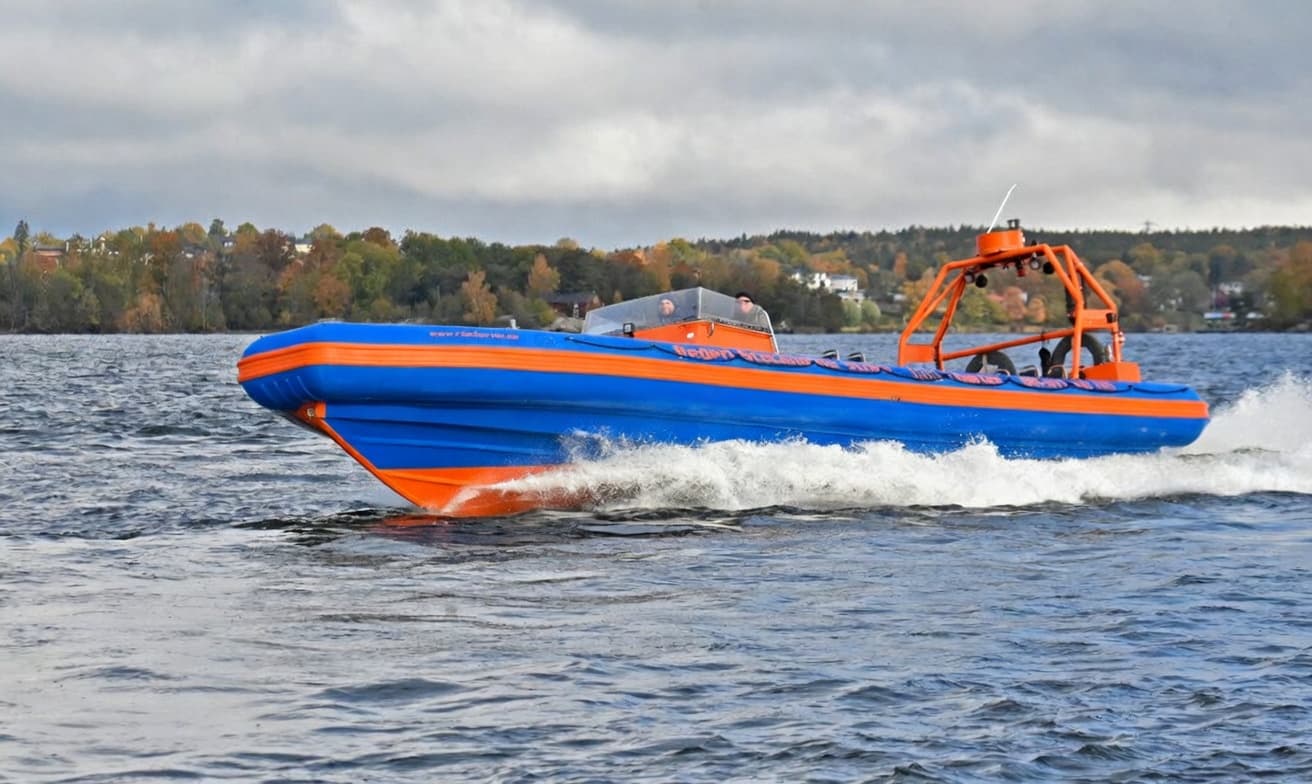
Why this hull handles waves
Curaçao's trade-wind seas typically run 0.5–1.5 m, occasionally 2 m or more. On lighter boats that means a bumpy ride, motion sickness, and a long day for guests. The Rupert 50 was engineered for conditions harder than that — and the geometry shows.
First: the waterline. At 15 metres long, the Rupert has a longer waterline than virtually any other RIB working Curaçao's coast. A longer waterline means the hull cuts through wave-tops instead of slamming into them. Boats half this length pitch over every swell. Ours stays level.
Second: the deep-V. The Rupert's hull deadrise is steep — built to slice through chop without the flat-bottomed pounding you get on cheaper RIBs. The keel runs deep enough to track straight even in cross-seas.
Third: the mass. We chose 5,500 kg (12,125 lb) on purpose. Lighter boats lift off the wave-tops and slam back down. A heavier hull stays in contact, riding through the trough and over the crest like a knife. Mass also lowers the centre of gravity — guests don't get thrown around.
Why the Scania + KaMeWa configuration
Most fast boats in Curaçao run twin or triple outboards. We run a single inboard Scania DI14 marine diesel driving a Rolls-Royce KaMeWa FF 375 HS waterjet. There's a reason.
Outboard propellers cavitate in waves — the propeller breaches the surface, ventilates, and the engine over-revs as it loses bite. Pilots have to back off the throttle in cross-seas, which makes the ride slower AND more uncomfortable. A waterjet has no such problem: the impeller draws water from below the hull through a sealed intake, so it bites consistently regardless of wave action.
Second: torque. The Scania DI14 is an 800 hp 14-litre inline-six designed for heavy marine work. It produces enormous low-end torque, which means the boat accelerates from a wave trough cleanly — no lag, no struggle, no over-revving. Outboard gas engines can match the peak power but not the rolling response in real seas.
Third: shallow-water capability. Waterjets have no propeller hanging below the hull. We can navigate over coral reefs and sand-bar entrances that outboard boats have to skirt around. It also means there's no spinning propeller in the water around swimmers — a real safety margin in busy snorkel zones.
Why professionals choose this configuration
Recreational tour operators usually optimise for top speed on flat water. Professional operators who actually have to perform in any condition — coast guard, search-and-rescue services, harbour pilots — make different choices.
Coast guard and SAR units around the world increasingly run jet-driven boats with deep-V hulls and inline-diesel power. The reason is simple: you can't predict sea conditions when you launch. A boat that's only fast in flat water is useless when the weather turns. The Rupert 50 is built to that brief — it's a working boat first, a recreational platform second. We bought one because we want our guests to get the same reliability you'd expect from a vessel that has to perform regardless of conditions.
What this means for Curaçao's trade-wind seas
On a typical Curaçao day — 12–18 knots of trade-wind, 0.5–1.5 m chop — the Rupert 50 cruises at 30–35 knots without anyone needing to brace. Compare to a lighter RIB at the same speed in the same conditions: guests holding on, faces in the spray, jaws clenched. Same destination, very different morning. We don't market this as 'extreme' — it's the opposite. The whole point is that the trip should feel calm, even at speed.
Speed AND comfort — the dual claim
Most fast boats in Curaçao trade one for the other. The Rupert 50's design — long waterline, deep-V geometry, deliberate mass, jet propulsion, diesel torque — is what lets you have both. It's not magic. It's geometry and engineering.
Ready to feel the difference?
We open public bookings from August 2026. Reserve a date now to lock it in — small-group snorkel tours, Klein Curaçao day trips, and sunset cruises with 26 guests maximum.
View tours