Voltar ao guia de viagem

Landhuizen — As Casas de Plantação de Curaçao

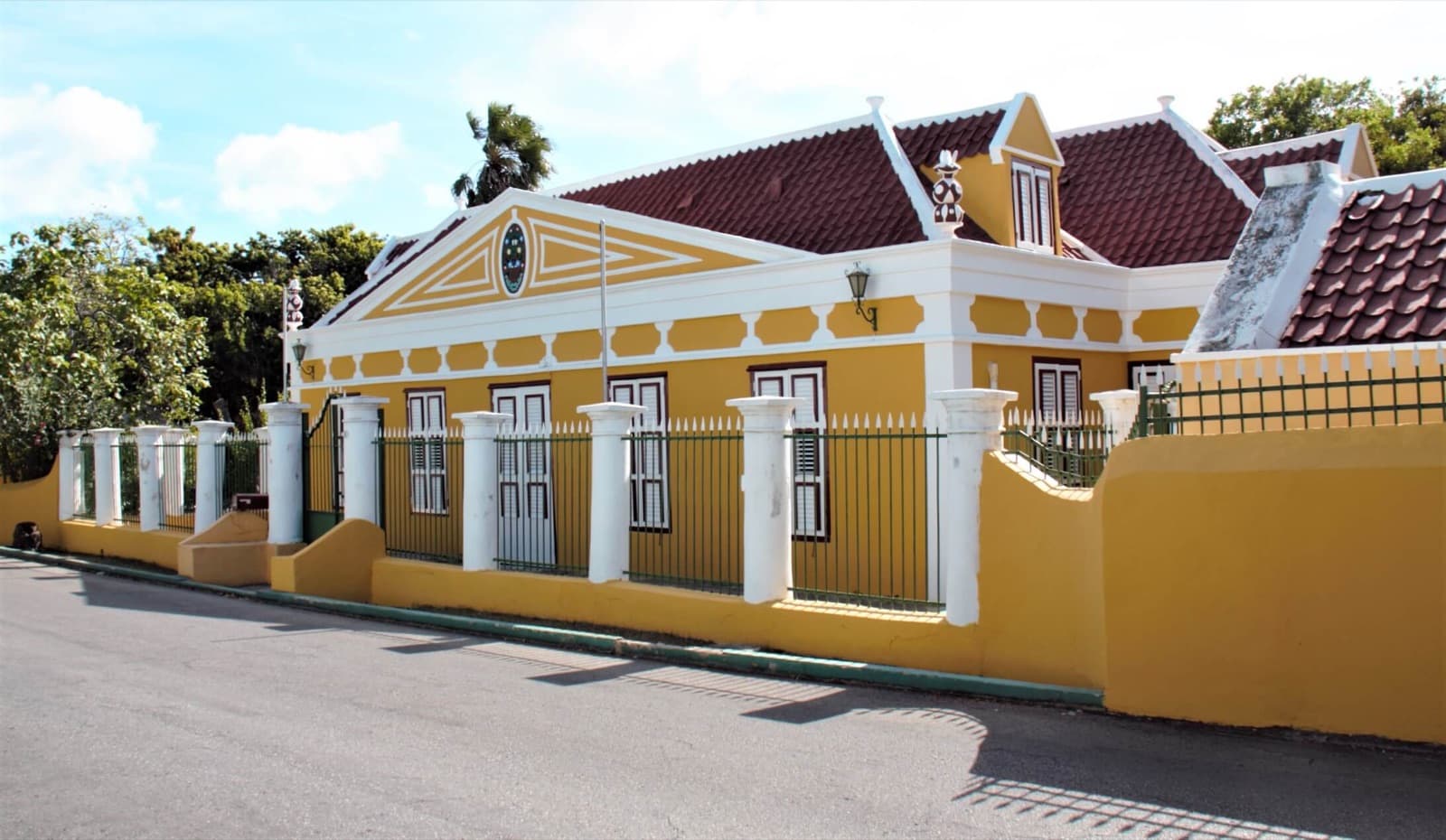
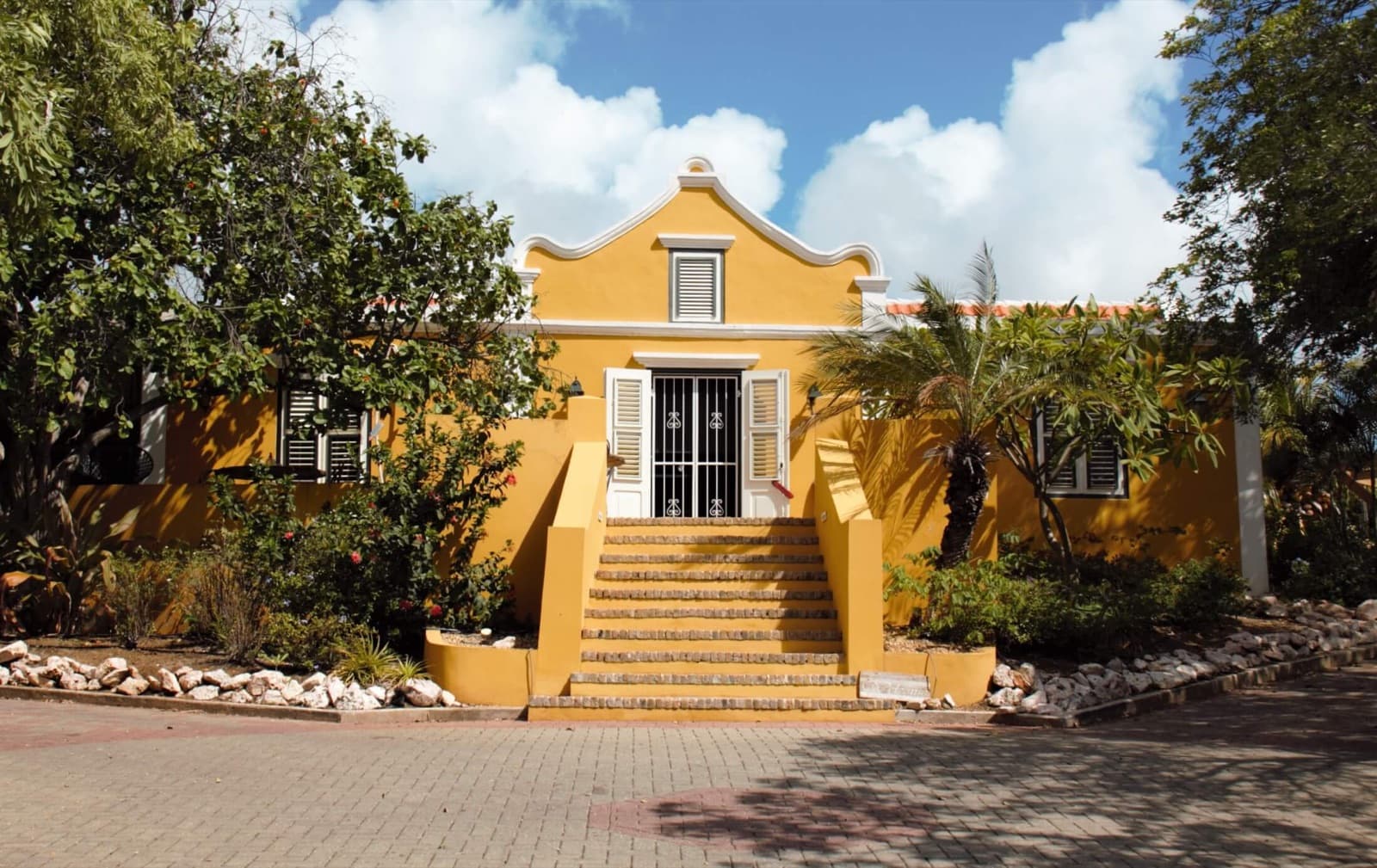
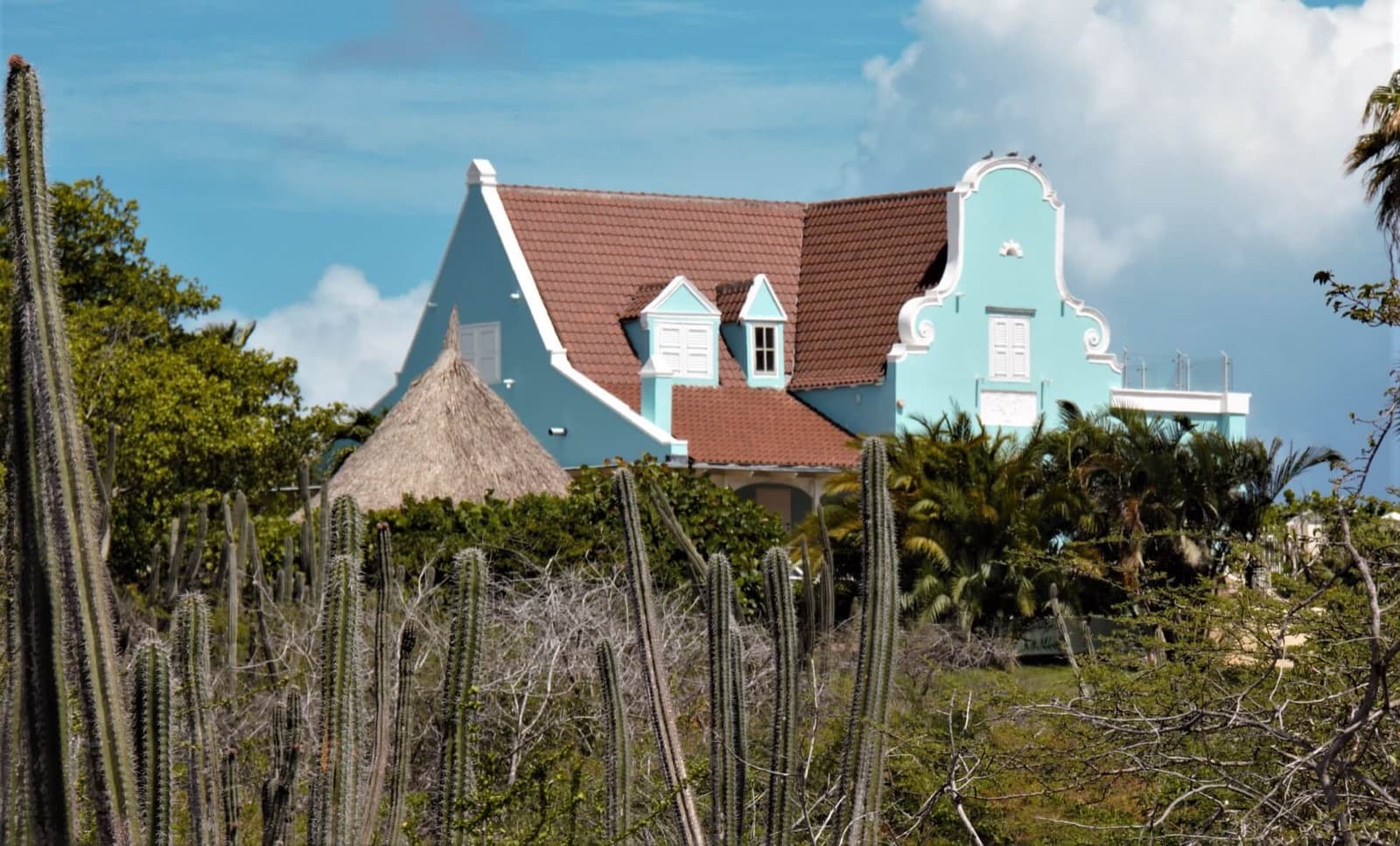
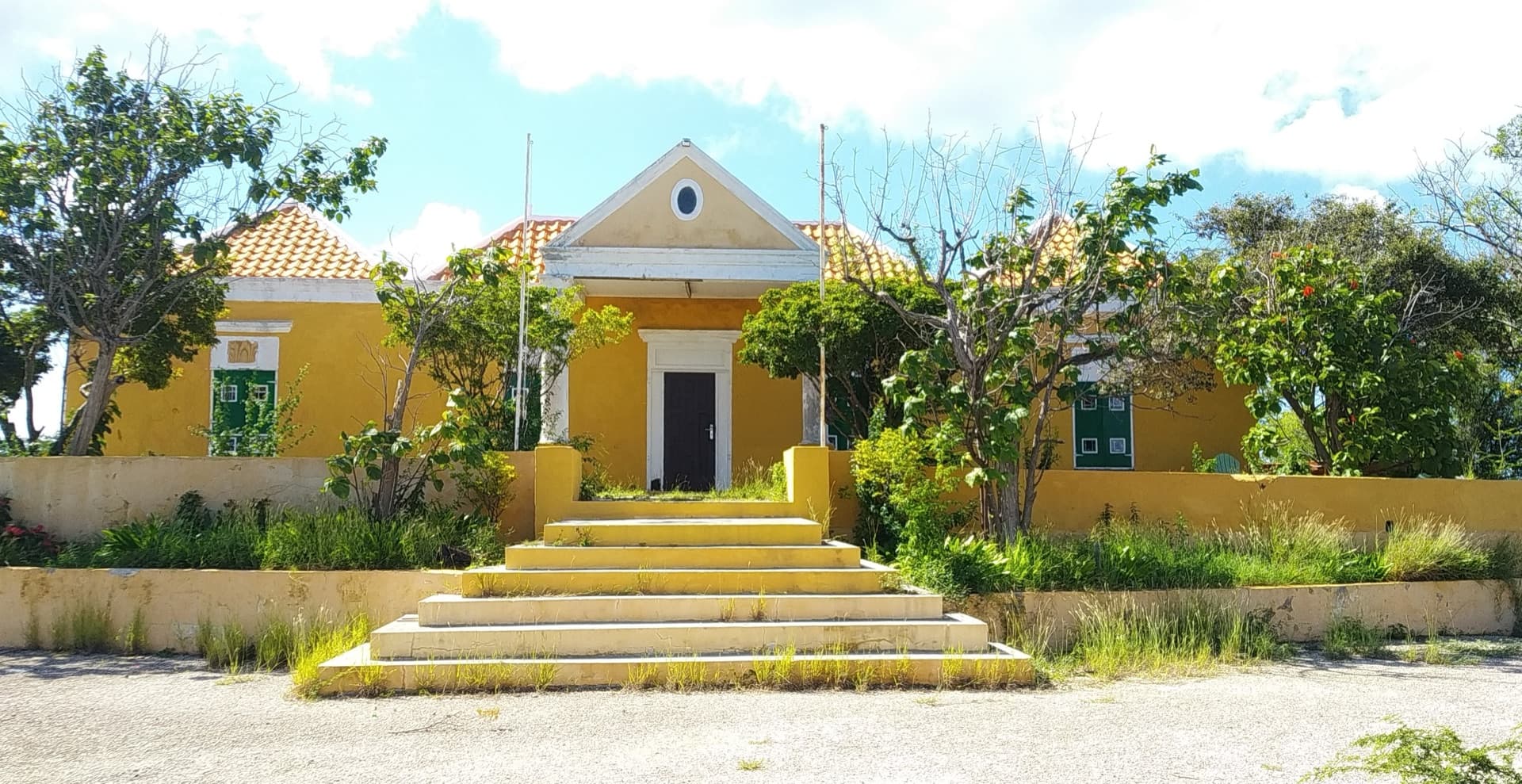
As casas de campo de paredes amarelas que contam a história em camadas de Curaçao — das plantações coloniais e escravatura a museus, destilarias e ruínas atmosféricas.

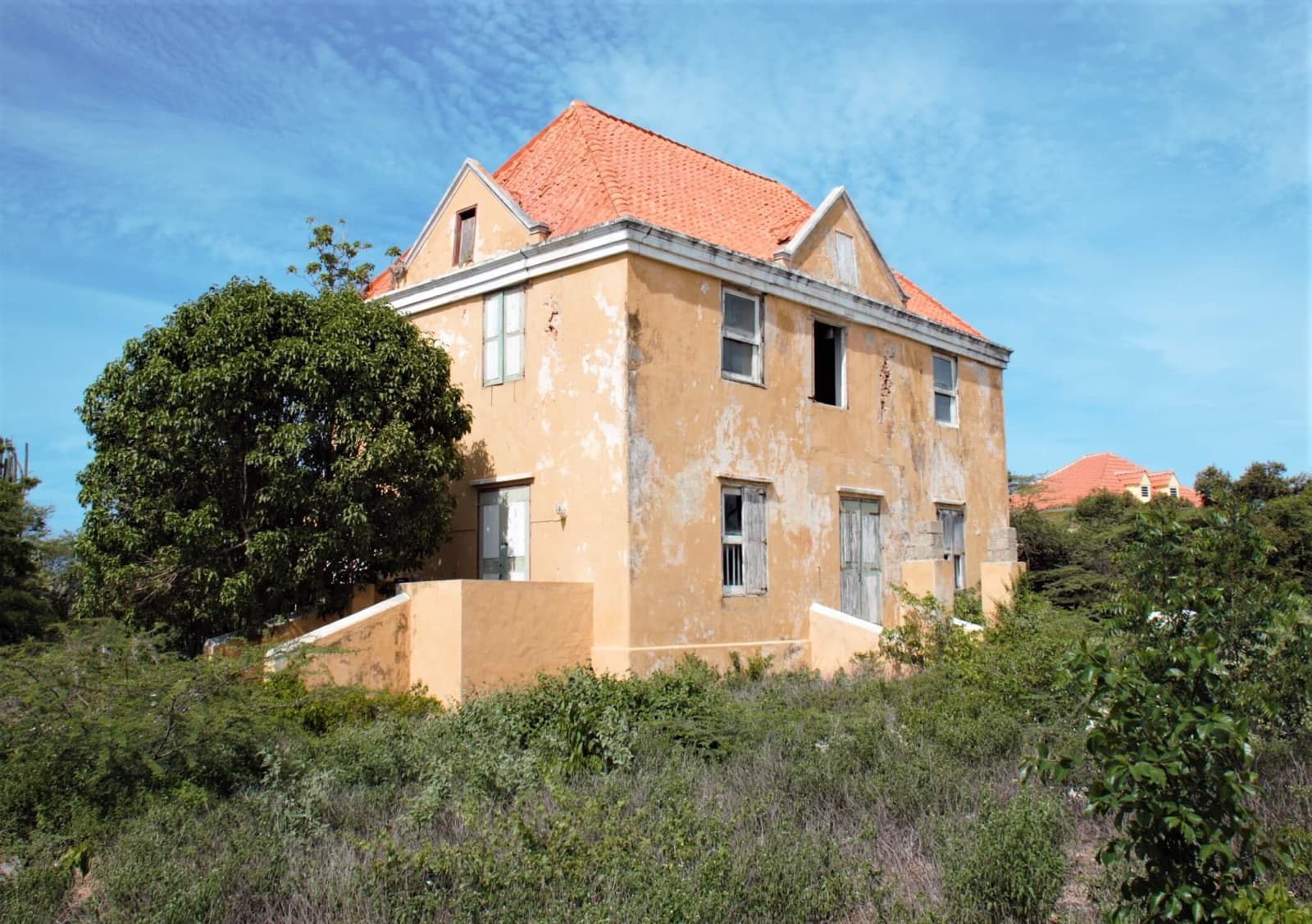
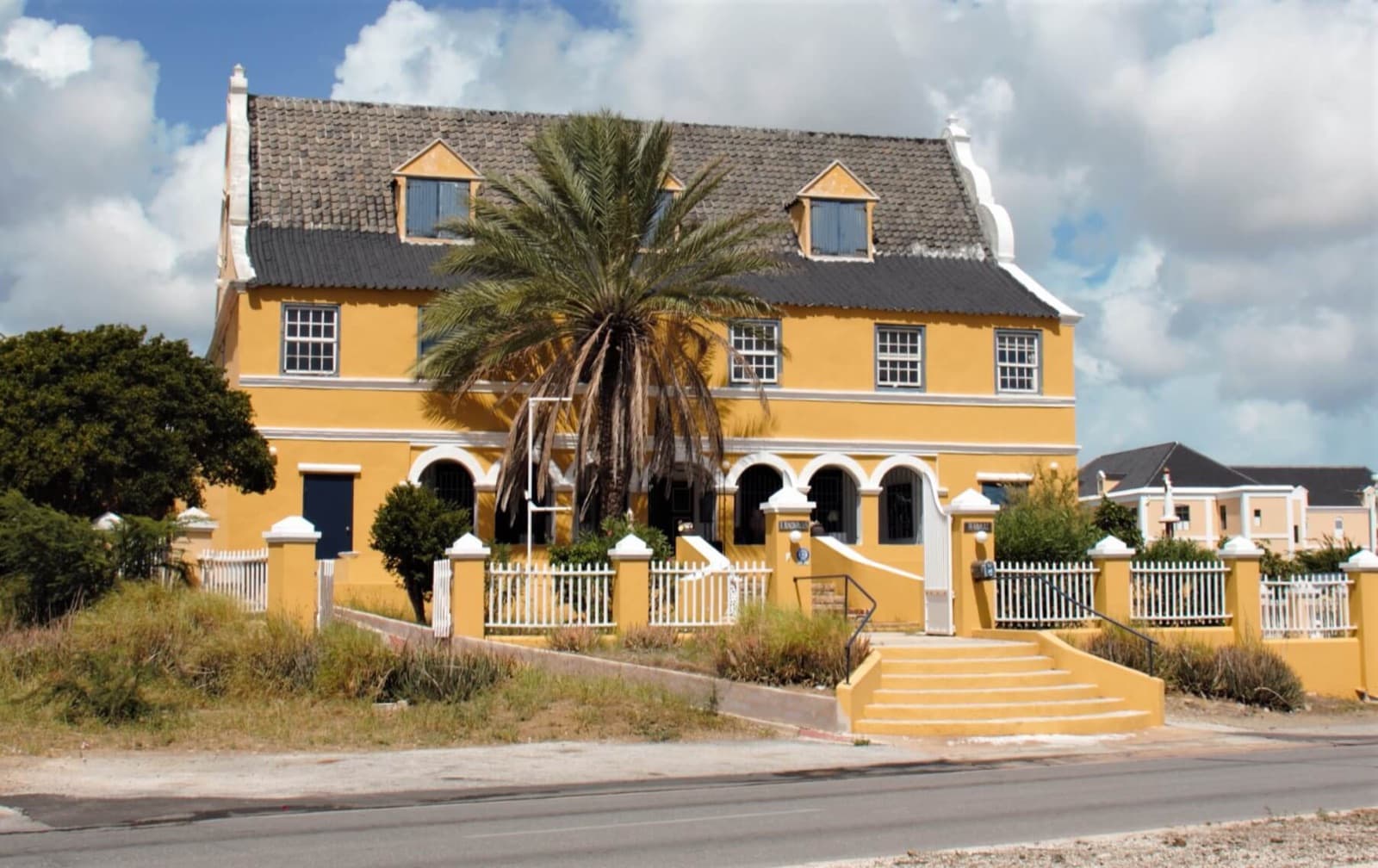
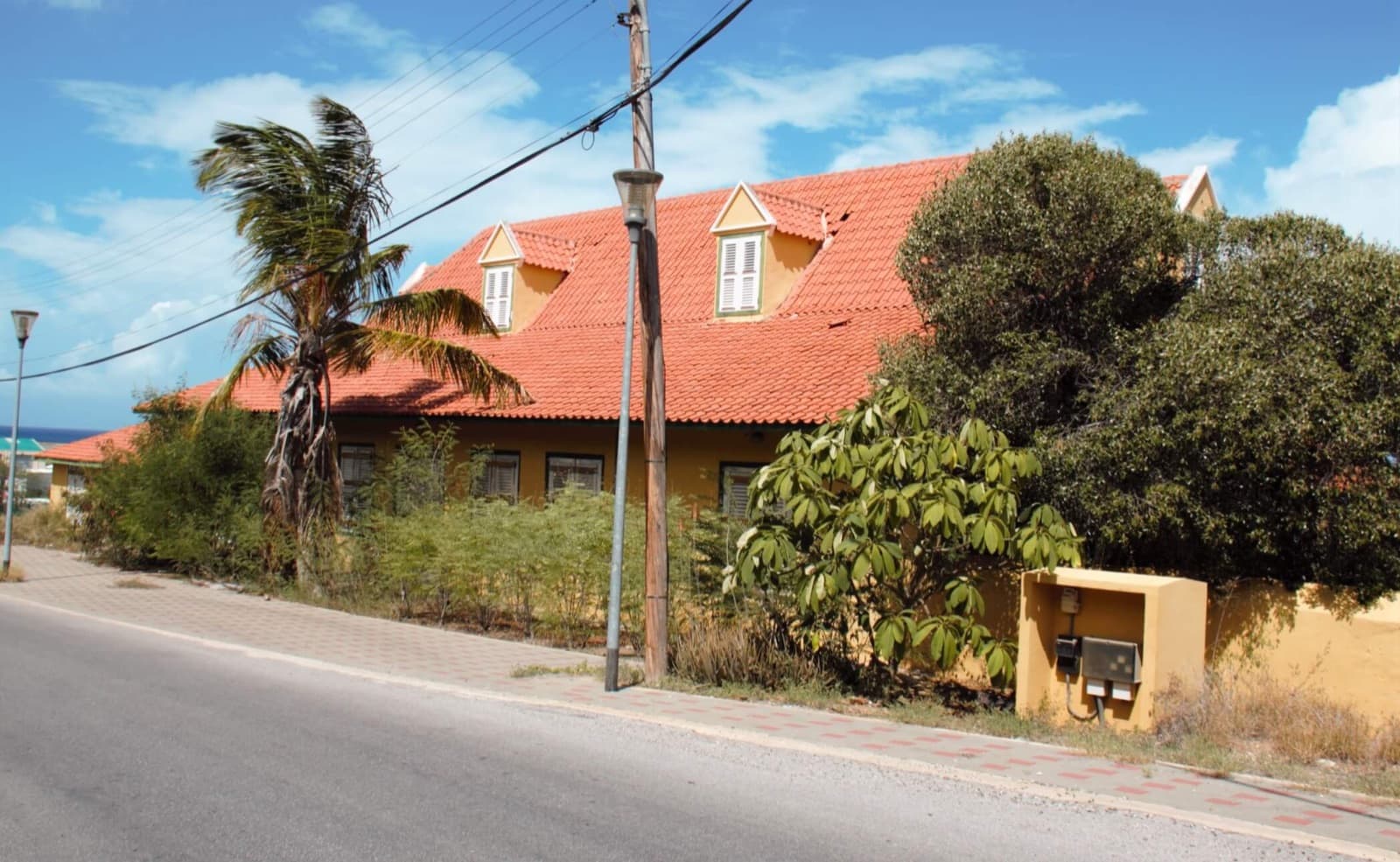
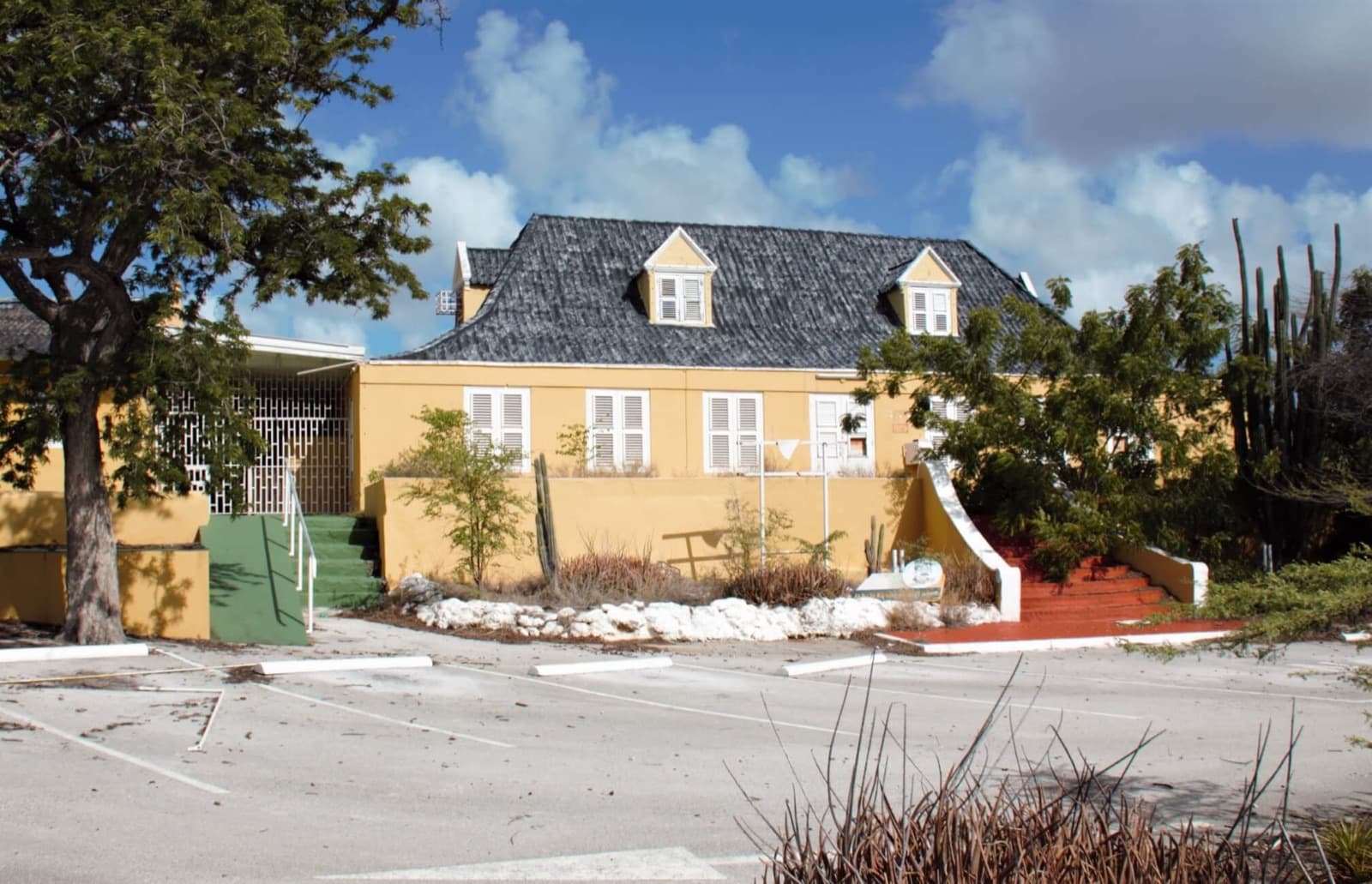
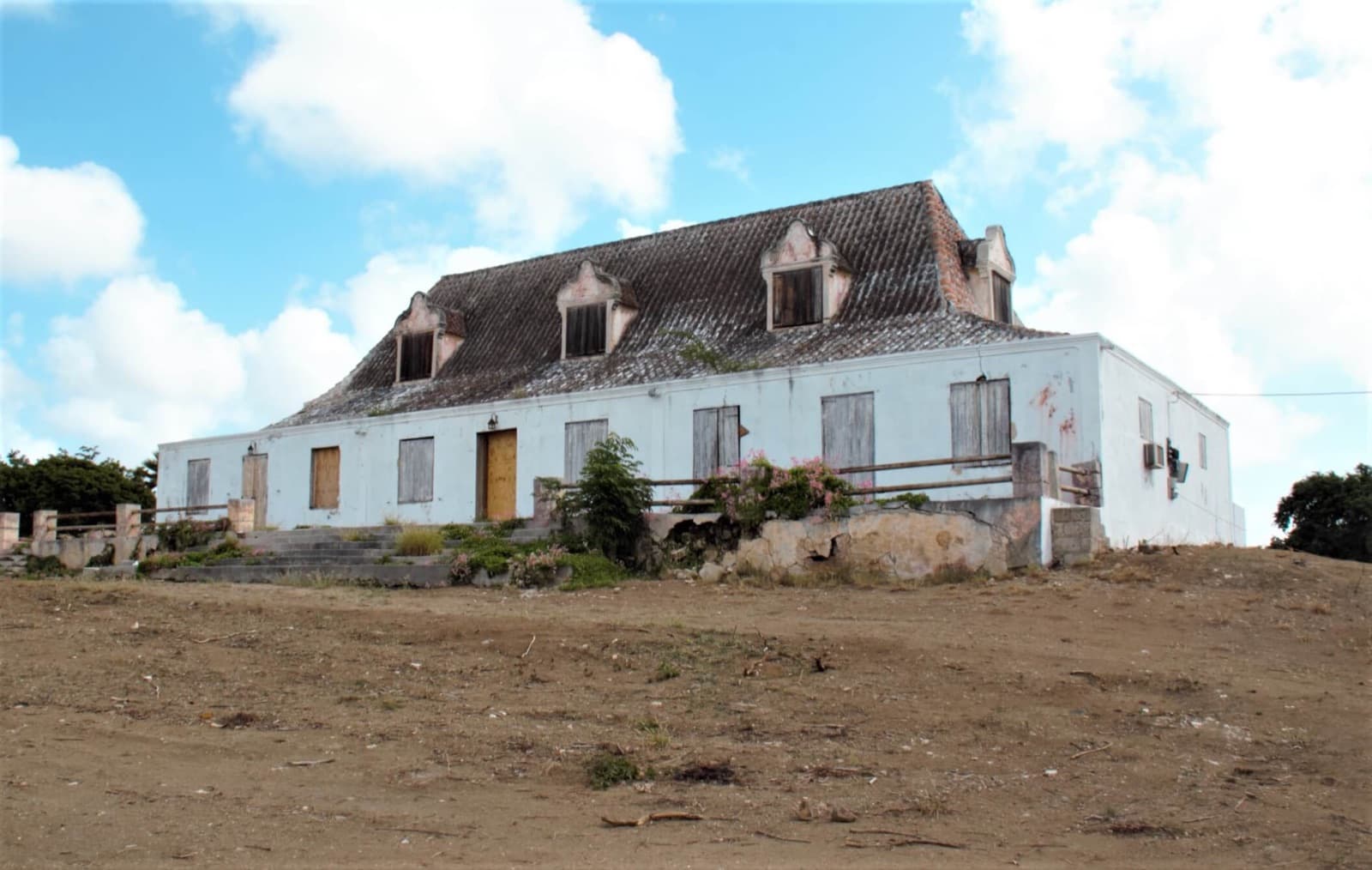
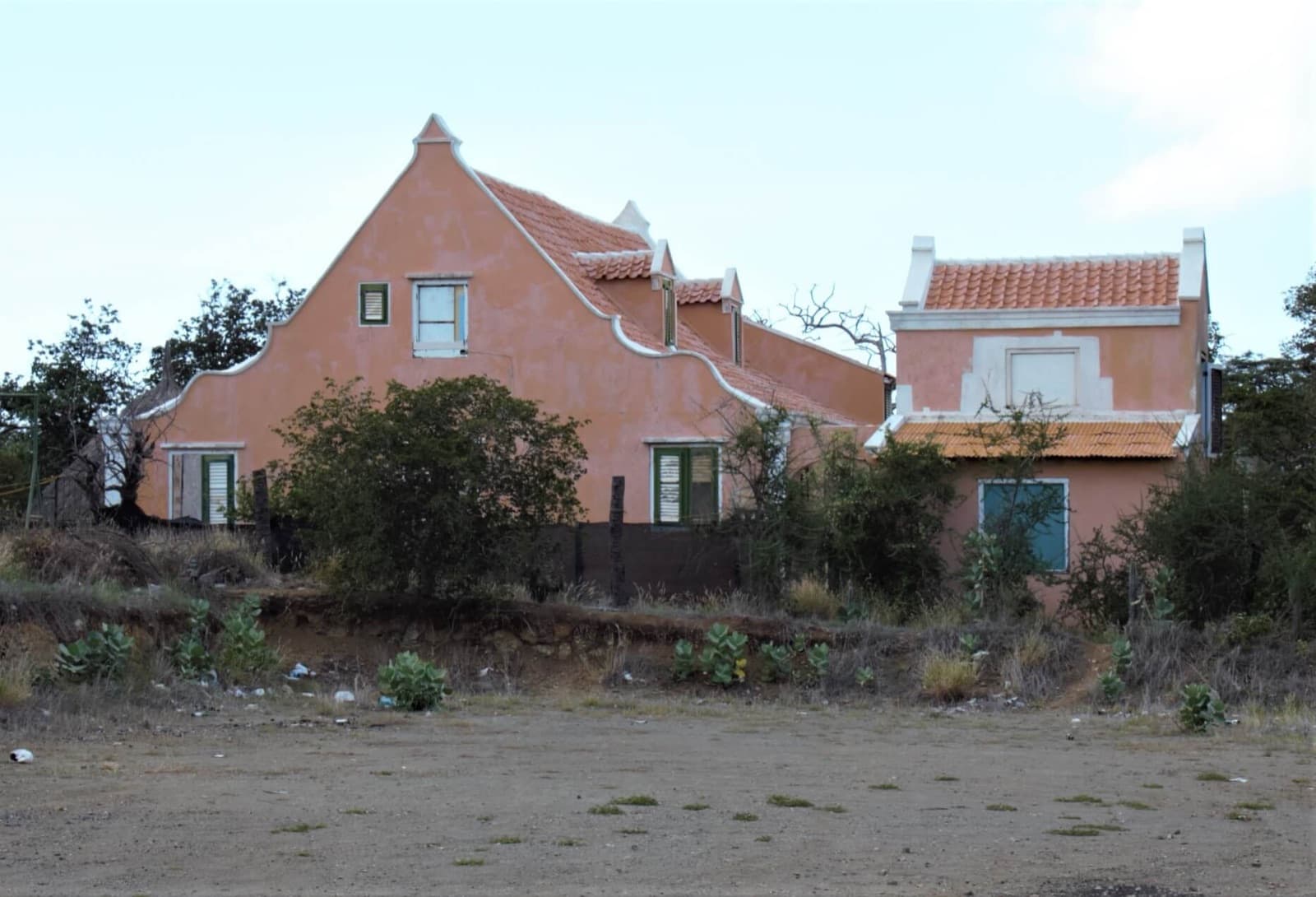
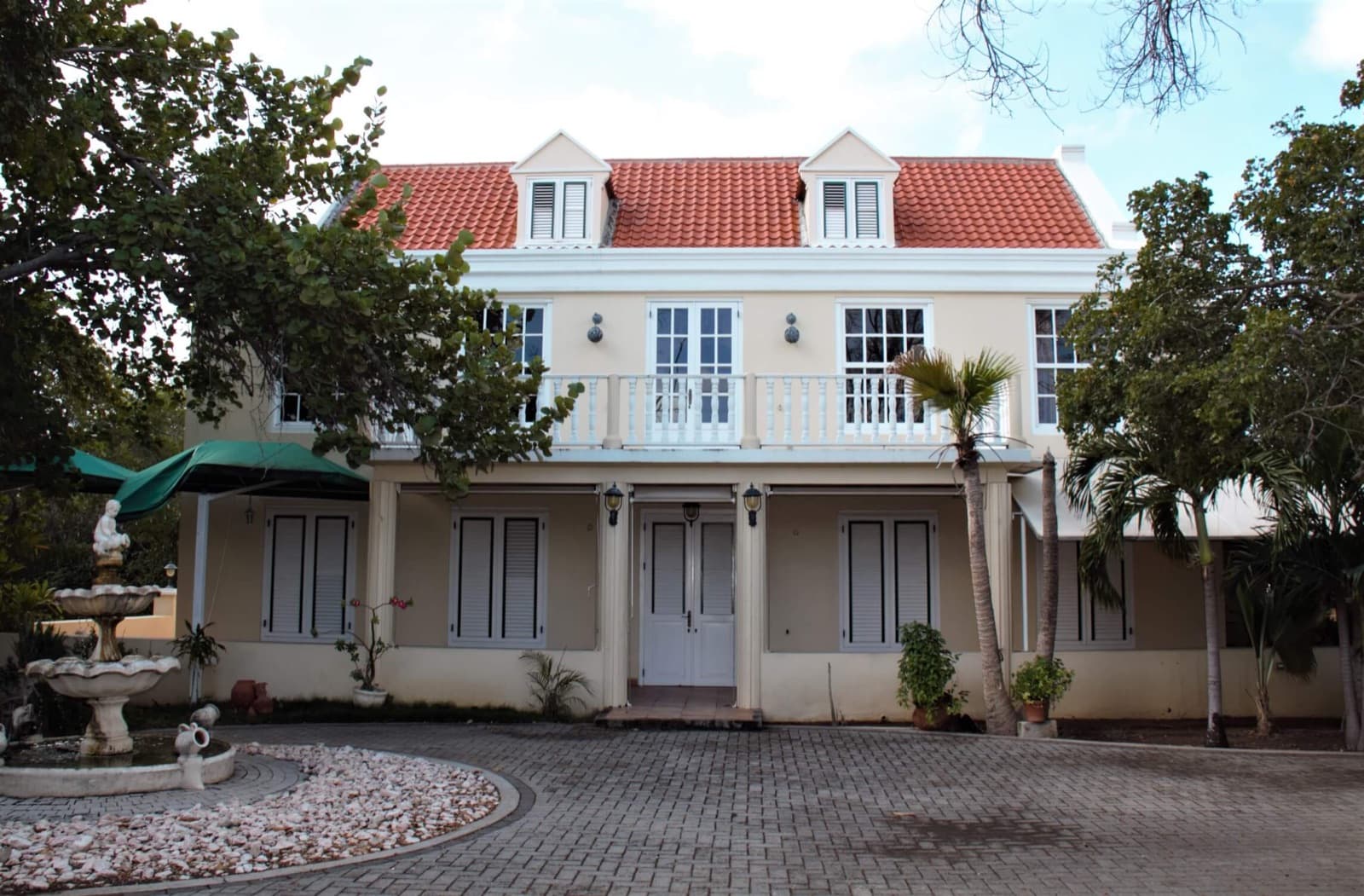
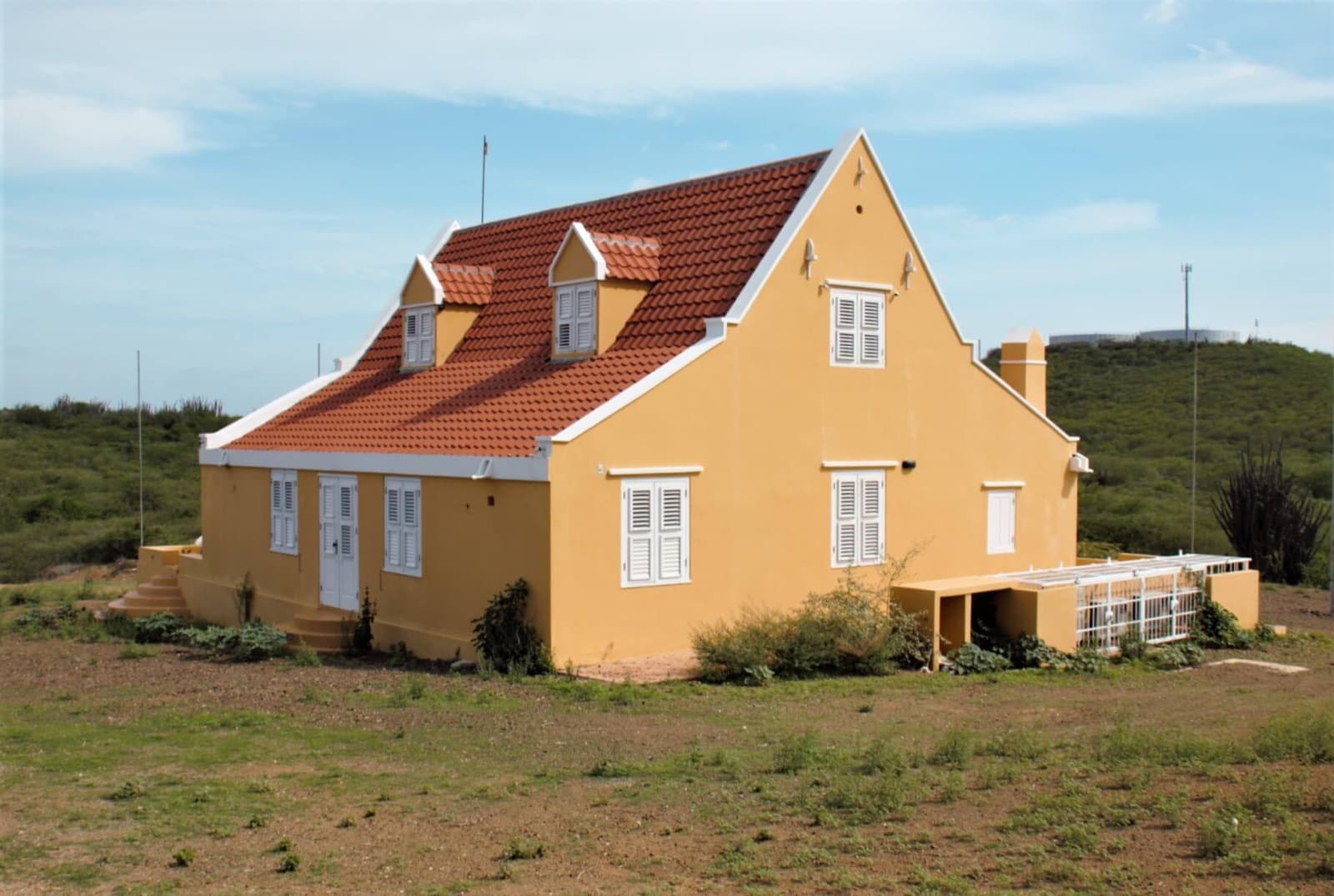
Curaçao conserva cerca de 75 landhuizen — casas de plantação da era colonial que outrora dominavam o interior da ilha. Algumas estão meticulosamente restauradas e abertas como museus, galerias ou restaurantes. Outras jazem em romântica ruína, engolidas pelos cactos e pelo sol. Visitar algumas é a forma mais rápida de sentir a história da ilha para além das muralhas da cidade.

Landhuis Ascencion — One of Curaçao's Oldest Plantations

Landhuis Ascencion — One of Curaçao's Oldest Plantations

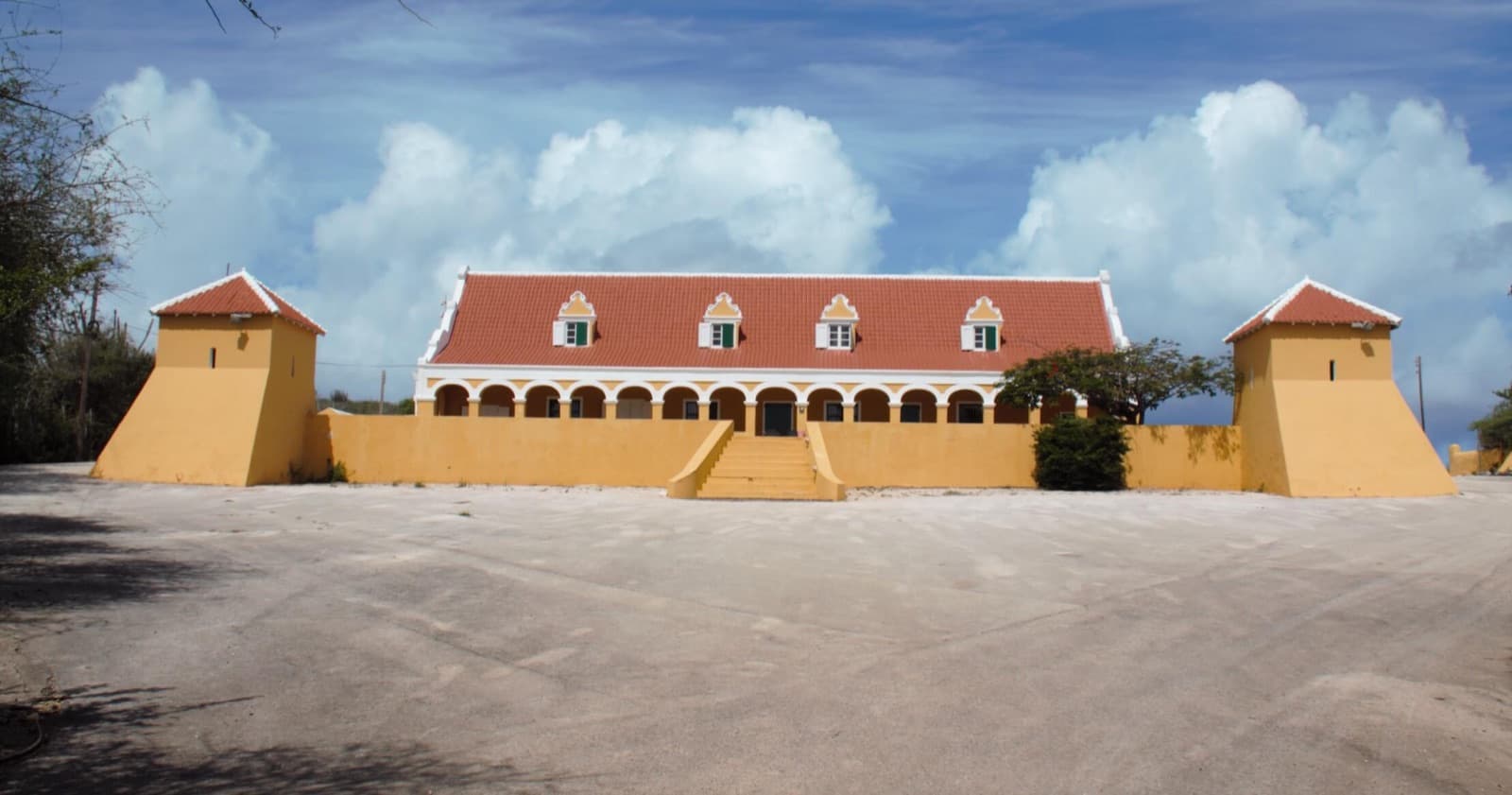
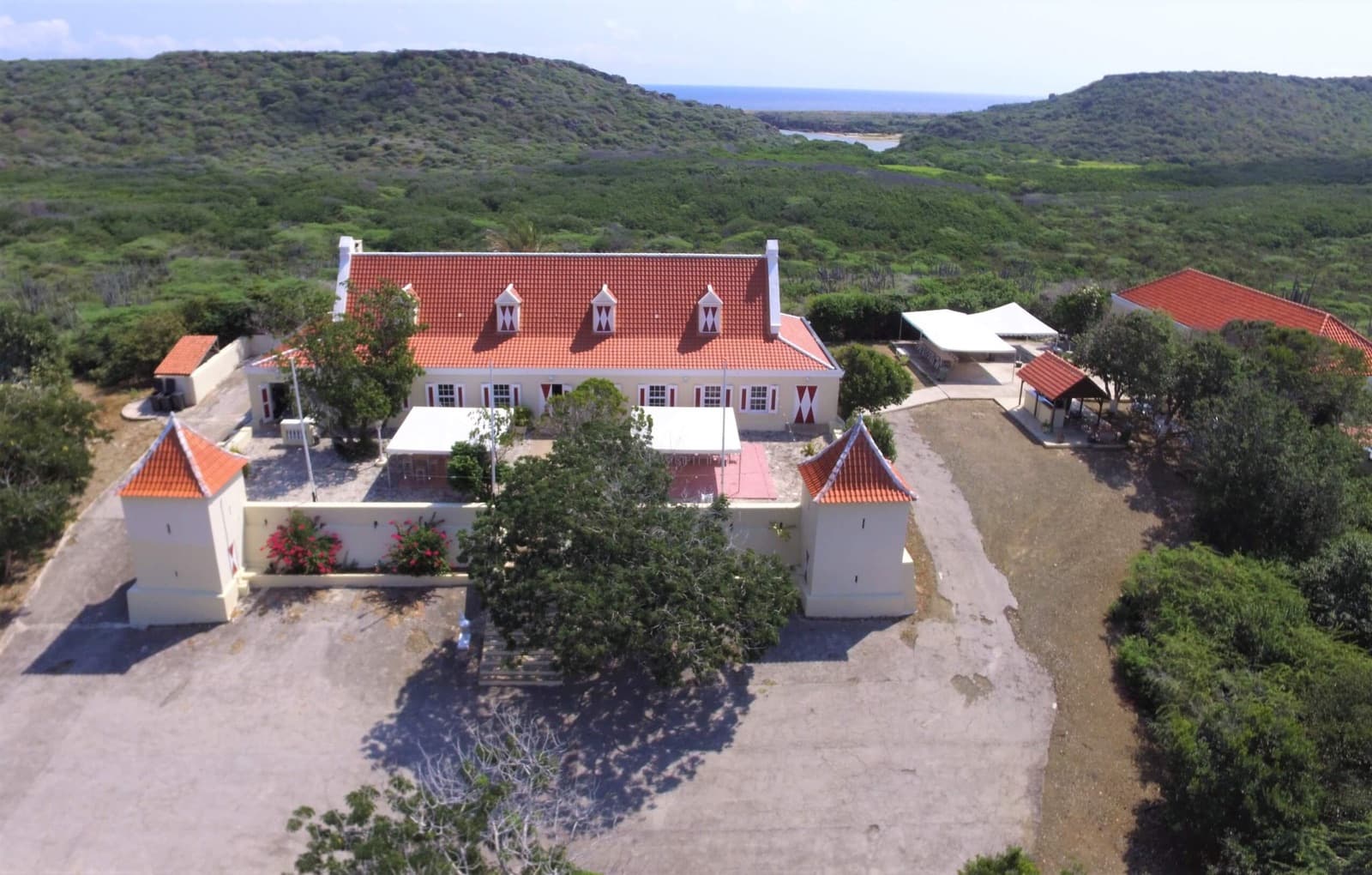
Landhuis Ascencion towers above the green hills of central Curaçao with its striking red-and-white shutters, a landmark visible from the road long before you reach the gates. The estate takes its name from a small indigenous settlement that once stood here: Pueblo de la Madre de Dios Ascencion, whose natural freshwater spring made the site valuable long before European arrival. Jurriaan Janszoon Exteen founded the plantation in 1672; the landhuis followed soon after. Its most distinctive architectural feature is a pair of imposing corner towers flanking the terrace — one of the few examples on Curaçao — which originally provided extra storage below and housed the plantation's pigeons on top, a food source kept by every self-respecting plantation owner of the era. The consistent water supply allowed sorghum, indigo, cotton, and later aloe to be cultivated, alongside herds of goats, sheep, cattle, and horses. Ascencion's fortunes rose again in 1884 when phosphate was discovered on the Seru Mainshi, part of the estate. The Curaçaosche Phosphaat Maatschappij Ascencion was founded the same year to exploit the find, part of an island-wide phosphate boom that followed the 1874 discovery on the Tafelberg near Santa Barbara. The current appearance owes much to architect Serge Alexeenko, who restored the house in 1963-1964 — the sandglass motif on the shutters is his addition, not historically original, but widely accepted as part of the landhuis' look today.

💡 Tip: The towers and their role as dovecotes are easiest to appreciate from the terrace side — walk around before leaving, the architecture makes more sense from there.
Landhuis Barber — Seminary, Then School, and the Oldest Tree on Curaçao

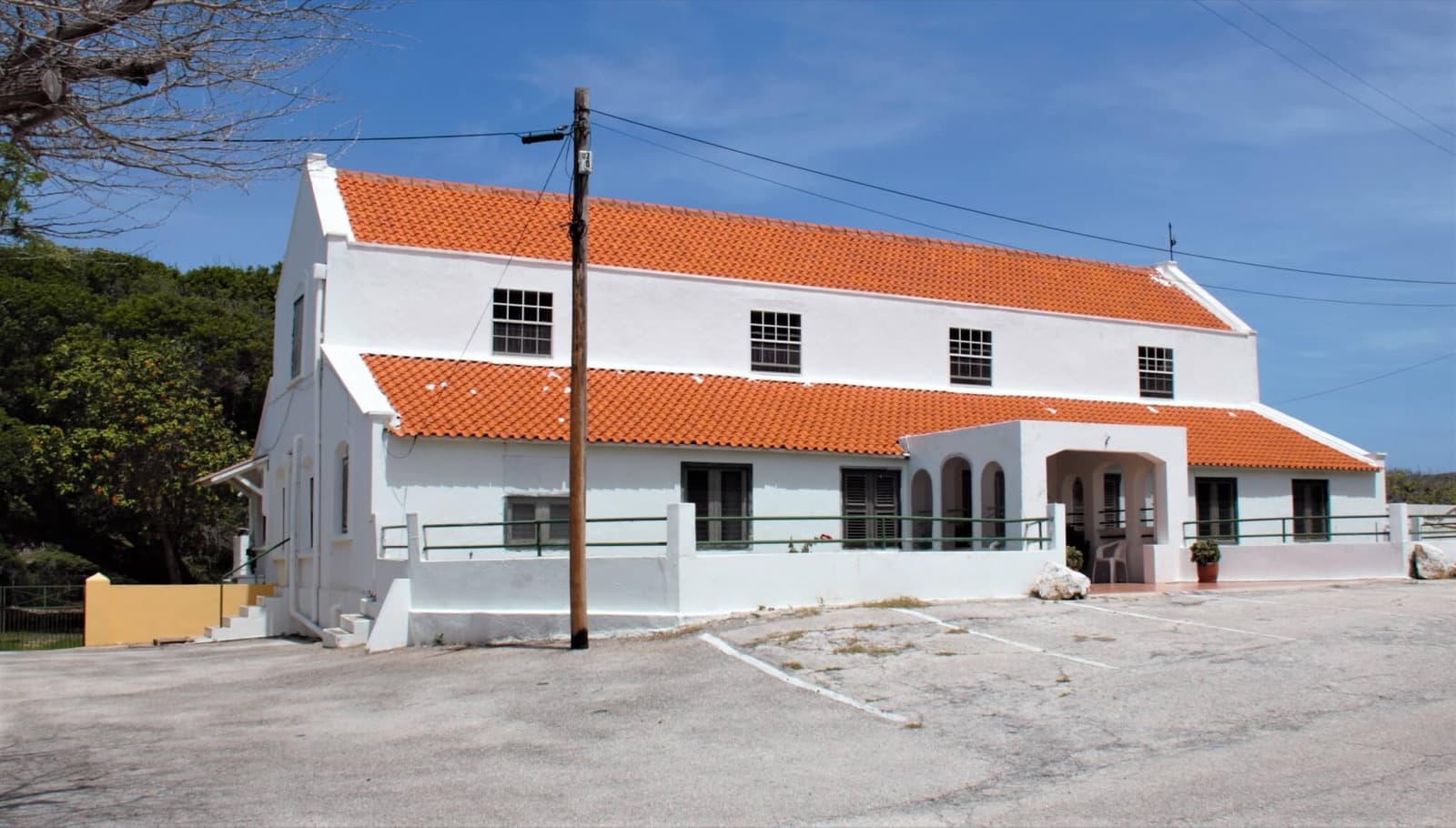
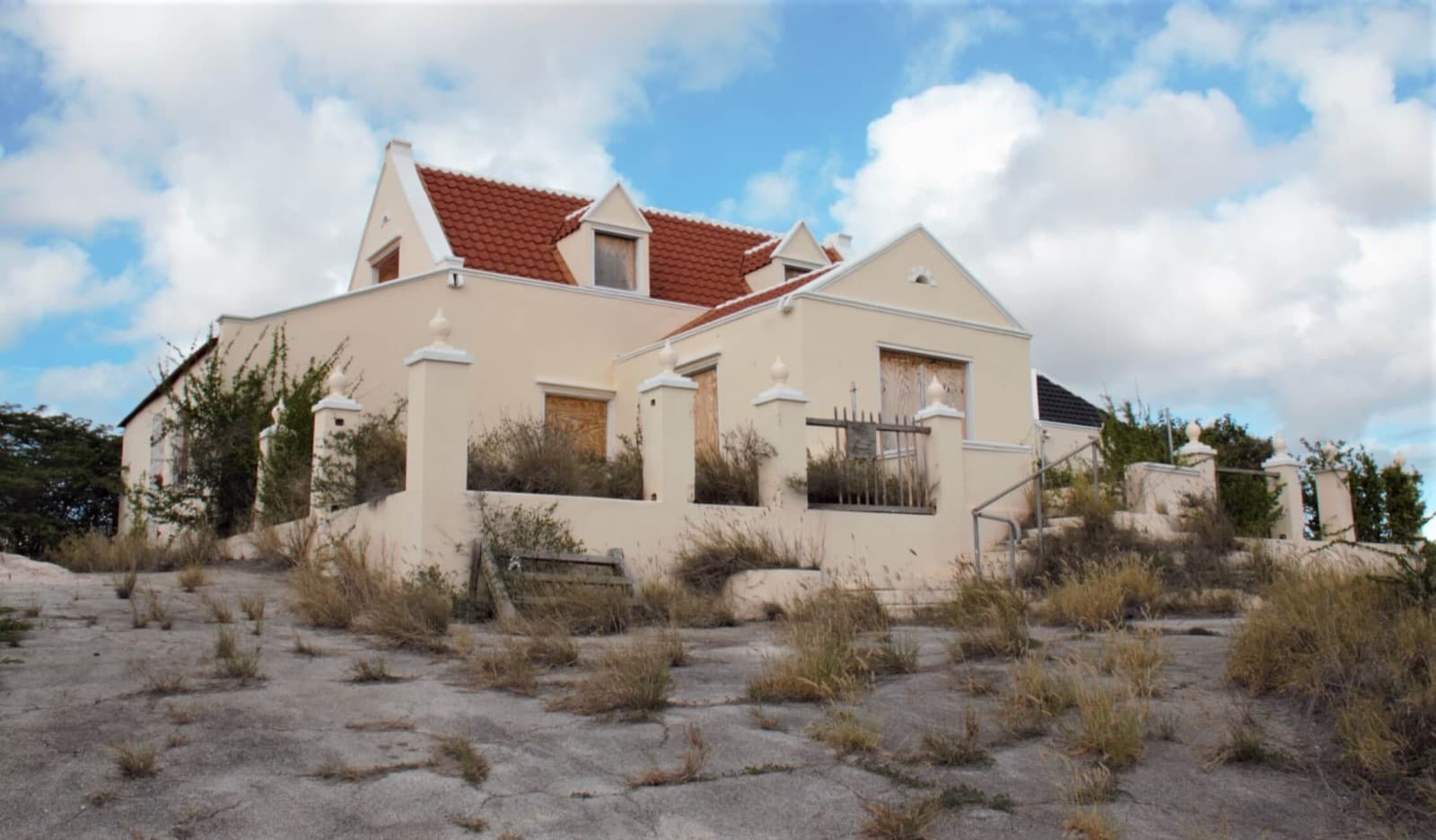
Plantage Barber was founded in 1711 by Barbara Boom-Exteen, daughter of the owner of Ascencion. At 283 hectares, it produced mainly wool and later attempted sisal cultivation. The landhuis has an upper storey added later atop the original core — a second floor built in 1833 when priest Niewindt bought the estate to convert it into a seminary and school. The priest-students lived on the new upper level. After the plantation was sold to the government in 1913, the landhuis remained property of the Roman Catholic church. Behind it lies the Hòfi Pastor nature park, an old orchard that still harbours what is reputedly the oldest tree on Curaçao — worth the walk for the botanical weight of it alone. The early 19th-century landhuis has a two-storey core with saddle roof (no dormers), and galleries along both long sides (northern narrower than southern). The Webata maps of the era show something unusual: Landhuis Barber stood outside the formal boundaries of its own plantation, which speaks to how the colonial landscape was organised by watershed and road more than by neat parcel lines.

💡 Tip: Visit the Hòfi Pastor park behind the landhuis — the reputed oldest tree on Curaçao is worth the walk. Entry usually free; best in the morning before the heat.

Landhuis Bever — Named After Its Army Surgeon

Landhuis Bever — Named After Its Army Surgeon

Originally the estate was called Buena Vista — 'beautiful view' in Spanish — and for good reason. From the hill on which Bever sits, the countryside opens out in every direction. On the grounds lie the graves of Jan Pietersz van Oxfort, his wife Johanna Mattias, and their son Thomas, both men 'cornet over de ruyterye' (cavalry cornets) in the 17th century. A hurricane in 1681 damaged the original house so badly that the West India Company director asked Jan Pietersz to rebuild — the old house stood too close to the soldiers' quarters. The current landhuis is probably that Pietersz rebuild, later adapted and extended, most likely around 1800 by Jacob Jessurun Sasportas. The name Bever comes from Daniel Beevers, chief surgeon of the local militia (Schutterij) from 1828 to 1840, who owned the estate during those years. In 1867 the house was 'repaired and put in best order'. It had a small orchard with fruit trees and a well with good drinking water. By the mid-20th century, Bever was the country home of Benny Maduro; the wells by then yielded only brackish water. The house has a vestibule with a semi-circular entrance stair and symmetrical flower beds on either side, edged with ijsselsteentjes — the small yellow Dutch bricks shipped as ship ballast. A partial restoration in 2016 returned the house to life.

💡 Tip: The graves of the Van Oxfort family are still on the estate. Private landhuis, visible only from the approach road, but worth the stop for the view that gave Bever its original name.

Landhuis Blauw — Rose Garden, Indigo, Now on a Golf Course

Plantage Blauw — also known as Blije Rust, Grote Blauw, or Blauw-Blauw — was founded around 1700 by Anno Blaauw. The 226-hectare estate was famous locally for two things: rose cultivation (unusually for the dry Curaçao climate) and the production of indigo dye, residues of which were reportedly still findable in the outbuildings until recently. The name 'Blauw' almost certainly derives from the indigo — the deep blue textile dye that was an export-grade product from the plantation. The current landhuis dates from around 1800. T-shaped, with no fewer than seven dormer windows in the saddle roof — an unusually generous number. Covered terraces run along all sides, and a lean-to-roofed gallery wraps the south-west elevation. The landhuis is today within the grounds of the Blue Bay Golf and Beach Resort, accessible only to registered guests. The 300-year arc — from indigo-making plantation to golf resort centerpiece — is characteristic of how many Curaçao landhuizen have ended up preserved: by being absorbed into a modern development that takes pride in the historical anchor. If you stay at Blue Bay, you get easy access to a 225-year-old landhuis with an industrial-chemistry backstory.

💡 Tip: Accessible to registered Blue Bay Resort guests. Ask at reception for the landhuis history — some of the resort concierges know the indigo-dye story and will point you to where the vats once stood.

Landhuis Bloemhof — Country House Turned Cultural Garden

Landhuis Bloemhof — Country House Turned Cultural Garden

Step through the wrought-iron gate (porta di heru) at Bloemhof today and you understand immediately why this estate was treasured as a country retreat for two centuries. The seven-hectare grounds still offer fresh air, quiet, and space — the same qualities that drew wealthy Willemstad families out of the stuffy city back when the drive took hours rather than minutes. The oldest preserved deed for Bloemhof dates to 1735. The present landhuis is nineteenth-century; by the time Emma Lopez Penha bought it in 1919, the plantation had already changed hands twenty-two times. Bloemhof produced rainwater and Laraha oranges (whose peels, essential for Blue Curaçao liqueur, were dried along the path leading up to the house from the Santa Rosaweg), but it was always primarily a buitenhuis — a country house — rather than a serious agricultural operation. Emma's granddaughter May Henriquez — herself a sculptor — transformed Bloemhof's creative life in the twentieth century. Working from the estate's old carriage house as her studio (preserved today in its original state), she turned the landhuis into a gathering place for Curaçao's artists. Exhibitions, theatre performances, and concerts became regular events. Gallery De Boog, founded by May with Ben Smit and Barbara Smeets, operated from the grounds in the 1960s. After May's death in 1999, her family chose to preserve that creative spirit: the landhuis was restored and reopened as Fundashon Bloemhof, a cultural centre hosting exhibitions of local and international artists, workshops, and public events. The old mangasinas became depots, archives, a library, and meeting rooms. On the foundations of a demolished family house, the artist Herman van Bergen began in 2014 to build his extraordinary Kathedraal van Doornen — the 'Cathedral of Thorns' — made entirely of sumpiña, the spines of the wabi (Acacia tortuosa) tree. Sculptures by other artists dot the grounds. Walking routes wind through the plantation, passing a hidden stone bath-house with two reclining tubs fed by an aquaduct from a neighbouring well — a small reminder of how different nineteenth-century luxury looked.

💡 Tip: Come midweek for the quiet. Admission is usually free or donation-based, but bring cash — the gift shop has beautiful small works by local artists that make much better souvenirs than airport magnets.

Landhuis Bloempot — Too Small to Be a Plantation

Landhuis Bloempot sits behind one of Curaçao's more charming arguments about terminology. The estate was named after one of its earliest owners, Aron Henriquez Moron, who arrived on Curaçao in 1730 at age twenty, married Esther Penso, and went to work for his wealthy brother-in-law Mosseh Penso. He branched out into ship-owning, freight, and marine insurance, and bought Bloempot in 1754 — undoubtedly as a country house, not a plantation. He held it for thirty years. That Bloempot was too small to count as a plantation was argued convincingly a century later by its then-owner, Moses Cohen Henriquez. In a letter to De Curaçaosche Courant defending the appraisal of his estate, he made the case that Bloempot could never be compared to, say, Klein Sint Joris. Sint Joris, he wrote, had room for fields of sorghum, beans, and peanuts; Bloempot barely had space for 'a quarter pint of corn'. The coconut palms and citrus trees had all died after he bought the place in 1833. Total annual fruit income: 450 gulden. 'This little summer place,' he concluded, 'in no way deserves the name plantation.' The current landhuis is privately inhabited. Two neoclassical blocks compose it; striking ornaments top the outermost corners of the front facade, and a triangular fronton above holds a medallion depicting a flowerpot with flowers — the estate's namesake, in stone. Empty flowerpots decorate the gate pillars to the left. To the right, the large rainwater reservoir has a handsome gabled roof. Cohen Henriquez, incidentally, was a key figure in the 1864 split within the Jewish community that led to the founding of Temple Emanu-el in Willemstad.

💡 Tip: Bloempot sits in Scharloo. The front gates are the photogenic draw — note the empty flowerpot ornaments, a playful reference to the estate's name.

Landhuis Bona Vista — Built of Dutch Ship-Ballast Bricks

Bona Vista — also historically Ons Tuintjie or Vriendenwijck — sits on a remarkably abundant water source, which defined its whole economic history. During its working centuries the estate had enough water to grow crops and maintain a substantial livestock herd; by the late 19th century, exporting fresh water to Punda (Willemstad) had become its main source of income. One of the more quietly strategic estates on the island. The landhuis is an architectural oddity for Curaçao: U-shaped with a saddle roof but no dormer windows, and almost all its walls built from ijsselstenen — the small yellow bricks from IJsselstein in the Netherlands that arrived as ballast in sailing ships. Using them for wall construction, rather than just the usual foundational courses, gives Bona Vista a distinctly Dutch-looking fabric that reads as imported even before you learn the story. The facade features a unique undulating gable with an arched top finish — elegant, unusual, and specific to this landhuis. The plantation is mentioned on 1820 maps but the landhuis itself was probably built slightly later in the first half of the 19th century. Property of a ship captain at the end of the 19th century.

💡 Tip: Look closely at the walls — the yellow ijsselsteen bricks are visible throughout. Most Curaçao landhuizen use only a few for foundation courses; Bona Vista uses them for entire wall surfaces.

Landhuis Bonam — The One We Know Less About

Not every landhuis on Curaçao has a fully worked-out history — and Bonam is one of those. On older maps the name is written as 'Bonnam'. The estate has the alternative names Fortuin Bon and Fortuijn. Beyond that, surprisingly little is definitively established. Current research by the cultural heritage scholars working on the Landhuizen van Curaçao project continues, but the specific dates of founding, owners, and economic activity remain to be pinned down. This matters because it's a useful reminder about how historical knowledge actually works. For every Brievengat or Savonet with a well-preserved paper trail, there are landhuizen like Bonam that carry on through the centuries without leaving a thorough archive. The building exists; the oral tradition exists in places; the document work is incomplete. Bonam sits near Brievengat and the now-closed estate of Liverpool. Its current use is unclear. When the research on Bonam eventually emerges — perhaps through archaeology, perhaps through an undiscovered deed or letter — it will slot into place alongside the better-documented estates as part of the 78-landhuis catalogue that represents Curaçao's plantation past. For now, it stands quietly, waiting for its story.

💡 Tip: View from the road. This is a landhuis for visitors who want to see the less-celebrated members of the catalogue — a reminder that not every Curaçao plantation house has a Wikipedia page.

Landhuis Brakkeput Abou — Rubber and Turtles

Landhuis Brakkeput Abou — Rubber and Turtles

The original Brakkeput was named after the brackish-water well on the plantation. Over time it was split into three separate estates — Abou ('below'), Ariba ('above'), and Mei Mei ('middle') — each with its own landhuis. Brakkeput Abou, bearing the date 1795 on the house, was never really a working plantation. Instead it has an oddly specific experimental history: in the 20th century successive owners tried to cultivate rubber plants and farm sea turtles on the grounds. Neither caught on commercially. Architecturally the house is a mix of several periods. It is T-shaped with a high saddle roof crowned by dormer windows of varying widths. A half-gallery runs along the north side. A secondary addition extends from the crossbar of the T on the north side, and a saddle-roofed gallery wraps the western and part of the southern elevations. It reads like what it is — a country retreat adapted again and again over two centuries, each generation leaving its mark. Today the landhuis is fully restored and functions as a private residence. You cannot go inside, but from the approach road the layering of the different building phases is clearly legible. Also known in earlier documents as 'Rust en Vrede' and 'Rust van Bonaire' — names whose disappearance into 'Brakkeput Abou' says something about how Papiamentu practicality tends to win over pretty-sounding Dutch.

💡 Tip: Private residence — observe from the road. The architectural layering is more interesting than most visitors realise; try to identify the different construction phases as you pass.

Landhuis Brakkeput Ariba — From Merchants' Retreat to School

Landhuis Brakkeput Ariba — From Merchants' Retreat to School

Brakkeput Ariba — 'above' in Papiamentu — is the upper of the three post-split Brakkeput estates. The original plantation was a single unit, named for its brackish-water well, before being divided in three in the 19th century. Ariba was probably a country retreat for city merchants from the start, used as an escape from the heat and crowding of Willemstad rather than a serious agricultural operation. Architecturally the house began as a U-shape around a patio; later the patio was roofed over, creating a contained central space. The house has a hipped roof without dormer windows — unusual for a Curaçao landhuis — and above the main entrance on the north side an extension rests on two columns, a 20th-century addition that changed the entrance rhythm significantly. In the first half of the 20th century the Kruisvaarders van Sint Jan — a Catholic teaching order — took possession. They ran a vocational school here for boys who could not attend the main trade schools in the city, teaching practical skills in what had been a merchant's summer retreat. The school closed decades ago. Brakkeput Ariba is now dormant, awaiting its next purpose. Like many Curaçao landhuizen, it has moved through cycles — agriculture, leisure, education, waiting — and the building survives each transition. The 19th-century bones are still intact.

💡 Tip: Private property. The twin-column entrance above the north door is the detail worth noticing from the road — a 20th-century intervention that's now as much 'the landhuis' as the original 18th-century structure.

Landhuis Brakkeput Mei Mei — From Plantation to CPIM Clubhouse to Nightlife

Landhuis Brakkeput Mei Mei — From Plantation to CPIM Clubhouse to Nightlife

Brakkeput Mei Mei — 'Brakkeput middle' — is the third of the post-split Brakkeput estates, between Abou and Ariba, all three named after the shared brackish-water well that once defined the parent plantation. On Mei Mei the crops were maize and beans; livestock grazed the surrounding land; and at one point lime was burned here for mortar and whitewash production. A plantation with multiple small revenue streams rather than one big commodity play. The landhuis was originally U-shaped. It has a corrugated-metal saddle roof (a relatively modern replacement) with some dormer windows, and a lean-to-roofed gallery along the front. The estate was once a country retreat for Willemstad merchants. In the mid-20th century it served as a clubhouse for employees of CPIM (Curaçaosche Petroleum Industrie Maatschappij) — a characteristic Curaçao mid-century use, turning old plantation houses into social venues for oil-industry workers. For many years now Brakkeput Mei Mei has been a popular restaurant and nightlife venue, one of the few landhuizen on the south-east where you can actually go in for dinner or a drink on a Friday night. The restored building is privately operated; the patio has become a dance floor; the 'Brakkeput' name now stands for night out rather than agricultural sweat.

💡 Tip: Book ahead for Friday or Saturday nights — it is a popular local venue. The patio is the best seat in the house on a cool evening.

Landhuis Brievengat — The Cultural Heart of Curaçao

Landhuis Brievengat — The Cultural Heart of Curaçao

Few landhuizen have flirted with demolition and come back as cultural icons quite like Brievengat. Built around 1750 on the plains northeast of Willemstad, the estate was alternately known as 'De Hoop' ('The Hope') in its early years — a name that would prove prophetic. In 1847, a young Hague-born Dutchman named Cornelis Janszoon Sprock bought the neglected plantation, restored its buildings, and brought new land under cultivation. Under his direction Brievengat flourished. But the twentieth century was less kind: Shell acquired the estate in 1927, convinced it held groundwater essential for the oil refinery at Isla. The water turned out not to exist, and a costly strategic error loomed. Worse was the aftermath — by the early 1950s the once-proud landhuis stood in ruins, and Shell was preparing to demolish it. What followed is Curaçao's most celebrated preservation story. A group of concerned residents founded Stichting Monumentenzorg Curaçao in 1954 specifically to save Brievengat. They bought it from Shell for a symbolic one guilder. A 75,000-guilder gift from industrialist Bernard van Leer funded a full restoration by architect Serge Alexeenko, completed in 1955, that returned the house to its 18th-century glory. For decades afterwards Brievengat was the island's premier cultural venue. Under proprietor René Hoetjes it hosted Friday-night Indonesian rijsttafel followed by open-air dancing to the house band, The Happy Peanuts. Cruise passengers came by day for folklore performances in the gardens. The dances ended in 2002, and since then the landhuis has cycled through various uses. It is currently vacant but remains one of the island's architectural jewels — a complete 18th-century plantation complex with main house, slave quarters, and grounds, all intact and open to visit.

💡 Tip: If you can only visit one restored landhuis on Curaçao, make it Brievengat. The scale, preservation quality, and story from demolition-date to rescue are unmatched.

Landhuis Cas Abou — Two Plantations Merged, One Beach Famous

Landhuis Cas Abou — Two Plantations Merged, One Beach Famous

Landhuis Cas Abou has one of the more confusing histories on Curaçao — because it's actually the merger of two older plantations, Engelenberg and Giftenberg. Willebrord van Engelen, temporarily director of the Dutch West India Company, founded Engelenburg in 1686 and built a house there. In 1838 August Statius Muller owned both Engelenberg and Giftenberg and combined them. The Giftenberg house was nicknamed 'e kas abou' — 'the other house' over there — and somehow that name eventually transferred to the 17th-century landhuis of the merged estate. Language is unreliable that way. By the early 1960s Cas Abou was a ruin. Architect Serge Alexeenko restored it. One of the more unusual survivals on the grounds is the original privy (wc-huisje) — a two-seater positioned on the western side, downwind from the house, because colonial architects had practical priorities. There is also a carriage house and the remains of a mangasina. A project developer took ownership in 1980 with big plans that came to nothing. In 1991 the Dutch Antilles civil servants' pension fund took over. Two years later a small hotel with restaurant opened in the landhuis and promptly closed. Today the landhuis stands empty, awaiting restoration and new purpose. But the beach directly below it — Cas Abou Beach — is one of Curaçao's most popular strands. Soft white sand, calm turquoise water, and a reef just offshore. The landhuis may be sleeping, but the bay below is wide awake.
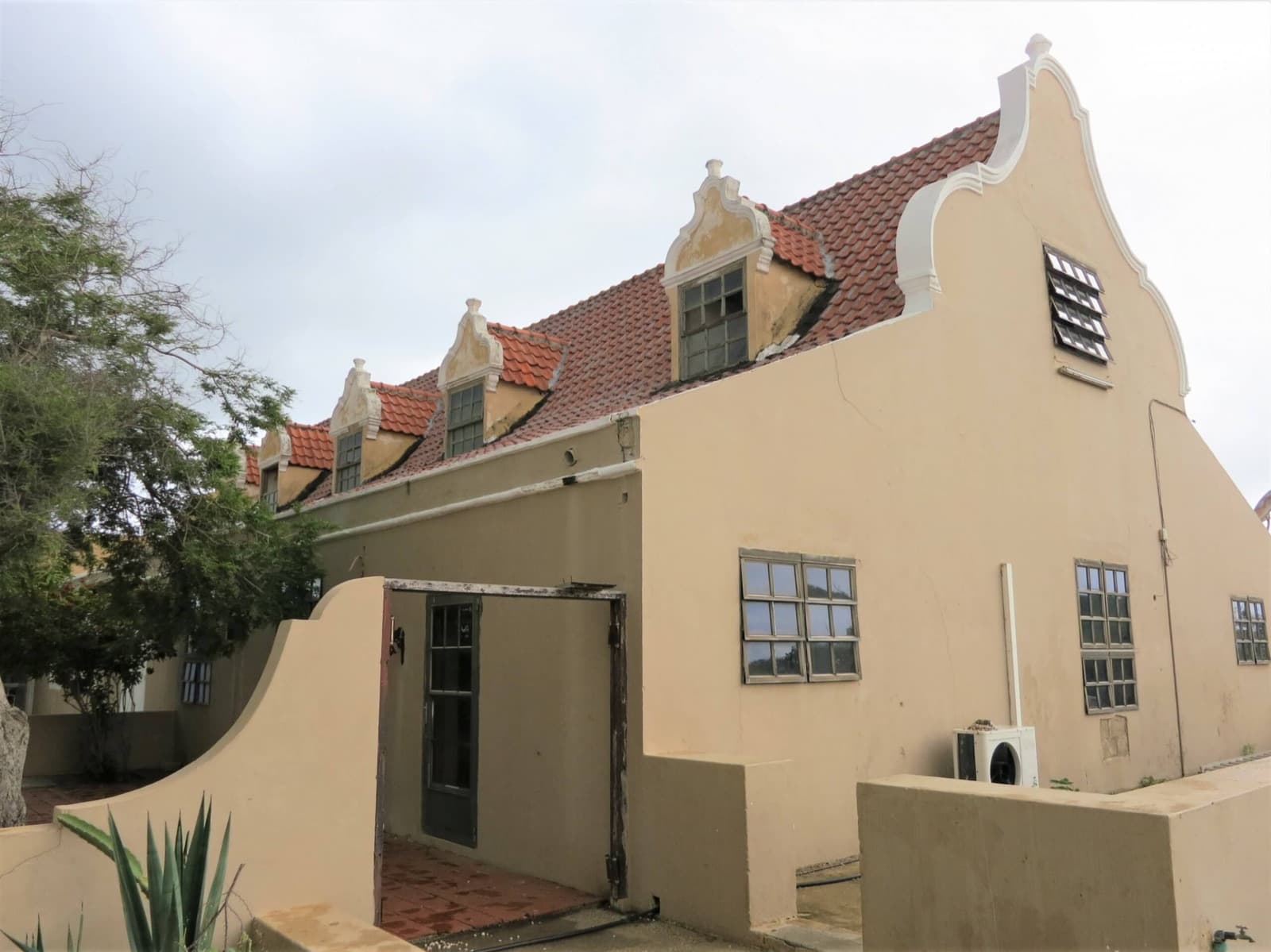
💡 Tip: Cas Abou beach is paid entry (around 10 USD per person including parking and palapa). Worth it for the water quality and facilities. The landhuis is visible from the beach — you can walk up for a closer look even if the house is closed.

Landhuis Cas Cora — Cattle Farm Turned Experimental Breeder

Cas Cora — on older maps Cas Koraal, meaning 'house of the corral' in a mix of Spanish and Dutch — is a 19th-century landhuis that sat on an 85-hectare cattle plantation. The operation was primarily livestock-based; in the mid-20th century it briefly became a specialised cattle-breeding facility, a short chapter in its long, mostly quiet history. The landhuis has a simple, practical architecture. Saddle roof, no dormer windows, lean-to galleries along both long sides. A rear extension and a large covered canopy have been added behind the main building — the kind of modest, functional expansions that have supported continued use over decades. The estate has also been known as Vredenberg and as Penso's Park, successive names that accumulate on a Curaçao landhuis like sediment. Cas Cora sits near Groot Santa Martha and Rio Magdalena in the island's north-western rural zone. Its current use is unclear but the building itself remains in good structural condition, a testament to the usefulness of simple forms that don't try to be grander than they are.

💡 Tip: The unpretentious architecture is actually the point here — not every landhuis was about showing off. Some were just working cattle farms with a house attached. Worth comparing to the more decorative estates.

Landhuis Cerito — Quiet in the Centre

Landhuis Cerito — Quiet in the Centre

Cerito — also spelled Cerrito, 'little hill' in Spanish — is one of the smaller and lesser-known landhuizen of central Curaçao. The estate and its house sit on gently raised ground that gave the plantation its name. Among the 78 intact landhuizen it is neither the oldest, nor the grandest, nor the most story-rich — but it belongs squarely in the continuous story of the island's plantation past, and its presence on the list matters. The landhuis has gone through the familiar Curaçao cycle: established as a working plantation with livestock, small-scale crops, and a supporting household staff; transformed in the 20th century as the economic basis for plantations evaporated; now preserved more by inertia than by active restoration. What survives is typical of the mid-scale Curaçaose landhuis — a rectangular main house with surrounding gallery, supporting outbuildings some of which are intact, some lost. Cerito illustrates an important truth about Curaçao's landhuizen catalogue: the famous estates (Brievengat, Chobolobo, Kenepa) represent maybe a dozen out of roughly 95 sites catalogued in the authoritative book. The other 80+ are smaller, quieter, less visited — but each holds a piece of the story. Cerito is one of those quieter pieces. The book of Curaçao history is not only written in capitals.

💡 Tip: Not a primary visit destination. Worth noting if you're driving through the central region and mapping out the distribution of landhuizen on the island — the small ones matter for the pattern.

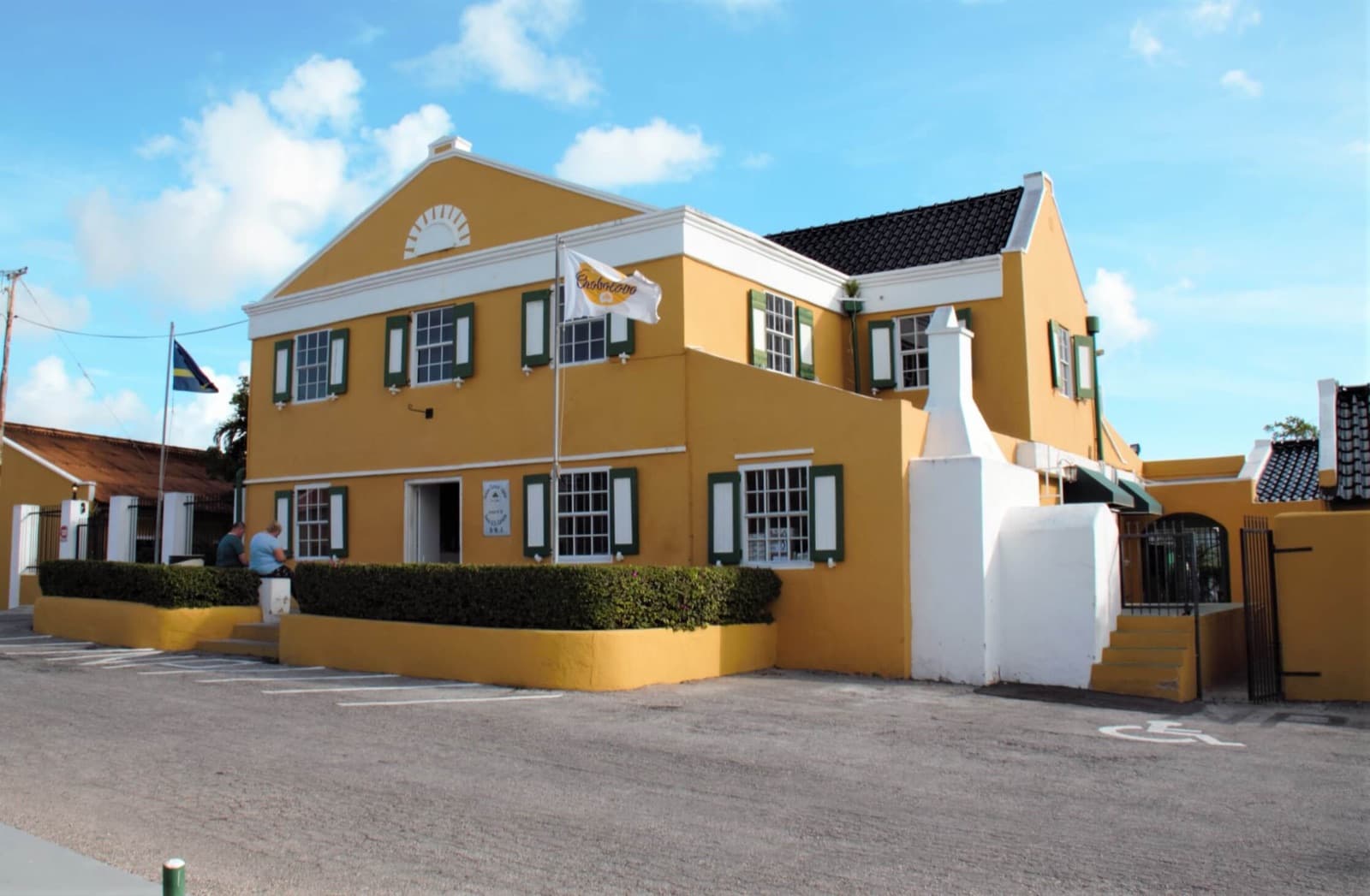
Landhuis Chobolobo — Home of Blue Curaçao

Landhuis Chobolobo — Home of Blue Curaçao

Landhuis Chobolobo, just southeast of Schottegat, is arguably Curaçao's most famous plantation house — not for its age or grandeur, but for what comes out of its copper kettles. This is the only place on Earth where real Blue Curaçao liqueur is distilled, a process unchanged since the late nineteenth century when pharmacists Isaac Chumaceiro and Edgar Senior first experimented with the bitter peels of the Laraha orange at their Botica Excelsior on Heerenstraat. The estate itself began as a country retreat, not a working plantation. Early records list it as 'De Zoutpan' (The Salt Pan), for the natural depression beside it, and later as 'Sebollobo' — the name used in 1796 by its then-owner, a free woman of colour named Anna Matthew, possibly of indigenous Arawak descent. The current two-storey landhuis was probably built around 1800; by the time the traveller M.D. Teenstra catalogued it in 1836, it was already a 'tuintje', a small genteel garden estate rather than a sugar or salt operation. The transformation to distillery came in 1947, when Senior & Co bought out the Chumaceiro widow — keeper of the original family recipe — and moved production to Chobolobo's old mangasinas (storage sheds). Architect Johan Heinrich Werner renovated the house the same year. The original plan for a tasting room didn't pencil out commercially, so in early 1949 it opened instead as a nightclub, hosting dances under the Caribbean stars. Today Chobolobo hosts daily guided tours that walk visitors through the 1896 copper still (still in use), the botanical story of the Laraha — a bitter orange found nowhere else — and a tasting of every colour variant of the liqueur, only one of which is actually blue. A 2014 restoration turned the old storage buildings into a museum and information centre; the following year, architect Anko van der Woude added a contemporary café behind the landhuis, its sweeping roof hovering over the terrace as a striking modern counterpoint to the 18th-century walls.

💡 Tip: Try the clear 'Triple Sec' variant during the tasting — it's the same recipe as the blue version, just without the food colouring, and gives you the purest expression of the Laraha.

Landhuis Daniel — From Bad Soil to Best Breakfast

Landhuis Daniel — From Bad Soil to Best Breakfast

Daniel was originally called Malpais — 'bad land' — because the soil here never really produced much. The current name comes from Daniel Ellis, founder of the plantation, who bought the land from the government in 1711. His first name stuck; the nickname faded. The plantation's 19th-century history is unusually interesting because twice, formerly enslaved people came to own it. Lourens Serni, manumitted in 1850, bought Daniel in 1867 and held it for at least twenty years. By 1873 he was running some 800 goats and sheep and around 40 cattle across the land. He was a butcher by trade; he and partner C. Maduro advertised 'best vleesch' (best meat) in the Curaçao newspaper. Adolph van Uytrecht, born into slavery in 1858 as the son of plantation owner Willem van Uytrecht and his enslaved partner Françoise Sera na la Condé, inherited enough after his father's 1893 death to buy Daniel a year later. By the time contractor H.J.M. van Lieshout acquired the landhuis in 1976 it was nearly a ruin — only the walls stood. His full restoration with antique Curaçao furniture returned the 17th-century estate to glory. Brief owners followed including Dutch television director Jef Rademakers. Since 1997 the property has belonged to Jan Francke, who immediately built a large covered terrace in front of the house (obscuring the two dormer windows — a controversial choice quickly followed by the landhuis being declared a protected monument). Today Daniel is a restaurant with a few apartments and an art gallery showing works by local artists and Francke himself.

💡 Tip: Go for breakfast or lunch rather than dinner — the light on the 17th-century walls in the morning is what makes this place. The aquaduct draining rainwater to the reservoir is worth a look, quietly engineered.

Landhuis De Goede Hoop — Three Generations, One Family

Landhuis De Goede Hoop — also known as Popo — sits splendidly on a hill, built around a core with four surrounding galleries. The 20th century added a pillared canopy over the large front terrace. The house dates from before 1800. The 1776 sale deed listed it as 'opstal van huisinge, een mangasina en een duivenhok' — farm house, a storage shed, and a dovecote. It was probably always more country retreat than working plantation, though as late as 1926 the owners retained the privilege of 'grazing 80 sheep on the public lands'. The estate has been in one family for over two centuries. Bernardus Anthony Cancrijn, member of the colonial Raad van Politie, bought it in 1807 — mostly as an investment, since he lived in Scharloo's Van den Brandhofstraat. With the estate he acquired 'one black man, one donkey cart, two mares, two donkeys, and various garden tools'. Later in the 19th century the estate passed to Mondecir Martinus Ecker — born into slavery — whose wife Dorothea Hipólita Leon was an extramarital but acknowledged daughter of Anton Leon, grandfather of the current owner. De Goede Hoop changed hands within the Leon family to Bernardus, who found it 'in a very poor state of repair' when he bought it. He rented out the landhuis until 1962, when his son Sergio returned from the United States with his American wife to open a gynaecological practice on Curaçao. Sergio moved into De Goede Hoop — fulfilling a childhood dream. He has maintained the estate and its grounds immaculately; countless antique pieces fill the interior, many restored by Leon himself. A swimming pool halfway up the hill is his one modern addition. The continuity here — three generations, same family, same house — is rare on Curaçao.

💡 Tip: Private residence — observe from the approach road. The pillared front canopy added in the 20th century is the detail to notice; it changed the house's profile dramatically.

Landhuis De Hoop — From Plantation to Fairytale Castle

Sometime around 1940, an owner of Landhuis De Hoop decided to turn it into a fairytale castle. Two cone-roofed towers were added to the facade; a formal castle gateway was built with crenellated battlements; the entire front looked like something out of a pantomime. Period photographs show this strange hybrid in its prime — a 19th-century Curaçao plantation house dressed up as a Bavarian fantasy. One of the towers has since been demolished; the remaining one has lost its cone roof. The gateway and the battlements were recently removed. What you see today is closer to the original 19th-century landhuis — a core with saddle roof, simple dormer windows, and galleries along two sides. The fairytale years are visible only in archive photographs. One persistent confusion: several books and websites incorrectly identify this landhuis as 'Toni Kunchi' (also known as Che Che). The actual Toni Kunchi stood about 200 metres south of De Hoop (1) and was demolished in 1965. The records are clear now; the misattribution lives on in older publications. Landhuis De Hoop was always a buitenverblijf, a country retreat rather than a working plantation. Further research into its history continues.

💡 Tip: Ask to see the 1940s-era photographs if you can — the fairytale-castle phase is the most photogenic chapter of De Hoop's life, even if the towers are gone.

Landhuis Dokterstuin — From Doctor's Garden to Krioyo Restaurant

Landhuis Dokterstuin — From Doctor's Garden to Krioyo Restaurant

The name goes back to one of the earliest owners: the doctor Jan Bernagie, who received the plantation from his brother Bastiaan at the end of the 17th century. It was the doctor's garden — 'hofje' — hence Dokterstuin. The name has outlasted the doctor by more than three centuries. Mid-19th century the government bought Dokterstuin and neighbouring Pannekoek from Hendrik de Quartel, because Pannekoek became the residence of the district master of the fifth district, Jan Jacob van Dam. Dokterstuin, Van Dam reported, was so far gone that the house might as well be demolished. In 1864 the roof tiles were stripped and moved to Pannekoek. Dokterstuin kept only a police post, where marechaussees checked transport permits — needed because district residents transporting plantation products to the city were suspected of theft. When in 1871 the district master again had to arrange his own housing, the government sold Dokterstuin and Pannekoek to Willem Simon 'shon Wilmu' da Costa Gomez. Almost nothing of the old landhuis was left, so shon Wilmu built the current house around 1880. The 20th century cycled through: government doctor's practice (1976 to late 1980s), school (1968-1974, closed due to structural decay), collapsed roof (again), restoration funded by Mama Bebi Mogen (1995), and today a genuine krioyo restaurant run by her daughter Daisy. Where the kitchen stood in district master Van Eps's time, the bar now pours. The sala retains its Curaçaoan furniture. Guests eat outside under a shaded canopy, right where the district master's chickens once scratched.

💡 Tip: Go for lunch. The krioyo menu is the real deal — karni stobá, kabritu stobá, fresh fish — served where district masters and government doctors once lived. Reservations recommended at weekends.

Landhuis Gaito — Quiet Symmetry and a Weathervane's Name

Landhuis Gaito — Quiet Symmetry and a Weathervane's Name

From 1783 for a century Gaito was owned by the same hands as Groot Kwartier. Martha Elisabeth Lamont, who owned both plantations, preferred to live on Gaito in 1830 — an interesting vote of confidence for the smaller estate. Whether she lived in the same house that stands today is an open question. A plan drawn in 1758 by Jan Esdré, son of the then-owner, shows a different house along with a dovecote, a mangasina with threshing floor and corn store, and the slave quarters. When the traveller M.D. Teenstra passed by around 1832 he dismissed Gaito as 'a minor garden'. Yet the estate was still running as a cattle farm well into the 20th century — a mid-century photograph shows cows walking behind the elegant landhuis, with a formal ornamental garden laid out in front. The current landhuis is probably 19th-century. Modest curled ornaments decorate the gables and stylised flower motifs sit above the windows. A stately 20th-century addition brought the pillared entrance and a generous balcony in front; two more pillars at the rear support a slightly smaller back balcony. The current owner, the Advent Zendingsgenootschap (Adventist Mission Society), has restored the estate beautifully. According to Father Brenneker, a water tank with a weathervane — a gaíto in the local vernacular — once stood in front of the house. That is where the name came from.

💡 Tip: Not usually open to the public. Worth a slow drive past on the Santa Rosaweg — the symmetrical front, the pillars, and the garden are all visible from the road.

Landhuis Girouette — Curaçao's Only French-Named Landhuis

Girouette is the only landhuis on Curaçao with a French name — French for 'weathervane'. It is one of the older estates on the island, founded around 1700 by Dirk Rijken, which is why early maps list it as Rijkenberg. Some accounts hold that the original indigenous name for the area already translated roughly to 'rich mountain' in Dutch, making Rijkenberg a native-to-Dutch cognate rather than a pure Dutch invention. At the end of the 18th century the plantation passed into the hands of Frenchman Jean Pierre Surhuet. Under Surhuet the name was reshaped into Girouette, and the French version has stuck ever since — a small linguistic anomaly in a landscape otherwise dominated by Dutch, Papiamentu, and Spanish place names. The 34-hectare plantation was agricultural in its early phase but shifted in the second half of the 19th century to use as a lusttuin — an ornamental pleasure garden rather than a working operation. This later stage explains some of the more refined features. The landhuis dates from around 1750 and has an asymmetrical dormer-window count: two on one side, three on the other. A partially open gallery wraps three sides of the core under a lean-to roof, giving Girouette the airy feel of a building designed for leisure rather than agriculture.

💡 Tip: The French name is the surface curiosity; the deeper interest is the shift from working plantation to lusttuin in the 19th century — one of the clearest examples of that transition on Curaçao.

Landhuis Granbeeuw — Retirement Home, Now Restaurant

Granbeeuw — also known as Sint Jansberg — is a modest landhuis whose institutional history tells much of the 20th-century Curaçao landhuis story in miniature. It began, as most did, as a plantation residence. Then it passed through use as a dwelling, then as a retirement home, and for quite some time now has operated as a restaurant — changing hands among several owners over the years as the food business does. The architecture matches the functional trajectory. A core with a small hipped roof and no dormer windows, with galleries wrapping all four sides under lean-to roofs. There are no grand architectural statements; it is a practical building that has been useful to each of its successive occupants. Deeper research into the landhuis's earlier history is still ongoing. For now Granbeeuw sits in central Curaçao with De Hoop and Semicok as its closest historical neighbours, serving dinner where ancestors once served livestock. The trajectory — plantation to residence to retirement home to restaurant — is repeated across so many of the 78 intact landhuizen that it functions almost as a template for how Curaçao country houses survived the end of the plantation economy.

💡 Tip: Good place for a quiet lunch if you're touring the central landhuizen. Less touristy than the better-known dining landhuizen; worth it for the relaxed atmosphere.

Landhuis Groot Davelaar — The Octagonal Heart and a President's Legend

Landhuis Groot Davelaar — The Octagonal Heart and a President's Legend

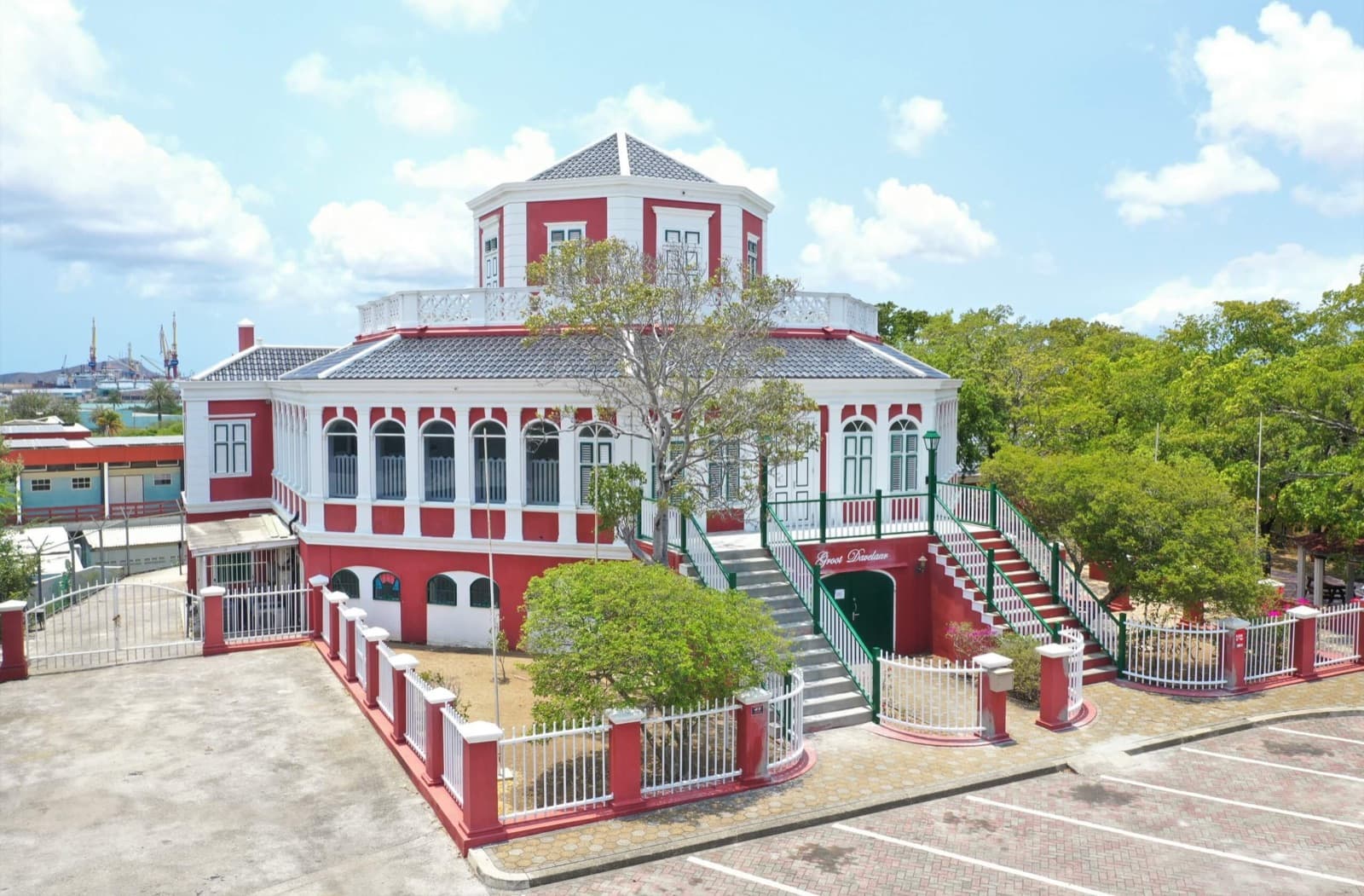
Groot Davelaar stands out architecturally among Curaçao's landhuizen for one striking reason: an octagonal core surrounded by a gallery, with another gallery wrapping three sides beyond. Small extensions on the north and south sides, with a further north extension, give the whole house the footprint of a lowercase 'b' from above. On the upper floor, under an eight-sided pyramid roof, an octagonal room with a balustrade crowns the entire composition. And unlike every other landhuis on the island, Groot Davelaar still has its name painted across the facade — a small architectural defiance of Curaçao's usual understatement. The origin stories dance. One legend claims the house was built around 1865 for the exiled revolutionary Antonio Guzmán Blanco — later President of Venezuela — as a private retreat during his time on the island. The more credible version, backed by records, places construction in 1873-1874 on the orders of Juan R. Blanch. The surname Davelaar (from a family that also named the neighbouring Klein Davelaar) gave the estate its lasting name. The romantic Venezuelan-president origin story persists, though, because nineteenth-century Curaçao really did shelter political exiles from across Latin America, and because the octagonal core looks exactly like the kind of architectural ambition a would-be president might commission. Whatever its origins, Groot Davelaar today is privately owned. The grounds are immaculate; the painted name on the facade remains legible; the octagonal upper room, just visible from the ascending approach road, is a small architectural secret you can keep spotting on repeat visits.

💡 Tip: Slow drive past in good light. The octagonal upper room under the pyramid roof is the visual signature — photograph from the approach angle where the whole eight-sided geometry is clearest.

Landhuis Groot Kwartier — First Windmills, Colonial Cannons, and Citrus

Landhuis Groot Kwartier — First Windmills, Colonial Cannons, and Citrus

Groot Kwartier — also historically called Rustenburg — was founded in 1694 and sits among the oldest continuously-recognised plantations on Curaçao. The house you see today, with its columned front supported by ten pillars and its mix of saddle and hipped roofs, has been extended and modified for over three centuries. Originally U-shaped and single-storey with the entrance on the west side, it was later raised a floor, had its patio built over, and the main entrance moved to the east. Over the years the house has worn ochre-yellow, red, and grey coats — each repaint a small archaeological layer. The plantation's reach was exceptional for its time. Maize grew in its fields; an orangerie sheltered citrus trees; banana groves and dividivi cultivation ran the slopes; salt was extracted; and a large herd of livestock grazed the hills. Groot Kwartier supplied its neighbourhood with water and — notably — supplied the Blue Curaçao distillers on Chobolobo with citrus peels for their liqueur. It was also the first plantation on Curaçao to install windmills, both at the wells and for grinding maize into meal. In the garden, cannons stand from 17 February 1804 — the day Curaçao's own citizens, marines, and gunners repelled a British invasion, and a decisive factor in the English leaving the island two weeks later. A full renovation in 2011 restored the house comprehensively, including the single preserved grave in the garden (others had to be moved when the access road was built). The cannons are still in the garden, pointed, improbably, at nothing now but the trees.

💡 Tip: The garden cannons from the 1804 defence are a worthwhile detail if the estate is accessible. A rare piece of Curaçao's military history preserved in situ rather than in a museum.

Landhuis Groot Piscadera — 308 Hectares, Mixed Crops, Still Standing

Plantage Groot Piscadera was originally 308 hectares and belonged to the larger plantations on the island. The fields grew maize, beans, and sugarcane. Indigo was cultivated for its blue dye, dividivi for its tannin-yielding pods. Livestock — cattle, sheep, goats — ran the surrounding terrain. This was a full-spectrum plantation rather than a specialist in any one commodity, and the mix of activities suggests an owner who preferred diversification to ambition. The landhuis has a core with a saddle roof, three dormer windows on the front and two on the rear. Galleries under lean-to roofs run along both long sides of the house — the classic Curaçao 18th-/19th-century configuration. Nothing flashy, nothing unusual, but well-built and solidly preserved. Groot Piscadera sits in the western suburbs of Willemstad, near De Savaan and Klein Piscadera (which, despite the name, is smaller). The area has been developed extensively over the last half-century, and the original plantation footprint is fragmented across modern neighbourhoods. But the landhuis itself survives, a 300-hectare ambition from another era persisting into a 21st-century suburb.

💡 Tip: Drive past on the way to the western beaches. The gallery-on-both-sides silhouette is textbook Curaçao landhuis architecture — a useful reference point for the more unusual ones you'll see elsewhere.

Landhuis Groot Santa Martha — Salt, Cattle, Community

Landhuis Groot Santa Martha — Salt, Cattle, Community

Groot Santa Martha — also known historically as Groot Sint Marten — was likely founded between 1670 and 1690, making it one of the older continuously-recognised estates on Curaçao's western coast. The landhuis dates from the same era; the large portico that now closes the patio is twentieth-century, with an image of Saint Martha carved into its fronton. For most of its history Groot Santa Martha was a salt plantation, particularly after David Dovale laid out new salt pans in Santa Martha Bay in the first half of the nineteenth century. Gerard Henri van der Linde Schotborgh, co-owner from 1914, was a planter to his core and lived in the landhuis. Financial pressure forced the sale to Jan Ernst van der Dijs in 1933, who also took up residence. Under his stewardship Santa Martha became a productive cattle farm, supplying Willemstad with milk, cheese, butter, and slaughter beef; the orchards yielded fruit and sorghum was grown for household use. When costs outran income, the plantation was sold to the government in 1952. After a thorough restoration of the landhuis and mangasinas in the early 1970s, the estate became home to Tayer Sosial Santa Martha — a sheltered workshop for people with physical and intellectual disabilities. Today the grounds produce leather goods (tanned on-site from goat skin), restored furniture, and other crafts; part of the landhuis functions as a small museum. It is one of Curaçao's most quietly moving reinventions of a colonial estate.

💡 Tip: The leather shop is the highlight — buy something here rather than at the airport. It directly funds the Tayer Sosial's work and the craftsmanship is genuinely excellent.

Landhuis Groot Sint Joris — 130 Years in One Family, a View Over the Bay

Landhuis Groot Sint Joris — also called Chinchó — carries one of the most elegant facades among the larger Curaçao estates: a distinctive semi-circular gable topped with palmette ornamentation. Beneath it sits an 18th-century marble slab depicting King David playing the harp, inscribed SCHOON GESIGT ('beautiful view'). The slab was likely placed by one of the estate's former Jewish owners. Groot Sint Joris has been in the hands of the Perret Gentil family for over 130 years. Casper Perret Gentil bought the plantation in 1884; his son Federico, grandfather of the current resident, took over in 1921. Five years later Federico sold the estate to Shell, who wanted to extract groundwater for the oil refinery at Isla. The family stayed as tenants of Shell, and continued farming and cattle-raising on the leased land until 1962. The estate was rich in laraha orange trees — the bitter oranges whose peels were dried on the plaza in front of the landhuis and sold to the Blue Curaçao distillery at Chobolobo. When Shell withdrew in 1985 the house passed to the Eilandgebied Curaçao. Though the front facade still looks striking, years of deferred maintenance have made the landhuis uninhabitable; the family lives in one of the outbuildings. The view from the rear terrace, however, remains spectacular. Sint Jorisbaai stretches below, and on a clear day Bonaire is visible on the horizon. It is one of the best vantage points on the island, from a landhuis that has seen three and a half centuries of change.

💡 Tip: Not publicly open but the back terrace view is worth asking about — the family has historically been welcoming to curious visitors who approach respectfully.

Landhuis Groot Sint Michiel — Bigger Plantation, Smaller Landhuis

The name is a slight misdirection. Though 'Groot' (big) in the plantation's title might suggest a grander house, Groot Sint Michiel's landhuis is actually smaller than that of neighbouring Klein Sint Michiel. The 'Groot' refers to the land area — 255 hectares — not to the building itself. Plantation naming conventions on Curaçao were often practical-descriptive rather than architecturally consistent, and Groot Sint Michiel is a case study in what that produces. The current landhuis was built around 1900, on the foundations of the original plantation house. Its form diverges noticeably from all other landhuizen on the island. A wide core block carries a saddle roof; a second, narrower block attaches to it along the same axis, also under a saddle roof. There are no galleries — unusual for Curaçao, where the gallery is almost a defining architectural element. The plantation itself served primarily as a buitenverblijf (country retreat). Two burial grounds were established on the estate: one in the east for the owner's family, and another beside the road for the enslaved people who had worked here. The second burial ground speaks, as it did at dozens of other plantations, to a history the island is still grappling with publicly. Plantation Groot Sint Michiel's landhuis stands at a distance from both, as a silent survivor of a history that extends far beyond its walls.

💡 Tip: The absence of galleries is the architectural curiosity — most Curaçao landhuizen have at least one gallery, often on all sides. Observe this directly to understand how much the gallery shapes what we think of as 'the landhuis look'.

Landhuis Grote Berg — The Big Mountain

Grote Berg — locally Seru Grandi, 'big mountain' in Papiamentu — is a two-storey landhuis with a hipped roof and one of the most architecturally distinctive facades on Curaçao. On every side of the building rises an unusually large triangular fronton, each carrying a dormer window. The consistency and scale of these frontons give Grote Berg a commanding presence: from any angle it looks intentional, imposing, symmetrical. The plantation worked primarily as a livestock operation. The landhuis's current use is uncertain. Its neighbours — Harmonie and Papaya — place it in the central western zone of the island. The combination of two-storey height and large frontons on every facade makes Grote Berg one of the more self-consciously designed landhuizen on the island. Most Curaçao plantation houses are pragmatic buildings first; Grote Berg is pragmatic second. The triangular frontons would have been visually striking from any approach road in an era before dense vegetation grew around the house. Even today, once you know what to look for, Grote Berg is unmistakable.

💡 Tip: The four large triangular frontons are the signature feature. Photograph from the ascending approach road — each elevation reads as a separate, balanced composition.

Landhuis Habaai — Baroque Elegance Turned Art Gallery

Landhuis Habaai — Baroque Elegance Turned Art Gallery

From 1651 Sephardic Jews from Amsterdam and Brazil began settling on Curaçao. The Dutch West India Company granted them land north of Schottegat, and plantations soon rose across the area — De Hoop, Bleinheim, Marchena, Welgelegen. For much of the following century and a half this part of the island was known as the Jodenkwartier (Jewish Quarter), and Habaai — originally called Welgelegen — was one of its flagship estates. The current name comes from the Gabay Henriquez family, owners from 1771, whose surname was slurred into 'Habaai' over generations. The baroque landhuis dates from the mid-eighteenth century, as the flamboyant curved gables reveal. Two storeys tall, with galleries running along the front and back and a large attic above, Habaai is one of the best-preserved examples of Curaçao's baroque plantation architecture. The original kitchen has been lost to time, but the rest survives. Habaai was among the first landhuizen to be given a second life. In 1864 the Franciscan sisters from Roosendaal bought it to open a boarding school for daughters of prosperous Curaçaoan and South American families. When a new building was erected for the school in 1867, Habaai became an orphanage; early in the twentieth century it housed a straw-hat weaving school — at one point nearly a fifth of the island's population earned income weaving Habaai's hats. After decades of religious and residential use, the estate became a retreat centre in the 1960s and then declined. Since 2005 it has housed Gallery Alma Blou — today one of Curaçao's most vibrant contemporary art spaces, showing rotating exhibitions of local and international artists.

💡 Tip: Exhibitions rotate roughly every six weeks. Check Gallery Alma Blou's schedule before you visit — the best openings are on Sunday afternoons and the landhuis garden hosts live music.

Landhuis Hato — The Airport's Forgotten Origin

Landhuis Hato — The Airport's Forgotten Origin

Most visitors passing through Curaçao International Airport have no idea that its grounds were once an 18th-century cattle plantation with a famous freshwater spring. Landhuis Hato sits just north of the runway today, a quiet reminder of what the site was before 1929. Until 1696 Hato was a government cattle estate that also grew food for the enslaved population; it doubled as a private retreat for directors of the Dutch West India Company. In the 19th century it pivoted into hospitality — one of Curaçao's earliest. Newspaper ads from 1843 by Michael Römer invited 'invalids and other visitors' to enjoy the freshwater pools, the cool shade of the orchard, and the 'beautiful gentleman's house' for multi-day luxury stays at $1.50 per day, meals included. Two decades later Frederik Pierre was still advertising the 'crystalline brook' and the restorative value of the spring-fed baths. Hato's transformation came in 1929, when the government decided to lay out the island's future airport across the plantation's fields. Later, the singing greengrocer Rudy Plaate farmed vegetables here for years, selling them first near Bloemhof and later at Zuikertuintje. In 2014 enterprising tenants planted a small vineyard and opened a bed & breakfast in the landhuis, but Curaçao Airport Holding ended the contract in 2016. The landhuis still stands — one of the few places on the island where you can see a working 18th-century plantation complex and a 21st-century international airport in a single glance.

💡 Tip: Best seen from the airport perimeter road just after landing. If you're picking someone up and have time, drive around the west side — you'll catch the landhuis just past the old terminal buildings.

Landhuis Hel — Paradise Named Hell, Across From Purgatory

Landhuis Hel carries one of the most surreal names on Curaçao's landhuis map. The estate's alternative names — Paradijs (Paradise), Tevredenheid (Contentment), Onverwachts (Unexpected) — suggest a long-standing semantic game, as does the fact that directly opposite it once stood Plantage Vagevuur (Purgatory). Whether the cluster was deliberately theological or just the product of successive owners naming their estates with dark humour is unclear. Either way, Paradijs, Vagevuur, and Hel once sat in a row, a kind of 18th-century three-act afterlife in the Curaçao countryside. Late 18th-century landhuis, architecturally distinguished. The core carries a hipped roof with dormer windows on all sides, with lean-to-roofed galleries wrapping every elevation. The approach stairway to the terrace features beautiful volutes at its base — elegant architectural flourishes that lift Hel above the common plantation house aesthetic. Originally an 18th-century plantation called Backer, part of it split off as Lesch den Dorst (Quench the Thirst — continuing the semantic riff), while the main plantation took the name Hel. In 1778 the Dutch war frigate Alphen exploded in Willemstad harbour — reportedly because a sailor walked into the powder magazine with a lit cigar, one of the island's worst historical disasters. Over 200 on board died, plus 50 ashore. Debris from the blast reportedly reached all the way to Landhuis Hel — kilometres inland. The crater is now history, but the landhuis's role as a marker of how far the shockwave travelled has passed into local memory.

💡 Tip: The volute detail at the base of the terrace stairway is what architectural historians quietly rate most highly at Hel. Worth a look if you can approach the entrance.

Landhuis Hermanus — Salt, Revolt, and a Quiet Weekend House

Landhuis Hermanus — Salt, Revolt, and a Quiet Weekend House

Along the road to Willibrordus, an old boundary post bears the names of two neighbouring plantations — Hermanus and Meiberg — in vintage lettering, restored in 2018 by Rensly Simon and finished by Herman Verboom and François van der Hoeven. The two estates shared ownership for almost all their recorded history. One of the earliest owners was Hermanus Storck, which is how the landhuis got its name. Like Jan Kok to the north, Hermanus was a salt plantation. Its owners relied on a large enslaved workforce until emancipation in 1863. During the 1795 uprising — the revolt led by Tula at Kenepa — one of Tula's co-leaders, Louis Mercier, ordered the original house at Hermanus set on fire. The current two-storey building, with a hipped roof and an unbroken cornice line running around the structure, is characteristic of second-half-nineteenth-century Curaçao architecture. A wing set perpendicular to the main block, with more traditional galleries, is likely older. Shell came calling in 1928, interested in both Hermanus and Meiberg because of their seaside location — perfect for an oil product export facility. In the end only Meiberg changed hands; Hermanus remained private. The current owners use it as a weekend retreat. Where cattle, sheep, and goats once grazed in the surrounding kraals, geese and peacocks now walk. The quiet contrast between the landhuis's past as a salt-extraction operation worked by enslaved people and its present as a peaceful private getaway is one of the harder things to reconcile on Curaçao.

💡 Tip: Private residence — observe from the roadside only. The restored boundary post near Willibrordus is a worthy photographic stop, a small act of historical preservation with visible results.

Landhuis Jan Kok — Flamingos, Salt, and Sunset

Landhuis Jan Kok — Flamingos, Salt, and Sunset

The plantation takes its name from a slurring of Dutch to Papiamentu: Adriaan Kock, a master mason and one of the island's earliest colonists, built the first house here around 1705. 'Adriaan' blurred to 'Arrian' and finally to 'Jan' — so when the traveller M.D. Teenstra wrote about it in 1836, he called it 'Plantaadje Arrienkok'. The formal name was originally Zevenhuizen, probably because it was the seventh house established on the south-western coast, after Oud Sint Marie (now Hermanus), Nieuw Sint Marie (now Rif), Malpais, Sint Joris (later Siberie), San Sebastiaan, and Port Marie. Adriaan's original house was already a ruin by 1784, likely destroyed by fire — only the seventeenth-century mangasina and cellar survived. The plantation itself carried on as a salt operation, particularly after 1832 when demand for Curaçao salt peaked. By the mid-nineteenth century eleven hectares of salt pans stretched out below the landhuis. Today those same pans are the feeding ground for flamingos that fly in from Bonaire — a tourist attraction in their own right, and arguably Jan Kok's most photographed feature. The current landhuis sits on a high terrace overlooking the pans, with galleries on both flanks. It was built in the mid-nineteenth century by Carel Zacharias de Haseth on the foundations of Adriaan's ruined house. In 1948 the veterinarian Max Diemont bought the then-derelict property from the government and, through the 1960s, restored it almost single-handedly with advice from architect Serge Alexeenko. He turned it into a popular nightspot with a museum, wine cellar, and outdoor dance floor. Diemont also bought the salt pans themselves in 1965, insisting that pans and landhuis belonged together. Since 1999 Stichting Monumentenzorg has owned the whole estate. The late Curaçaoan artist Nena Sanchez kept her studio and gallery here for years, and today the landhuis operates as a restaurant with a terrace that looks out over the pink reflections of the salt pans at sunset. Krioyo home cooking is the menu; the flamingos walking the flats at dusk are the show.

💡 Tip: Reserve a table for around 5 PM. The sunset over the flamingos and the pink-tinted salt pans is one of Curaçao's quiet great moments — and you'll want time to linger over dinner rather than rushing.

Landhuis Jan Sofat — Four Centuries, Three Name Corruptions

The name Jan Sofat is the end point of a 300-year linguistic drift. In 1715 Jan Houtvat bought the plantation Uylenburg from the West India Company. The estate soon became known as Jan Zoutvat (zout = salt, though the estate never ran as a salt plantation — likely a transcription error that stuck). Over generations Zoutvat corrupted further into Sofat, and that is what the plantation has been called for the past two centuries. Name-drift like this is characteristic of Curaçao, where Dutch, Papiamentu, Spanish, and spoken colonial vernacular have all layered onto each other over four hundred years. The plantation was primarily a maize farm in its working centuries; cotton was added later. The original landhuis no longer exists. The current building stands on its foundations and is reported to reproduce its form, but it is a reconstruction rather than a continuation — an honest statement from the cultural heritage records that many Curaçao landhuizen don't make. The current landhuis has a core with a hipped roof and dormer windows on three sides. Galleries with lean-to roofs run along all four elevations. Recent renovations have added extensions. It sits near Brakkeput Ariba and Brakkeput Mei Mei, a cluster of estates in the south-east that between them tell the story of old plantation subdivision, name corruption, and architectural reconstruction.

💡 Tip: The original landhuis no longer exists — what you see is an honest reconstruction on original foundations. A useful reminder that 'restored' and 'rebuilt' are not the same thing in Curaçao's landhuis catalogue.

Landhuis Jan Thiel — From Salt Pans to Resort District

Landhuis Jan Thiel — From Salt Pans to Resort District

The man who turned Jan Thiel into the resort and beach district it is today was Casper Arturo Perret Gentil — known locally as shon Tutu. In 1915 he bought the roughly 400-hectare estate, including its landhuis, from the heirs of David Vidal. He expanded the existing eighteenth-century salt pans and in 1924 founded the seaside resort Vista Alegre at Jan Thiel bay: a wooden hotel, bathhouse, and five rental cottages, with paid entry and weekend musical performances — one of Curaçao's earliest organised leisure venues. The plantation was originally called Damasco, but the salt pans and landhuis quickly took the name of the earliest known owner, Jan Thielen (early 18th century). His descendants sold in 1737 to Moses Penso, and the plantation changed hands many times before settling into productive salt production. In the eighteenth century some 40 enslaved people worked the salt harvest, cultivated sorghum, indigo, and vegetables, and tended a substantial herd. In 1816 the inventory still listed '15 bags of Cotton Beans'. The current landhuis likely dates to the mid-eighteenth century — building materials were already on-site in 1752. The Perret Gentil family moved in during 1929, modernising the house with a bathroom and other conveniences. In the 1970s shon Tutu began subdividing the estate for the Vista Royal development, then sold the remainder — including the landhuis — to the pension fund APNA. After passing through Monumentenzorg and a 1997 restoration by architect Norbert Broos (sponsored by lawyer Leo Spigt's lease agreement), the complex opened as a boutique hotel. Today it operates as Plantation Jan Thiel Lodge, a bed & breakfast with the original cattle stable, corrals, and milking area all preserved.

💡 Tip: The breakfast terrace at the Lodge is the closest you'll get to how a plantation family would have lived — worth booking a night if the pace of the main resort side of Jan Thiel feels too hectic.

Landhuis Janwe — A Quieter Entry in the Catalogue

Janwe — historically also Klein Zuurzak and Goed Begin — is a smaller landhuis in the eastern rural zone of Curaçao. The estate's specific founding date, early ownership, and economic activities are among the items still being worked out by ongoing research into Curaçao's 78 intact landhuizen. It stands on its foundations, architecturally unadorned, waiting for its fuller archival story to be written. Like many quieter landhuizen, Janwe's survival has depended more on persistence than celebrity. Its neighbours in the landscape connect it to the eastern cluster of plantation estates that together shaped the agricultural and livestock economy of that side of the island. If later archaeological or archive work emerges, this entry will grow; for now it is part of the complete list of 78 and that in itself is the story worth telling.

💡 Tip: For visitors interested in the 'lesser-known' landhuizen of Curaçao, Janwe represents the midsize estates that survive without fanfare — worth knowing for the pattern, not the specific drama.

Landhuis Joonchi — Eastern Rural Curaçao

Joonchi is a lesser-documented landhuis in the eastern zone of Curaçao. It sits within the network of 78 intact estates that together make up the formal catalogue, but detailed archival work on its specific history is still incomplete. What the broader historical context tells us about Joonchi is that the eastern rural landhuizen typically combined modest agricultural activities (goat herding, small-scale cultivation) with the role of country retreat. That pattern is likely to describe Joonchi too, pending confirmation from deeper archive work. The building stands; its neighbours place it in a cluster of similarly-sized plantations; its story is partial but its place on the list is secure. For visitors who collect landhuizen like birdwatchers collect sightings, Joonchi is one of the entries that rewards the complete-list impulse rather than the highlight-reel approach.

💡 Tip: Like several eastern Curaçao landhuizen, Joonchi is better seen as part of a driving tour of the area than as a destination in itself. The pattern emerges from the accumulation.

Landhuis Kas Chikitu — 'Little House' on the Eastern Side

Kas Chikitu — Papiamentu for 'little house' — lives up to its name. It is one of the smallest landhuizen in the catalogue, a modest building on a modest plot on the eastern side of Curaçao. The Papiamentu name is a reminder that not every estate inherited a Dutch or Spanish designation; sometimes the vernacular simply stuck. Detailed historical research on Kas Chikitu's founding, ownership, and economic activities remains to be completed. What can be said is that the small eastern landhuizen tended to function as modest country retreats for city residents rather than as significant agricultural operations — the landscape and scale didn't support the latter. The building is part of the 78-item catalogue because its architectural form and location document a particular layer of how colonial-era Curaçaoans organised the countryside. Its presence on the list is the story, even when the detail is pending.

💡 Tip: Combine with other small eastern landhuizen in a single driving circuit — the pattern of small country retreats across this side of the island becomes clear when seen as a sequence.

Landhuis Klein Bloemhof — The Smaller Bloemhof

Klein Bloemhof — 'small Bloemhof' — is the lesser-known companion to Landhuis Bloemhof, the more famous cultural centre and sculpture garden a short distance away. Historically the two estates had related ownership and operated in connection with each other, though not as a single plantation. Both drew on the same water-rich microclimate that made the Bloemhof name valuable and attractive for country-house use. Klein Bloemhof is a smaller property with a modest landhuis. Its specific architectural features, founding date, and detailed ownership sequence are among the items still being worked out by ongoing cultural heritage research. What is known is its place in the 78-landhuis catalogue, its neighbourhood adjacency to Bloemhof, and its role as a quieter eastern-peripheral-Willemstad country retreat. For visitors already touring the main Bloemhof with its art exhibitions and Cathedral of Thorns, Klein Bloemhof is worth at least a drive-past to see the smaller sibling in the same broader landscape context.

💡 Tip: Visit alongside the main Bloemhof (cultural centre) — seeing both together makes the scale difference and the shared microclimate context more legible.

Landhuis Klein Kwartier — Laraha Oranges and a Literary Childhood

Klein Kwartier is a small landhuis with an outsized footprint on Curaçao's cultural history. Around 1900 it was a major laraha plantation — roughly a thousand bitter-orange trees — owned by the Senior family, pharmacists who distilled the peels into Blue Curaçao behind their Botica Excelsior on Heerenstraat (see Chobolobo). In 1927 the government bought the estate to house the Landswatervoorzieningsdienst (Island Water Supply Service). Director Richard 'Hensey' Beaujon lived in the landhuis with his family. Among the laraha trees in the 1920s and 30s, two boys played and later changed Curaçao: his son Jan Jacob 'Ipa' Beaujon, who went on to govern the Netherlands Windward Islands, and the writer Boelie van Leeuwen, son of the district master. Both of them swam in the dams of Klein Kwartier in the rainy season — an evocative image for anyone who knows Boelie van Leeuwen's later novels, where water and memory run together. Later the government medical officers were stationed at the landhuis. In 1965 the Eilandgebied transferred it to Stichting Monumentenzorg, which leased it to Donny Bakhuis. A subsequent restoration cost the landhuis some of its historical character: the original roof and three dormer windows vanished. Since 2012 the Curaçao Lions Club has rented the estate for its meetings and rents the house and its grounds for parties and events — the large garden and rear terrace make an elegant setting. Klein Kwartier has become, quietly, a place where the island's civic life still plays out.

💡 Tip: Available for private event rental — if you are planning a wedding, milestone birthday, or small conference on Curaçao, this is one of the more atmospheric choices on the island.

Landhuis Klein Santa Martha — Salt, Revolt, Boutique Hotel

Landhuis Klein Santa Martha — Salt, Revolt, Boutique Hotel

Aron Levi Maduro, one of the first Sephardic Jewish settlers on Curaçao, owned Klein Santa Martha in 1698. Sugarcane grew on the grounds then, alongside dividivi trees whose pods yielded tannin for leather. The plantation prospered. By 1819, under Matthias Schotborgh, it ran on the labour of 99 enslaved people — some tending sheep, cattle, donkeys, or poultry; others sent to work in the city as cook's apprentices or saleswomen. Together with Groot Santa Martha and San Nicolas, Klein Santa Martha drew its wealth from the salt pans of Santa Martha Bay. The plantation made uglier headlines during the 1795 slave revolt. The Dutch tutor Sabel, the only white person at Klein Santa Martha when the uprising reached the estate, was seized by the rebels. Under the leadership of Pedro Wacao, they tied him behind a horse and dragged him to Fontein, where he was killed. The incident is one of many that make the history of these estates difficult to tell without flinching. The government took over Klein Santa Martha in 1937. Dutch farmer Wietse de Vries moved into the landhuis to help promote modern agriculture and cattle-raising — part of former governor Oscar Helfrich's rural development plan. Farmers could settle in a purpose-built village, Helfrichdorp, to learn the trade. The project ultimately failed. By 1954 the landhuis was proposed for sale. It weathered decades of decline, brief stretches as a holiday camp, a family's occupation, then squatters. By the time the government transferred it to Monumentenzorg in 1995 it was a skeleton. Finally in 2012 a full restoration began. Two years later Klein Santa Martha reopened as a boutique hotel, with the restoration led by architects Anko van der Woude and Cas Aalbers — returning the landhuis, at last, to habitable life.

💡 Tip: Book a night at the boutique hotel if you want to stay somewhere with actual historical weight. The rooms in the restored mangasinas have an atmosphere the beach resorts can't touch.

Landhuis Klein Sint Joris — Hanging Balcony, Pyramid Tower

Landhuis Klein Sint Joris — Hanging Balcony, Pyramid Tower

Known locally as Chenchó Chiki, Klein Sint Joris is one of the oldest plantations on Curaçao, with land first brought into cultivation in 1635 and the full plantation established in the mid-17th century. Livestock, small-scale agriculture, and — unusually — sugarcane all grew here. Sugar cultivation was rare on Curaçao; the dry climate did not favour it, but some estates persisted into the 19th century. Klein Sint Joris was one of them. The landhuis dates from the late 18th century and has several distinctive features. The saddle roof carries four dormer windows on one side and two on the other — an asymmetrical arrangement that's rare on the island. It is one of the very few Curaçao landhuizen with a hanging balcony — a small architectural luxury. A few metres from the main house stands a square tower with a pyramid roof whose original function remains unclear; similar towers on larger estates served as dovecotes or lookout posts, but its exact role here is undocumented. The house has been modified visibly over the years — different additions and interventions have left a legible archaeological layering. The surrounding landscape is still agricultural in character, with traces of the original plantation footprint visible in the placement of outbuildings and boundary walls. It is a quieter entry in the landhuizen catalogue, but the combination of early foundation date (1635), hanging balcony, and mysterious pyramid tower makes Klein Sint Joris architecturally more curious than its low profile suggests.

💡 Tip: The hanging balcony and the pyramid-roofed tower are the architectural signatures. Both are visible from the approach road — worth a slow drive-by.

Landhuis Klein Sint Michiel — Saint Michael and the Dragon

Landhuis Klein Sint Michiel — Saint Michael and the Dragon

Above the main entrance of Landhuis Klein Sint Michiel, carved or mounted as an image, the archangel Michael battles a dragon. This is the kind of explicit iconographic statement you rarely find on a Curaçao landhuis — most restrict themselves to a single family crest or an inscribed date. The image makes the house's namesake instantly clear. Klein Sint Michiel was a 185-hectare salt plantation, part of the south-coast cluster that worked the salt pans of Sint Michiel Bay. The plantation's economic core was salt production, supplemented in the 20th century by cattle raising. Where Groot Sint Michiel across the peninsula was larger in landholding (the 'groot' refers to the extent of land, not the building), the landhuis here at Klein Sint Michiel is actually the larger and more architecturally assertive of the two. The current building was rebuilt in 1862 on earlier foundations. It consists of two adjoining blocks — one longer than the other — each with its own saddle roof and dormer windows. A gallery runs along the south side, catching the coastal breeze. The alternative historical names Jan Doret and Jan Dorst attach a long-forgotten owner's identity to the place. Klein Sint Michiel sits today in the landscape it has always occupied, its salt pans long quiet, the fight between Michael and the dragon still being waged above the front door.

💡 Tip: The Saint Michael and dragon image above the front door is the detail to photograph — ask respectfully if the current owner allows visitors to approach the entrance.

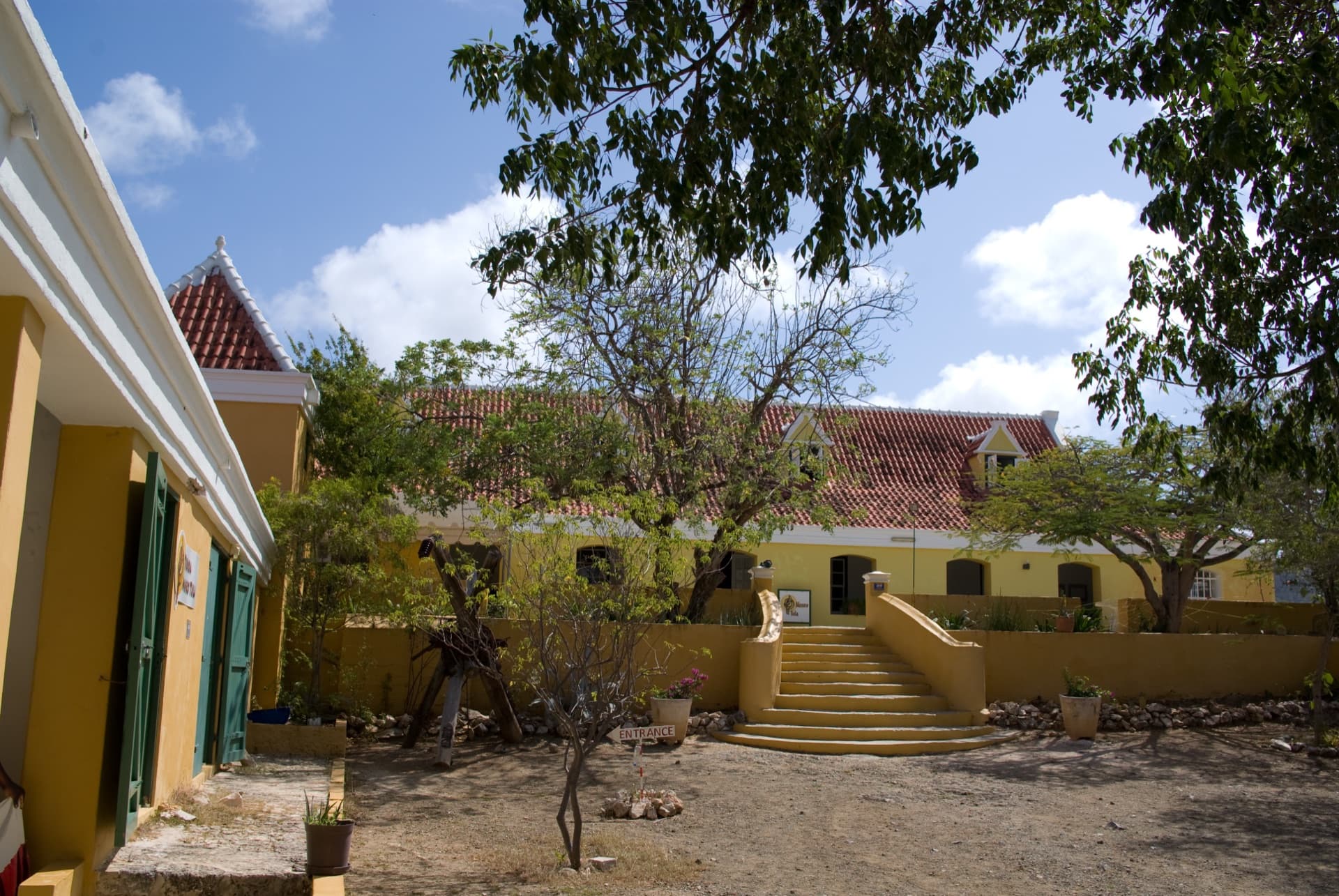
Landhuis Kenepa (Knip) — Where the Revolt Began

Landhuis Kenepa (Knip) — Where the Revolt Began

Among all of Curaçao's plantation houses, Landhuis Kenepa — locally Knip — carries the heaviest history. Here, on 17 August 1795, an enslaved man named Tula led the largest slave uprising in the Dutch Caribbean, a six-week revolt that shook the colonial order to its core and is now commemorated annually as Curaçao's Day of the Struggle for Freedom. The plantation itself is far older. Records of its sale date to 1693, with rights to graze an unlimited herd of cattle across its hills — a use that would define it for three centuries. The current landhuis bears 1830 in its gable, suggesting the main building dates from that year or was extensively rebuilt then. By the early twentieth century Knip was still home to hundreds of goats grazing the now-empty corrals. A 1832 probate inventory reveals the other side of plantation life: the house of owner Jannetje van der Meulen was fitted with mahogany furniture, paintings, curios, and mirrors, while the plantation ran on the labour of 128 enslaved Africans and one person of mixed heritage. The grounds still hold traces of this past — eighteenth-century indigo vats (discovered in 2014 by the Werkgroep Archeologie), an old inloopput (walk-in well), and consolidated boundary stones restored in 2018 with support of the Prins Bernhard Cultuurfonds Caribisch Gebied. The Muskus family brought life back to the house in the early twentieth century, using it as a weekend retreat and restoring it in 1939. Since 1998 the landhuis has housed the Museo Tula, with permanent exhibitions on slavery, Tula's revolt, and Afro-Curaçaoan heritage. On the first floor, a long list details the punishments — from lashings to days of confinement — that enslaved people could expect for specific infractions. It is heavy material, but essential for understanding the island's story.

💡 Tip: Combine a visit to the Tula Museum at Kenepa with a stop at Grote Knip beach, a short walk downhill. The contrast between the plantation's history and the beach's beauty is one of Curaçao's most striking juxtapositions.

Landhuis Koningsplein — 1650 in an Inside Wall

Landhuis Koningsplein — 1650 in an Inside Wall

Plantage Koningsplein likely dates back to the 17th century. During work on the original landhuis, the year 1650 emerged on an inside wall — a single inscription that pushed the estate's known history back by decades. That would make Koningsplein one of the oldest datable structures on the island. The plantation was small (35 hectares) and the landhuis was used primarily as a country retreat rather than an agricultural operation. The building itself is architecturally unusual. It consists of three blocks attached along their long sides, with the middle block rising slightly higher than the flanking outer blocks. All three have saddle roofs. The middle block is probably the oldest, betrayed by its dormer windows — which look outward over the roofs of the outer blocks, an uncommon and slightly awkward arrangement that reveals the building's layered construction history. The outer blocks have additional cornice mouldings on their short sides. The property sits in the central-south area of the island, with nearby landhuizen Meerwijk and Pos Cabai. Its current use is uncertain, but the building survives — 1650 in an inside wall, still there for anyone who knows where to look.

💡 Tip: The 1650 inscription on an inside wall is what makes Koningsplein historically remarkable. Worth asking on any scheduled tour if you can see it — it is one of the oldest dated architectural features on Curaçao.

Landhuis Koraal Tabak — Tobacco, Drag Races, a Gated Future

Landhuis Koraal Tabak — Tobacco, Drag Races, a Gated Future

Around 1700 Koraal Tabak — 'coral tobacco' — was one of the major West India Company plantations on Curaçao. As the name suggests, tobacco was grown here. In 1636 the WIC director reported to the Heren XIX in Amsterdam that the 'toeback saet in onse tuijn van Chinchorro' (tobacco seed in our garden at Chinchorro) produced disappointingly little. He probably meant Sint Joris, which lies just east of Koraal Tabak. The 19th-century landhuis consists of two blocks with a spacious hall in the front section. A kitchen and other additions sit behind. The house stands on a small rise, giving it a fine view. Two large mangasinas and cattle corrals once stood beside it; these have unfortunately been bulldozed. Mid-20th century the Bakhuis family bought the plantation. In 1963 Hugo Bakhuis opened Wonderful Beach on the Sint Joris Bay side — a recreation centre with weekend cottages, horse trails, football and volleyball pitches. The landhuis housed a restaurant. Bakhuis, nicknamed Mr Wonderful, even ran a special bus line from Punda to the beach. The operation closed after two years. But the plantation's north-coast plain continued hosting drag races (short car races) for decades. Until recently, diabaas — a volcanic stone — was quarried on the grounds, and rubbish was dumped there too. Koraal Tabak has recently been sold to investors interested in restoring the landhuis. What comes next is anyone's guess, but the site has more lives in it yet.

💡 Tip: Access depends on the new owners' plans. Worth asking at the tourist info for current status — the view toward Sint Joris Bay from the hill is worth the trip if the estate is accessible.

Landhuis Morgenster — Political Party HQ to Artist's Atelier

Landhuis Morgenster — Political Party HQ to Artist's Atelier

Landhuis Morgenster — 'Morning Star' — was originally a buitenverblijf, a country retreat rather than a working plantation. The asymmetric front — gallery deeper on one side than the other — gives it an immediately distinctive silhouette. A saddle roof with two dormer windows on each side crowns the house, and the front facade reads like a small architectural joke about symmetry, noting the rule by breaking it. For a long stretch of the 20th century Morgenster served as the headquarters of a political party — one of the unusual uses to which Curaçao's smaller landhuizen have been put as the plantation economy faded. Political offices, teachers' unions, children's homes, retirement homes, restaurants, art galleries, boutique hotels: the shift from agriculture to service and cultural use is not about losing the landhuizen but about finding them new roles, and Morgenster is part of that story. The estate was fully restored a few years ago and now houses the gallery and atelier of the current owner-artist. Research into its deeper history — the foundational owners, exact construction date, and early uses — is still ongoing. What is certain is that the house has survived into what seems like its most enjoyable current iteration: an asymmetric morning-star of a building, painted white and open for the making and showing of art, just off the road between the centre and Jan Thiel.

💡 Tip: Check with the current owner about atelier viewing days. This is one of the landhuizen where you can meet a working artist and walk out with an original piece — an experience unlike any other on the island.

Landhuis Mount Pleasant (Malpais) — Sisal Gamble, Baroque Gables

Landhuis Mount Pleasant (Malpais) — Sisal Gamble, Baroque Gables

The estate has gone by two names for two centuries. Originally Malpais — 'bad land' — a name that hardly inspires investment confidence. In 1810, twelve years after buying the plantation, owner Gerard Duyckink officially renamed it Mount Pleasant. The rebrand was understandable; the name stuck for a long time, though locals have drifted back to calling it Malpais today. Salt harvesting and livestock were Malpais's mainstays for most of its history. That changed in the early 20th century when 200 hectares were planted with sisal. By 1918 the Eerste Sisal Cultuur Maatschappij had a quarter of Malpais under sisal and had acquired a defibering machine. The Sisal Company was led by Gijsbert d'Aumale, Baron van Hardenbroek, who lived in neighbouring landhuis Papaya. Despite the initial enthusiasm, the enterprise went bankrupt in 1922. Shell bought the plantation in 1924. In 1943 Stichting Birgen di Rosario wanted — with Shell's blessing — to open an old-age home at Malpais, but the renovation costs were prohibitive; they settled on Santa Catharina instead, moving to Huize Welgelegen less than a year later. In the 1960s Dutch farmers ran the landhuis; Keijzer milk advertised fresh milk, butter, cheese, and yoghurt from Malpais. The 18th-century landhuis itself is architecturally remarkable: baroque side gables and five baroque dormer windows on the front facade. It was declared a protected monument two years ago. Currently owned by a Christian congregation, it briefly served as a children's home. A church building stands on the grounds. The mix of industrial gamble, livestock, religious use, and protected architectural gem is pure Curaçao.

💡 Tip: Drive by in late afternoon when the sun catches the five dormer windows of the baroque facade. The church building on the grounds is 20th-century and not part of the historical landhuis complex.

Landhuis Oost Jongbloed — Rebuild After the Fire

The original plantage Jongbloed — 90 hectares — was bought in 1727 by skipper Jan Jongbloed, who renamed the estate Boventuin to Jongbloed. In 1803 the plantation was plundered; the landhuis was burned down in the raid. For decades the plantation operated without a main residence. Eventually, well into the 19th century, a new landhuis was built on a different part of the estate — becoming known as Oost Jongbloed (East Jongbloed) because of its location. The original Jongbloed landhuis site is occupied today by a different building; some books and websites confusingly depict Oost Jongbloed as if it were the original Jongbloed. In this catalogue Oost Jongbloed is listed as a separate landhuis because that is historically accurate: it is not a restoration of Jongbloed, it is a successor structure on the same plantation. The late-19th-century Oost Jongbloed is small: just a core with a hipped roof. Around 1920 a short saddle-roofed transverse wing was added to the north. It is a modest, functional building. Together with its predecessor (the lost Jongbloed) and the surviving mangasina of the original estate (reportedly converted to a crèche and dwelling), Oost Jongbloed represents the full arc: founded in 1727, burned in 1803, rebuilt, repurposed, and still standing today.

💡 Tip: The distinction between the lost Jongbloed and the surviving Oost Jongbloed is easy to miss. Historical accuracy matters here — don't accept the misattribution in older guidebooks.

Landhuis Pannekoek — 175 Hectares and a Family Name

Pannekoek — yes, pancake in Dutch — is named after Gerrit Pannekoek, the first owner of this 175-hectare plantation, which had previously been part of the larger Klein Kolonie estate. The name is mundane; the plantation was not. At various times it ran tillage, livestock, and served as the residence of the fifth district's district master (Jan Jacob van Dam, from 1863) — when the roof tiles from neighbouring Dokterstuin were stripped and relocated here in 1864 to keep Pannekoek functional. The late 18th-century landhuis has a compact core with a saddle roof, wrapped on all four sides by a lean-to gallery. There are no dormer windows — a clean, relatively unadorned silhouette. The estate has been in government hands since 1913. Various public functions have rotated through over the last century, and the building remains standing in rural central Curaçao. The plantation's nearest neighbours are Groot Santa Martha and San Juan, both larger and more storied, but Pannekoek anchors its section of the inland countryside the way a reliable mid-sized landhuis does: not the attraction you drive to, but the one you pass on the way.

💡 Tip: Drive past when returning from Santa Cruz or Playa Jeremi — the pattern of this mid-scale 18th-century house with its 4-sided lean-to gallery is textbook Curaçao plantation architecture.

Landhuis Papaya — Small Plantation, One Surviving Tree

Papaya was a small plantation in the central west of Curaçao, a subdivision of the larger Malpais estate. It raised cattle and sheep, cultivated the fruit that gave it its name, and was known earlier as 'Wel te Vrede' ('Well Satisfied'). The 19th-century landhuis is modest — three small adjoining blocks, each with a hipped roof, and a single understated dormer window on the front. This was once the home of Gijsbert d'Aumale, Baron van Hardenbroek, director of the ambitious sisal-growing Eerste Sisal Cultuur Maatschappij that tried to plant 200 hectares of sisal across neighbouring Malpais before going bankrupt in 1922 (see: Mount Pleasant / Malpais). The baron lived at Papaya while his company gambled on sisal next door. One papaya tree still stands next to the landhuis — the last of the working orchard, a tree-sized archaeological trace. The house most recently served as a rehabilitation centre. Its current use is uncertain. Papaya is small, quiet, and a reminder that not every landhuis was grand: some were working kitchen-gardens with a modest house to match.

💡 Tip: The surviving papaya tree beside the landhuis is worth asking about if you visit — one living tree as the last trace of a centuries-old plantation.

Landhuis Parera — Salt Plantation Turned Guarded Retreat

Landhuis Parera derives its name from the Pareira family, one of its earliest owners. The estate operated first as a salt plantation — extracting salt from nearby pans — and by the mid-19th century had shifted to a modest livestock holding dominated by goats. Later still it transitioned into a buitenverblijf, a country retreat, as the plantation economy wound down and Willemstad merchants looked for cooler air away from the city. The landhuis dates from the end of the 18th century. The form is unusual for Curaçao: a long two-storey core with saddle roof, galleries running along both long sides of the lower floor, and a balustraded terrace wrapping a colonnaded open space. The house has been recently refurbished, giving it a more finished appearance than the 1978 and 2011 archival photographs would suggest. Access is controlled through a guarded entrance gate, a modern security reality that limits casual visits. The landhuis sits near Arrarat to the east and Hel to the west — unusual neighbours that frame it within one of Curaçao's more concentrated clusters of historical country houses, just inside the south-coast suburbs of Willemstad.

💡 Tip: Access by invitation or appointment only (guarded entrance). If you're interested in the architectural comparison between Parera and Arrarat, ask at local tour operators — some specialised walking tours visit both.

Landhuis Pos Cabai — Horse Well, 8 Hectares, U-Shaped

Pos Cabai translates as 'horse well' — the estate was named for the important water well on its grounds, which was apparently reserved for or associated with horses. Plantations on Curaçao often took their names from their most important feature, whether a tree (Papaya), a fruit (Kenepa), or a water source (Pos Cabai, Brakkeput). Water was precious, wells were infrastructure, and a well named for horses tells you something about how stock was valued. The plantation was small — just 8 hectares — and was soon used as a country retreat rather than a working agricultural operation. The landhuis dates from around 1800. It has a core with a saddle roof and three dormer windows on each side, every one of them topped with a triangular fronton — an unusually consistent decorative detail. Lean-to-roofed galleries run along both long sides of the core. The house is U-shaped, with two wings added later — probably mid-19th century. A decorated cornice with drapery ornamentation runs above the main body, an elegant Victorian touch. Pos Cabai sits near Bever and Meerwijk. The estate is also known by the alternative name Zuikertuin, which is confusing given that the nearby shopping district bears the same name after a different, entirely separate landhuis (Suikertuintje). Welcome to Curaçao toponymy.

💡 Tip: The triangular frontons above all six dormer windows are the key architectural detail — a consistency that sets Pos Cabai apart from more hastily-built landhuizen where dormers were added ad hoc.

Landhuis Ronde Klip — Classical Grace, Hollywood Cameo

Landhuis Ronde Klip — Classical Grace, Hollywood Cameo

Landhuis Ronde Klip belongs without question to the most beautiful landhuizen on Curaçao. The main building is built in classicist style with a hipped roof over two storeys, flanked by separate wings to the north, east, and west — each with its own hipped roof. The wings date from later than the main house; the northern wing is the most recent addition, built in 2002 and partly standing on columns. Only the eastern wing has dormer windows. An elegant open-arched gallery runs along the lower storey of the main building and continues into the western side of the east wing. The pillared south facade, added in the early 20th century, is supported by six columns. The plantation of Ronde Klip was enormous — 825 hectares. Cattle ranged across the land; cotton was grown; aloe was cultivated. For several years in the mid-20th century the landhuis served as a reform school for girls, under the direction of the Zusters van Bethanie in de Antillen. A sharp departure from the sisters' oversight came in 1979, when parts of the feature film 'Firepower' — starring Sophia Loren and James Coburn — were shot at the landhuis. It is Curaçao's most unexpected Hollywood cameo. The estate has been fully restored and modernised in recent years while preserving its most important historical details. The classical composition still reads clearly: symmetry, proportion, columns. Ronde Klip is one of the estates where the architectural ambition of 18th-century Curaçao plantation owners is still fully legible, not buried under later accretion.

💡 Tip: Private property. Try to catch it from the ascending road on the west side — the pillared south facade with its six columns plays beautifully against afternoon light.

Landhuis Rooi Catootje — Where a 19th-Century Library Met the 21st

Landhuis Rooi Catootje — Where a 19th-Century Library Met the 21st

Rooi Catootje is the rare landhuis where two centuries share the same garden without visibly contradicting each other. The 19th-century house stands furnished with antique pieces that feel like they have always been there. Next to it, since 2010, rises a glass-walled hyper-modern library built by the last owner, Ena Dankmeijer-Maduro (1920-2016), to house her father's remarkable collection of Judaica and Antilliana. Together they form exactly the unity the then-ninety-year-old Ena had envisioned. The plantation's name comes from a rooi — a seasonal drainage gully — running along its eastern border, and from a small female owner named Catootje whose name somehow attached to the place. It was founded in the mid-18th century. Goats and sheep grazed the common pastures; chickens and other poultry ran the orchard; coconut, papaya, tamarind, and lime grew in the garden plots. The library that now sits beside the landhuis is one of Curaçao's most important scholarly resources — the Mongui Maduro Library — holding over 30,000 books, manuscripts, and documents covering the Jewish diaspora in the Americas, the history of the Dutch Antilles, and Caribbean culture more broadly. Researchers come from across the region to work in its quiet reading rooms. Walk from the 19th-century landhuis, with its heavy mahogany furniture and portraits, into the glass library, and you feel two centuries shaking hands without needing to speak.
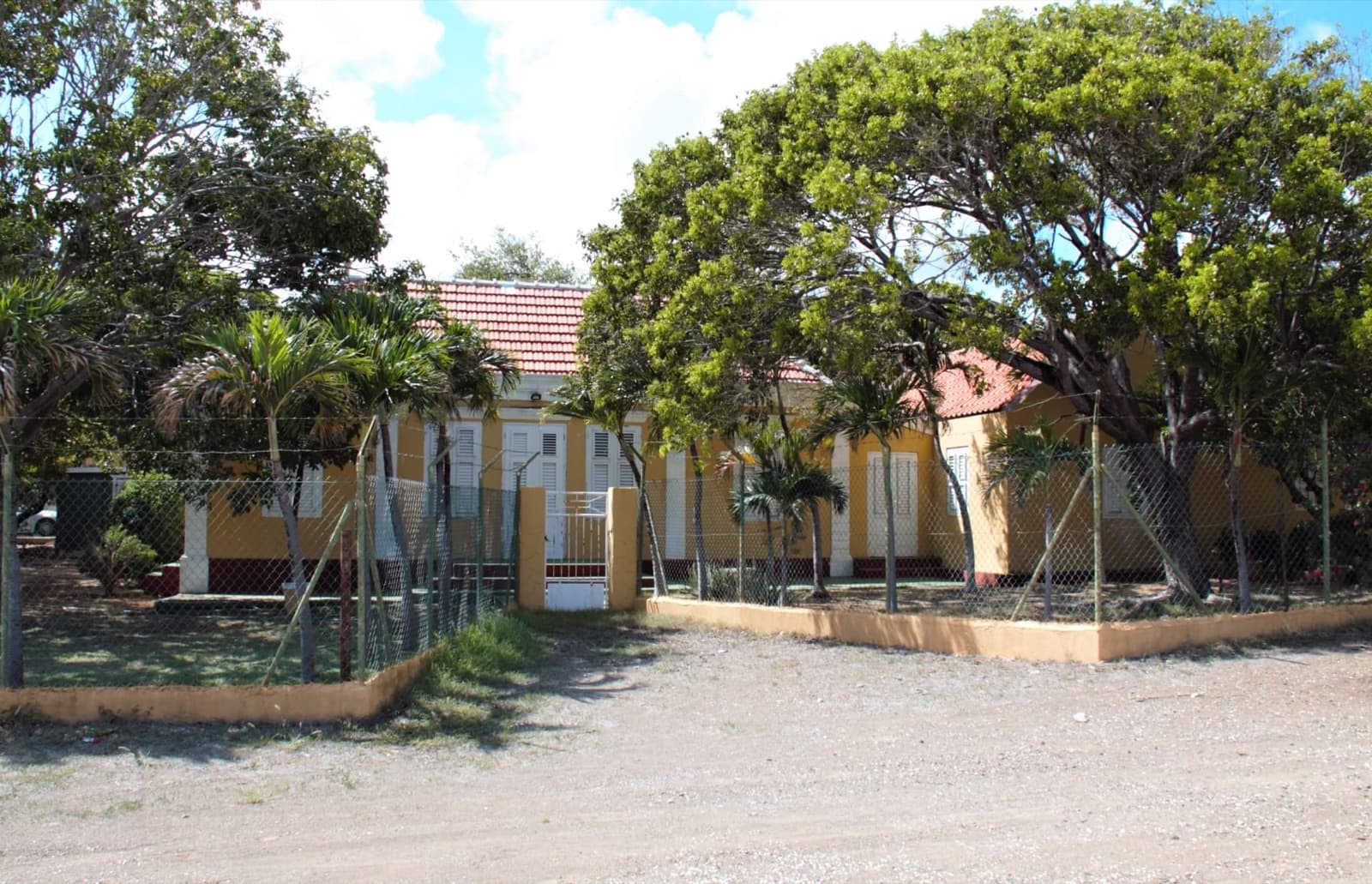
💡 Tip: Open by appointment for researchers, and occasionally for public events and tours. The contrast between the antique landhuis interior and the library's floor-to-ceiling glass is the photographic gift here — bring a good camera.

Landhuis Rust en Vrede — A Doctor's House in Slow Decline

For most of the 20th century Rust en Vrede — 'Rest and Peace' — served as the official residence of the district master of the surrounding area. In the 1930s it housed shon Piet van Leeuwen, father of the writer Boelie van Leeuwen. His successor was Herman Schotborgh. The house itself dates from the second half of the 19th century and was originally known as De Vergenoeging. Later the government stationed its doctors at Rust en Vrede. Dr Gorsira first, then Dr Rauchbaar who lived there with his family until 1990. Rauchbaar ran his private practice from the house, with the government practice just across from the Santa Rosa church. Deep gardens stretched in front of and behind the landhuis; he fenced them with a cactus hedge, and two staircases led down to the rear garden — faint traces that still exist today, though overgrown. After Rauchbaar's departure there was real interest from several parties in taking over the landhuis. The government did nothing. Windows and doors were bricked up, a common defense against squatters that also guarantees decline. In 2002 Rust en Vrede was officially declared a protected monument — but protection without maintenance is a slow eulogy. Today it stands as a shadow of the country house it was: the front facade still legible as 19th-century colonial, the gardens still guessable in outline, but visibly fading year on year. It is a reminder that without active care even solid landhuizen drift toward ruin. The 17 recognised ruins on Curaçao are not an exhaustive list; there is a long waiting room.

💡 Tip: View from the road only. Rust en Vrede is a useful landhuis to visit as a contrast — most featured landhuizen show the success of restoration; this one shows what the alternative looks like.

Landhuis Saliña Abou — The Lower Salt Pan

Saliña Abou — 'lower salt pan' — was a small 80-hectare plantation that functioned primarily as a buitenverblijf, a country retreat rather than a serious salt operation, despite the name. The landhuis dates from the late 18th century. It has a core with a saddle roof, two dormer windows on the west side, and narrow galleries along both long sides. The western gallery was originally open but was closed in during a later renovation. On the south side two adjoining blocks have been added. The name has shifted. The plantation appeared in 19th-century records under multiple aliases: Genoegen is het al ('Contentment is all'), Goed Heenkomen ('Good Escape'). Each generation of owners seems to have had their own preferred name, and Saliña Abou won out only in modern usage. Neighbours Chobolobo and Saliña (proper) locate the estate in the eastern peripheral area of Willemstad. Its current use is uncertain. It is a landhuis for visitors who want to understand how the smaller estates of Curaçao anchor a landscape — not spectacular, not neglected, just continuing to exist as quiet architectural history.

💡 Tip: Drive past when you are at Chobolobo for the Blue Curaçao tour — Saliña Abou is a short detour and offers a useful contrast between a distillery-celebrity landhuis and a quiet-neighbour landhuis.

Landhuis Saliña Ariba — Nopal Cactus and a New Name

Saliña Ariba — 'higher salt pan' — was a small plantation with an unusual early 19th-century crop: nopal, the paddle-shaped cactus that hosts cochineal insects, whose bodies yield the brilliant carmine red dye that coloured textiles across Europe and Asia. Cochineal cultivation was the high-margin specialty of a handful of Curaçao plantations in this era, and Saliña Ariba was among them. Later the landhuis shifted to use as a buitenverblijf. In recent years the estate has become increasingly known by an alternative name: Landhuis Stadsrust. The corrugated-metal saddle roof tops the core; broad galleries run along both long sides, with an additional appended gallery on the south. The western terrace is covered. The landhuis is currently on the market, awaiting the next owner with the patience and capital to carry it into its next chapter. Saliña Ariba's neighbours are Chobolobo and Goede Hoop. It sits in a small cluster of eastern-peripheral Willemstad estates that once lived symbiotically on the salt pans that defined the area. The pans are largely filled in now; the name lives on.

💡 Tip: If architectural history and a renovation project appeal — Saliña Ariba is on the market. For visitors, observe from the road; ask at local real estate agents for viewings if seriously interested.

Landhuis San Juan — Once the Most Important Plantation on Curaçao

Landhuis San Juan — Once the Most Important Plantation on Curaçao

San Juan — originally Sint Jan — was founded in the middle of the 17th century and grew, at 657 hectares, into what was considered in the early 19th century the most important plantation on Curaçao. Corn, sugar cane, cotton, and indigo grew in its fields; livestock ranged its slopes; even modest salt extraction was added in the first half of the 19th century. In the 20th century — an unusually specific late chapter — an iguana farm operated on the grounds. The 18th-century landhuis has a core with a hipped roof and three dormer windows on one side, with lean-to galleries running along all four elevations. The distinctive feature is architectural and practical: a long, alternately arched and straight-bowed aqueduct connects the house to its rainwater reservoir, ensuring that every drop of runoff from the roof reaches storage. Forty centimetres higher than groundwater, stone-built, and visually striking against the landscape, it is one of the more elegant pieces of plantation water engineering on the island. Plantage San Juan sits in the rural west, its neighbours Cas Abou and Pannekoek. Its current use is uncertain, but the house and its aqueduct still stand, and the scale of its former importance is legible in every direction — 657 hectares is a very large number.

💡 Tip: The aqueduct is the signature architectural element. Drive the approach road slowly in good light — stone aqueduct + landhuis in combination is a photograph worth framing.

Landhuis San Nicolas — 339 Hectares of Salt

Landhuis San Nicolas — 339 Hectares of Salt

By the end of the 17th century the plantation of San Nicolas already existed, eventually covering 339 hectares. The trinity of 18th- and 19th-century Curaçao economy — tillage, livestock, and above all salt extraction — all three played out here. San Nicolas was part of the west-coast salt cluster that, together with Groot Santa Martha and Klein Santa Martha, drew its wealth from the salt pans of Santa Martha Bay. The landhuis itself dates from the 18th century. The core has a hipped roof with dormer windows, and long lean-to galleries run along its two long sides. Several outbuildings cluster around the main house — the remnants of the operational infrastructure that supported a 300+ hectare agricultural and salt-extracting enterprise. Like neighbouring Klein Santa Martha, San Nicolas relied for two centuries on the labour of enslaved people; unlike its better-restored neighbour it has not yet found a second life as a museum, boutique hotel, or cultural centre. San Nicolas sits today in an area that remains rural in character, still near the salt pans that built its economy, still within a landscape where the geography of 17th-century Curaçao plantation zoning can be traced almost unchanged. It is the kind of landhuis that rewards the visitor who comes for the larger story — one salt plantation among a cluster, one outbuilding complex among many that served the salt industry, one mid-sized 18th-century house that survived into the 21st.
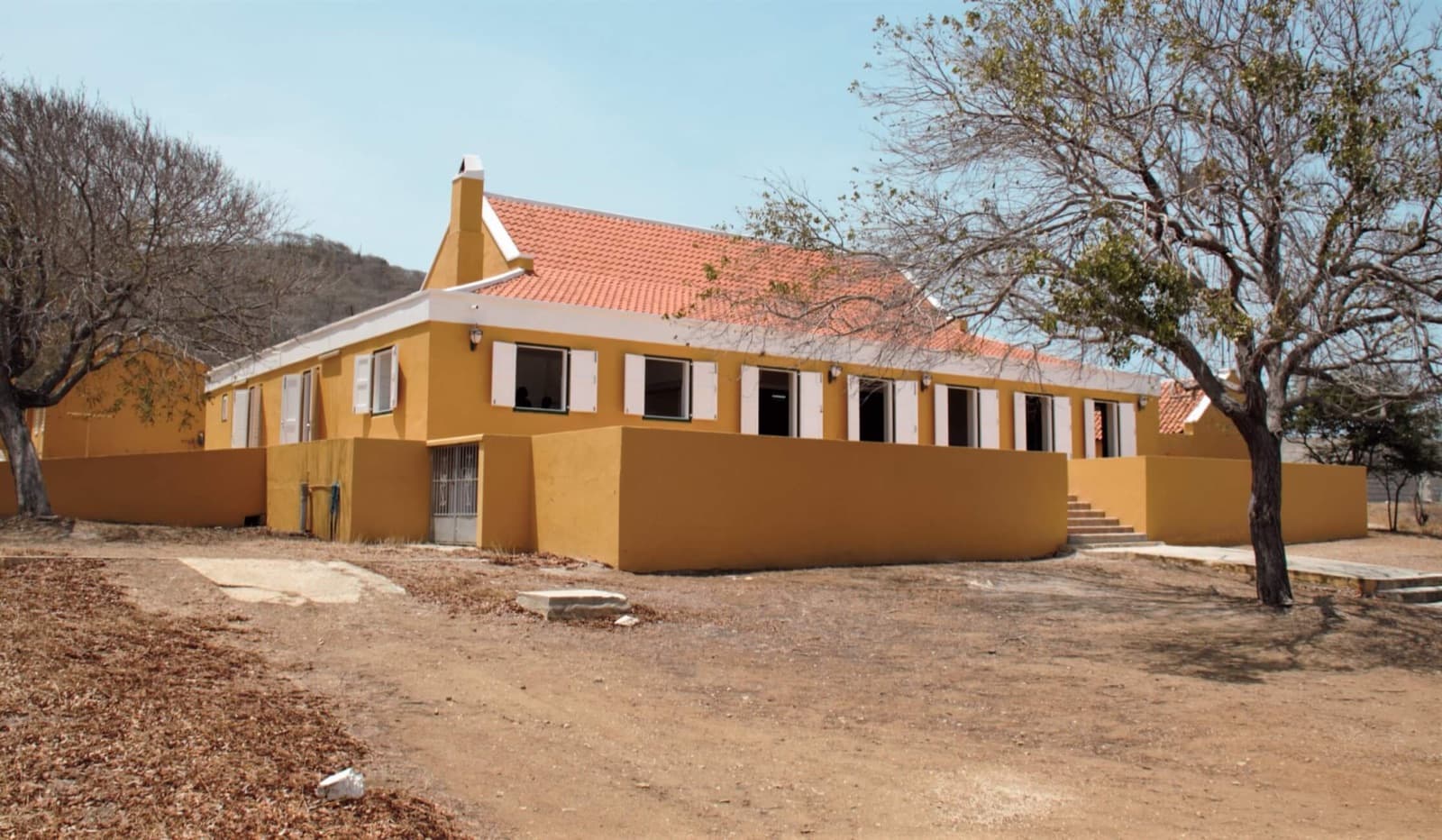
💡 Tip: Combine a visit with Groot Santa Martha and Klein Santa Martha — the three together give a clearer picture of the west-coast salt economy than any single estate can.

Landhuis San Sebastian — Burned by the British, Rebuilt 1805

San Sebastian — also Sint Sebastiaan or Sint Bastiaan — was founded in the mid-17th century as part of the large Company Plantation. Maize grew in its fields at first; later, cochineal was cultivated (for carmine dye), and at the end of the 19th century aloe plantings were added — a quiet succession of agricultural experiments, each trying to match a different export market. The landhuis itself carries the date 1754 on its gable. It did not survive the 19th century unchanged. In 1805 British raiders plundering the island set the house on fire; it was rebuilt afterward. The current structure shows its complex architectural history. The original core has a saddle roof and a single dormer window, with lean-to galleries running the length of both long sides. Added later: a two-storey wing attached to the south gallery (with its own saddle roof) and two short wings flanking the east-facing short side of the core, connected by a gate over the patio. It reads like three buildings sharing a footprint. The plantation's neighbours — Buitenbosch and Jan Kock — place it in the north-western rural zone. It is privately owned today, quietly standing where it was burned, rebuilt, extended, and survives still.

💡 Tip: Access by invitation. The 1754 gable date is the architectural punctuation mark worth looking for — a date burned on one side, a rebuilding legible on the other.

Landhuis Santa Barbara — The Grandest House on the Island

Landhuis Santa Barbara — The Grandest House on the Island

When the traveller M.D. Teenstra passed through Curaçao around 1832 he called Santa Barbara 'the largest and most magnificent house in all of Curaçao'. It has not lost the title since. The estate rises majestically out of the green, with a stately high staircase leading up to the living quarters. From the high terrace above the mangasinas the view opens across the Spaanse Water and to the Tafelberg beyond. The oldest part of the current building — dating from around 1800 — sits in the north wing. Possibly this is a remnant of the fortified house built in the 16th century by Lazaro Bejarano, the Spanish governor of Curaçao. Matthias Beck, vice-director of the Dutch West India Company between 1657 and 1668, founded the plantation. In that era it produced sugarcane, tobacco, and — to judge from the indigo vats recovered on the grounds — indigo. It later became a mixed operation with sorghum, beans, peanuts, and other vegetables, alongside herds of sheep, goats, cattle, donkeys, and a few horses. In the mid-19th century nopal cactus was planted to farm cochineal, the source of carmine red dye. Santa Barbara's guest list is remarkable. In 1874 phosphate was discovered on the estate's Tafelberg — launching a decades-long mining operation that shaped Curaçao's economy. Pastor Niewindt said fortnightly mass here under owner George Curiel (1815-1833). Prince Willem Frederik Hendrik spent the night here in 1835. Governor René Römer lived on Santa Barbara for almost three years (1983-1990) while the governor's residence in Fort Amsterdam was being restored. At the end of the 20th century the plantation grounds were sold to a developer; today the famous Barbara Beach is a private beach for hotel guests, and the landhuis, still standing in its green surround, is gradually becoming an island within villa developments and golf courses.

💡 Tip: The Tafelberg view from the rear terrace is the signature shot. The beach below is private to hotel guests — but the terrace is the better vantage point anyway.

Landhuis Santa Cruz — Rum, Quarantine, and Reclaimed Beach

Landhuis Santa Cruz — Rum, Quarantine, and Reclaimed Beach

Santa Cruz is a small landhuis with a surprisingly industrial past. It was one of the few Curaçao plantations where sugarcane cultivation persisted well into the 19th century; the stump of the sugar mill still stands across the road from the landhuis — the only surviving example on the island. From the cane, rum was distilled for local consumption. During the 1795 slave revolt, the enslaved people of Santa Cruz made ample use of the distilled stock. In the middle of the 19th century a distillery with two stills was still operating on the grounds. The landhuis itself dates from the first half of the 18th century. Livestock ran the grounds; remains of pig sheds are still visible, along with three old wells. In 1866 owner Willem van Uytrecht ceded a piece of land for the construction of a quarantine building, because Santa Cruz Bay had become the quarantine anchorage for ships arriving from areas where contagious diseases were active — yellow fever, cholera. The bay served this purpose into the early 20th century. In the 20th century, shon Etie — August Georg Statius Muller — owned the plantation. His decision in 1941 to close the beach to the public caused a local storm, with access limited to members of the Sportvereniging Kwiek. From 1944 the landhuis was rented out and the beach reopened to the public. Since 1983 the house has been privately owned and inhabited. The beach today is again public and one of the quieter west-coast options — less crowded than Grote Knip or Cas Abou, with calm clear water and the same reef life.

💡 Tip: Park at Santa Cruz beach and walk past the old sugar mill stump on your way back up — it is easy to miss but the only surviving example of its kind on Curaçao.

Landhuis Santa Helena — Western Curaçao, Modest and Persistent

Santa Helena is a lesser-known landhuis in the western rural zone of Curaçao. It belongs to the middle band of the 78-item catalogue: neither the famous celebrities like Brievengat, nor the active restoration projects currently in the news, but one of the working backdrop estates that together form the plantation landscape of the island's west. Detailed research on Santa Helena's founding date, ownership sequence, and specific economic activities continues. The general shape of the western rural landhuizen story applies: mixed agriculture, livestock, eventual shift to lower intensity use as the plantation economy faded, survival into the 21st century as a protected or semi-protected architectural artefact. Santa Helena's neighbours place it in the coastal-interior mix that defines the western third of the island. Like Janwe and Joonchi and several others in this wave, Santa Helena is representative rather than spectacular — a member of the list because the list is meant to be complete, not because it demands attention individually.

💡 Tip: If you're driving the western loop from Westpunt back toward Willemstad, Santa Helena is worth noting as you pass — one of many mid-scale landhuizen that make the western countryside architecturally coherent.

Landhuis Savonet — Four Centuries of Curaçao in One Estate

Landhuis Savonet — Four Centuries of Curaçao in One Estate

Few places on Curaçao compress as much of the island's history into a single piece of land as the Savonet estate. The first European owner, Willem Beck, took possession in 1660. Before that, Arawak people had lived and farmed here for nearly four thousand years — a span now threaded through the museum that the landhuis became in 2010. The plantation's golden age arrived with Matthias van der Dijs, who took ownership in 1815 and grew Savonet into one of the largest operations on the island. He experimented with nopal cactus, cotton, and aloe, and in 1830 bought the neighbouring plantation Zorgvlied to expand his holdings. The scale of the enterprise shaped the landscape: hundreds of goats, sheep, and cattle grazed the fields, which grew dense with maishi chikí (sorghum) and other crops. Plundering English raiders torched the landhuis in 1805; what stands today is a nineteenth-century rebuild, though the undulating gables and dormer windows faithfully echo the eighteenth-century original. Savonet is remarkable for how much of its supporting infrastructure still stands. Beyond the main house and its mangasina, visitors can still see the stables, a small dairy house, a five-seat privy, a dovecote, a smithy, a charcoal storage hut, an overseer's house, and the cattle corrals — all restored under Ingenieursbureau Techcon NV. The original wooden window latches, known locally as soldaatjes, were reproduced by hand. A cluster of old wells with stone drinking troughs, used to water both livestock and fields, remains visible within walking distance of the landhuis. Since 1978 the combined former plantations of Savonet, Zorgvlied, and Zevenbergen form the 2,000-hectare Christoffelpark, home to the endangered Curaçao deer (biná). The landhuis functions today as the park's museum, telling the story of the plantation, its natural setting, and the generations of Arawak, European, and African people who shaped it.

💡 Tip: Start at the Savonet museum before climbing Christoffelberg — the geological and ecological displays turn the hike from a workout into a landscape reading session.

Landhuis Siberie — Named After Its Venezuelan Owner

Landhuis Siberie — Named After Its Venezuelan Owner

Landhuis Siberie is one of the few plantations on Curaçao that was owned by a Venezuelan. Silberio Cañero bought Siberie and Jan Kok in 1784. The estate was actually called Sint Joris at the time; it gradually became known after its owner — Silberio slurred into Siberie, the name that stuck. From 1830 to 1978 Siberie was owned by the Statius Muller family. August Leberegt Statius Muller, owner of the Curaçaosche Courant, lived on the plantation and in 1832 expanded the salt pans in Sint Mariebaai. He also experimented with cotton cultivation. Professor Went, who surveyed Curaçao's agriculture in 1901, was generous in his praise of Siberie's substantial herd — though he had reservations about the quality of its butter and cheese production. From 1906 to 1913 the district master lived in the 18th-century house. When heavy rains in 1906 caused the steep original roof with its eight dormer windows to collapse, it was replaced with a hipped roof over the core — a structural decision that saved the building but gave it an architectural awkwardness: the new roof has no dormers and doesn't quite connect to the lean-to galleries. The original kitchen still features its fornu (oven), built with ijsselsteentjes — small yellow Dutch bricks from IJsselstein, shipped as ballast. The current owner restored the landhuis in 2018 while preserving numerous authentic elements; the old donkey stable (with its original wooden door) and the large mangasina were converted into vacation apartments. You can stay here today — sleep in the converted mangasina where salt-plantation grain was once stored.

💡 Tip: Book one of the mangasina apartments for a night or two if you want the most atmospheric accommodation on Curaçao. The stone walls keep the interior cool even at midday.

Landhuis Steenen Koraal — From Goat Pastures to Teachers' Union

In the 17th century Steenen Koraal was a maize plot with grazing rights for 80 goats. Goat farming remained central to the estate through the centuries, until the 20th-century government bought the plantation for housing development. The landhuis at the centre of it survived. The previous owner had restored the house, deepened the wells, installed windmills, and strung barbed wire before selling. In the 1930s the government made the landhuis available to the scouting movement. After that it housed several families in succession. In the early 1970s the Algemene Antilliaanse Padvindersvereniging used it, then other occupants passed through, and the house fell gradually into decline. Since 1980, SITEK — the Curaçao teachers' union — has had its headquarters in this modest landhuis. It is not one of the island's grandest estates, but it occupies a role you don't find in guidebooks: the place where teachers organise. Worth noting for anyone interested in the island's civic life beyond the obvious tourist sights. The neighbourhood around it is now mostly suburban housing, but the landhuis's original footprint, water features, and walled plots remain legible to anyone who knows to look.

💡 Tip: If you find yourself in the area, a brief stop is worth it — it's a good reminder that 'landhuis' means a lot more on Curaçao than restored tourist attractions. Some continue quietly serving the community.

Landhuis Suikertuintje — Sugar Garden at the Edge of the City

Landhuis Suikertuintje — Sugar Garden at the Edge of the City

Suikertuintje sits just north-east of Willemstad's Schottegat, a small estate whose name — 'little sugar garden' — tells you exactly what it once produced. Among the hundreds of working plantations on Curaçao, few persisted with sugarcane for long; the island's climate was simply too dry for the scale of sugar-growing that worked in Suriname or the larger Caribbean islands. Suikertuintje nevertheless tried, and the name stuck. The landhuis has stood through the shift from sugar to mixed agriculture to country retreat to modern suburb. It is captured in a 1964 photograph by Boy Lawson (Nationaal Museum van Wereldculturen) in the kind of long, reflective light that made the landhuizen photographable subjects for earlier generations of Dutch archive photographers. Today Suikertuintje is surrounded by modern Willemstad — shopping centres, residential neighbourhoods, and a shopping district that has made the estate name into a commercial brand for the area. The landhuis itself is dwarfed by its surroundings, a preserved island within a 21st-century urban setting, the way many of Curaçao's near-Willemstad landhuizen have ended up. Drive past Suikertuintje and you are looking at the centuries-old kernel of what the shopping district is still named after.

💡 Tip: Easy to see while shopping in the Zuikertuintje shopping area. The contrast between the 19th-century landhuis and the surrounding commerce is exactly what 'preserved within urban growth' means in practice.

Landhuis Urdal — Modest and Still Researching

Urdal — also known historically as Roozendaal and Arrarat — is a 19th-century buitenverblijf in the eastern peripheral area of Willemstad. The landhuis has a core with a hipped roof and a few dormer windows. Deeper research into the estate's history is still ongoing; the Landhuizen van Curaçao project has not yet pinned down the founders, the detailed sequence of owners, or the specific economic activities of the plantation in its earlier centuries. This entry exists to mark the place in the catalogue and to be honest about what is and is not known. For every Brievengat or Chobolobo with a well-documented history, there are Urdals — modest estates that have persisted into the 21st century without yet receiving the archival attention they deserve. Urdal's neighbours are Bona Vista and Klein Bloempot, placing it in a cluster of smaller peripheral landhuizen. When further research emerges, this entry will grow. For now Urdal is representative of the 'long tail' of Curaçao landhuizen — the ones that survive by persistence rather than by fame.

💡 Tip: Observation from the road. A useful stop if you're interested in the less-researched entries in the catalogue — Urdal represents what an average surviving landhuis looks like without celebrity treatment.

Landhuis Van Engelen — The Founder's Second Plantation

Landhuis Van Engelen is named after Willebrord van Engelen, temporary director of the Dutch West India Company, who founded it alongside his other plantation Engelenberg (later merged into Cas Abou). The 34-hectare plantation was not an agricultural success. Experiments with tobacco cultivation and aloe never took off commercially. An orange orchard also failed. Vegetables and maize were grown for household use, but Van Engelen's economic significance was always modest. The landhuis architecturally is handsome. The core has a hipped roof with a generous eight dormer windows. Lean-to galleries wrap all four sides, making Van Engelen one of the more airy-looking landhuizen from any angle. The alternative names — De Hooijberg, Soar, Mount Vernon, Mount Vermount — show an owner or two flirting with aspirational American references. Van Engelen's neighbours are Bona Vista and De Hoop (1). It sits in the eastern rural zone, on land that has been modestly productive but never lucrative. Its current use is uncertain. It stands as the quieter sibling to Cas Abou — founded by the same man, lower-profile, still there.
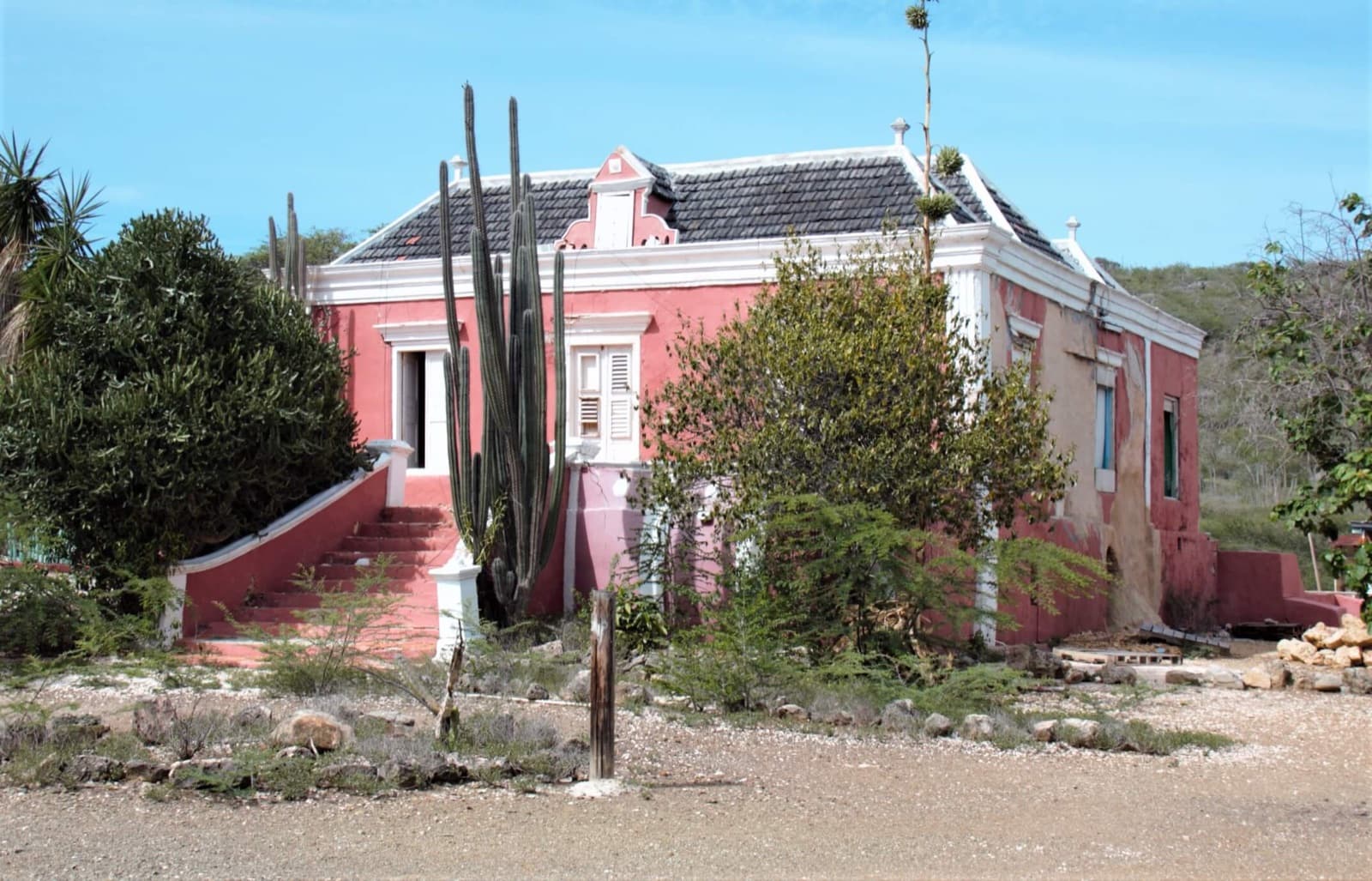
💡 Tip: Pair a visit with the Cas Abou beach — the two plantations share a founder (Willebrord van Engelen) and comparing their architectural and economic histories is genuinely interesting.

Landhuis Veeris — Empty, Waiting, 108 Hectares of Backstory

Landhuis Veeris — Empty, Waiting, 108 Hectares of Backstory

Veeris is a 19th-century landhuis now standing empty and visibly decaying — a reminder that protection without restoration is slow erosion. The plantation covered 108 hectares in its working days; livestock was the main operation. Its alternative names layer up across centuries: Union, Drie Gebroeders (Three Brothers), Goede Hoop. Each new owner left a trace in the records; none of the names stuck as well as Veeris. The architecture is typical mid-scale Curaçao landhuis: a core with a saddle roof and dormer windows, with a gallery running along three sides under a lean-to roof. The east facade has a clean upper section above the core but a curved cornice above the gallery — a small architectural flourish. Both the east and west facades end in a triangular crowning gable. Symmetrical, balanced, dignified even in neglect. The neighbourhood around Veeris has changed; the landhuis itself awaits its turn. In a catalogue of 78 intact landhuizen, some are boutique hotels and museums, some are restaurants and art galleries — and some, like Veeris, are in the interstitial state: too well-built to collapse, too expensive to revive without a patron or purpose. The island has a long list of landhuizen waiting for their next chapter.

💡 Tip: Observe from the public road only. Do not enter an empty landhuis without permission; beyond the trespass issue, deteriorating structures are genuinely unsafe.

Landhuis Vredenberg — Two Storeys, Two Restorations

Vredenberg is a two-storey country retreat with a saddle roof and dormer windows. Both long sides carry galleries on both floors, each under a lean-to roof. Above the main entrance on the front, a balcony projects outward — giving the house an elegant vertical rhythm. The estate was always primarily a buitenverblijf — a country getaway for wealthy city residents — rather than a working plantation. Its construction date is undocumented, but the architectural details place it somewhere in the late 18th or early 19th century. The alternative name Kunuku Abou (Papiamentu for 'lower field') places it in local geography more precisely than its formal title. Two restorations — in 1911 and again in 1997 — have preserved the structure through the century that saw many of its peers collapse. Much of the deeper history remains to be researched, which is itself a reminder that the 78 intact landhuizen of Curaçao are catalogued but not fully studied; there are decades of archive work still to do before every landhuis's story is known. Vredenberg sits between Koraal Specht and Saliña Abou, holding its ground quietly, awaiting the scholarship it deserves.

💡 Tip: Observe the two-storey gallery rhythm — both floors have full galleries, which is rarer than it looks. Most Curaçao landhuizen have a gallery only on one floor or one side.

Landhuis Wacao — Youngest Landhuis on Curaçao

Landhuis Wacao holds a curious distinction: built around 1927, it is the youngest landhuis on Curaçao — making it roughly a century old in a catalogue where most entries claim 200-300 years. The original Wacao sat elsewhere, on what is now Kaminda Johan M. Statius van Eps near the side road Leliënbergh H. After the original was demolished, a new landhuis was built along the road to Westpunt, near the entrance to the military shooting range where it stands today. Alternative names include Barthoolse Kust, Sint Silvester, and Wakawa. The specific history of the plantation — which era of the original, which owners, what activities — is still being researched. What is known is that Wacao joined the catalogue by being newly built at a moment when the old plantation economy had long since faded. It is a 20th-century entry in an 18th- and 19th-century story. Its neighbours are Flip and Sint Hyronimus (the latter a ruin). Wacao sits in the far western rural zone of the island. Its current use is uncertain. As the most recently built among the 78 intact landhuizen, it offers an interesting counterpoint to the older entries — proof that the category 'landhuis' is still being added to, not just preserved.

💡 Tip: The youngest landhuis on Curaçao is a worthy curiosity for visitors with a completist streak — every other landhuis in the catalogue is older than Wacao.

Landhuis Wechi — 200 Years in One Family

Plantage Wechi — also spelled Weitje, and alternatively known as Klein Malpais, Rustplaats, or Daantje Boom — was a 133-hectare estate. The name Wechi or Weitje probably derives from Wijt Timmer, owner around the middle of the 18th century. From the beginning of the 19th century until the end of the 20th century, the plantation remained in the hands of the same family — a continuity of nearly 200 years that is rare even by Curaçao standards. The early-19th-century landhuis has a core with a saddle roof and dormer windows. Lean-to-roofed galleries run along both long sides. The gable ends are clean, simple — not decorated like the baroque-era landhuizen but balanced and dignified. The estate was renovated a few years ago, bringing the building out of a period of quiet neglect. Wechi's neighbours are Rustplaats (one of its alternative names, now applied to a separate nearby landhuis) and Zorgendal. The two-century family ownership is the key data point: very few properties on Curaçao stayed in one family from the 1810s through the 1990s. That kind of continuity tends to preserve a building better than any formal heritage designation — because each generation had a reason to maintain it. Wechi is the proof.

💡 Tip: Observe the clean gable lines — unusual for 19th-century Curaçao where decorative volutes were more common. The family-continuity story is why Wechi's architecture stayed this pure.
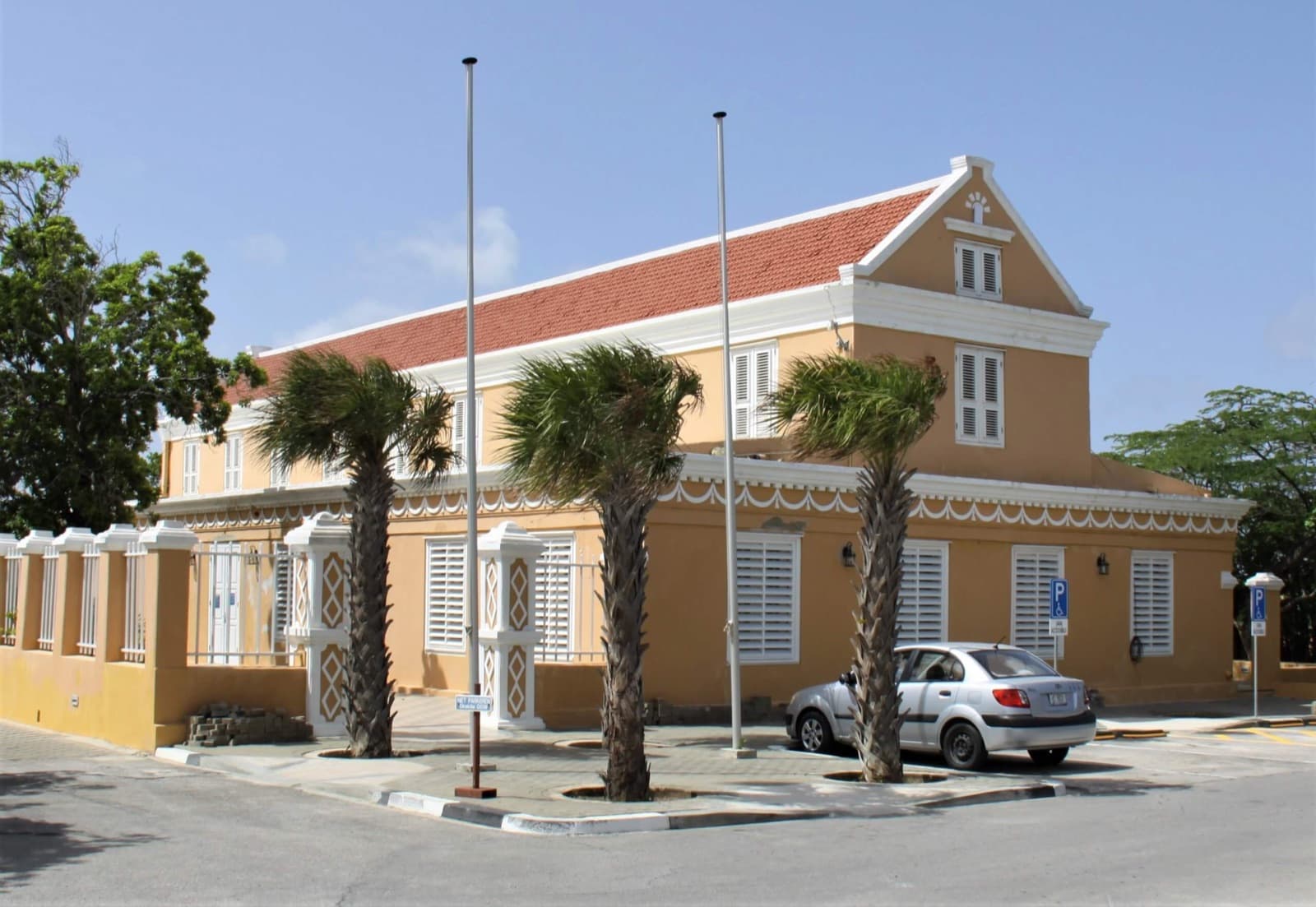
Landhuis Zeelandia — Retirement Home Behind Baroque Gables

Landhuis Zeelandia — Retirement Home Behind Baroque Gables

The imposing Landhuis Zeelandia has a cross-shaped core with the north-south block rising to two storeys. The saddle roof carries dormer windows, and the east and west facades are elegantly decorated with volutes and arched top finishes. The north and south facades are simpler — a low pointed gable to one side, a tall one to the other. The east and west wings have open galleries along all sides, with lean-to roofs supported by colonnades. The north-south block dates from the 19th century; the east-west section is older, reaching back to the late 18th century. Near the landhuis stands a long and imposing outbuilding, though of later date. It was constructed in 1945 as an extension to the retirement home that occupied the landhuis at the time. It has a saddle roof and open galleries along both long sides — fifteen open arches on the south-west side, thirteen open and two closed arches on the north-east side, plus a projecting central entrance with extra arches. The decorative top gables, with their elaborately in- and out-swinging contours, spiral ornaments, and arched top finishes, echo the style of Brievengat. Zeelandia was originally a country retreat for wealthy city dwellers. The adjoining plantation was only 39 hectares and produced little of commercial value. From before the 20th century until 1983 the estate served as a retirement home — 'Koningin Wilhelmina'. Since then its purpose has been unclear; the building awaits its next chapter. Its baroque architectural flourishes and the visible family resemblance to Brievengat keep it among the most architecturally significant of the secondary-tier landhuizen.
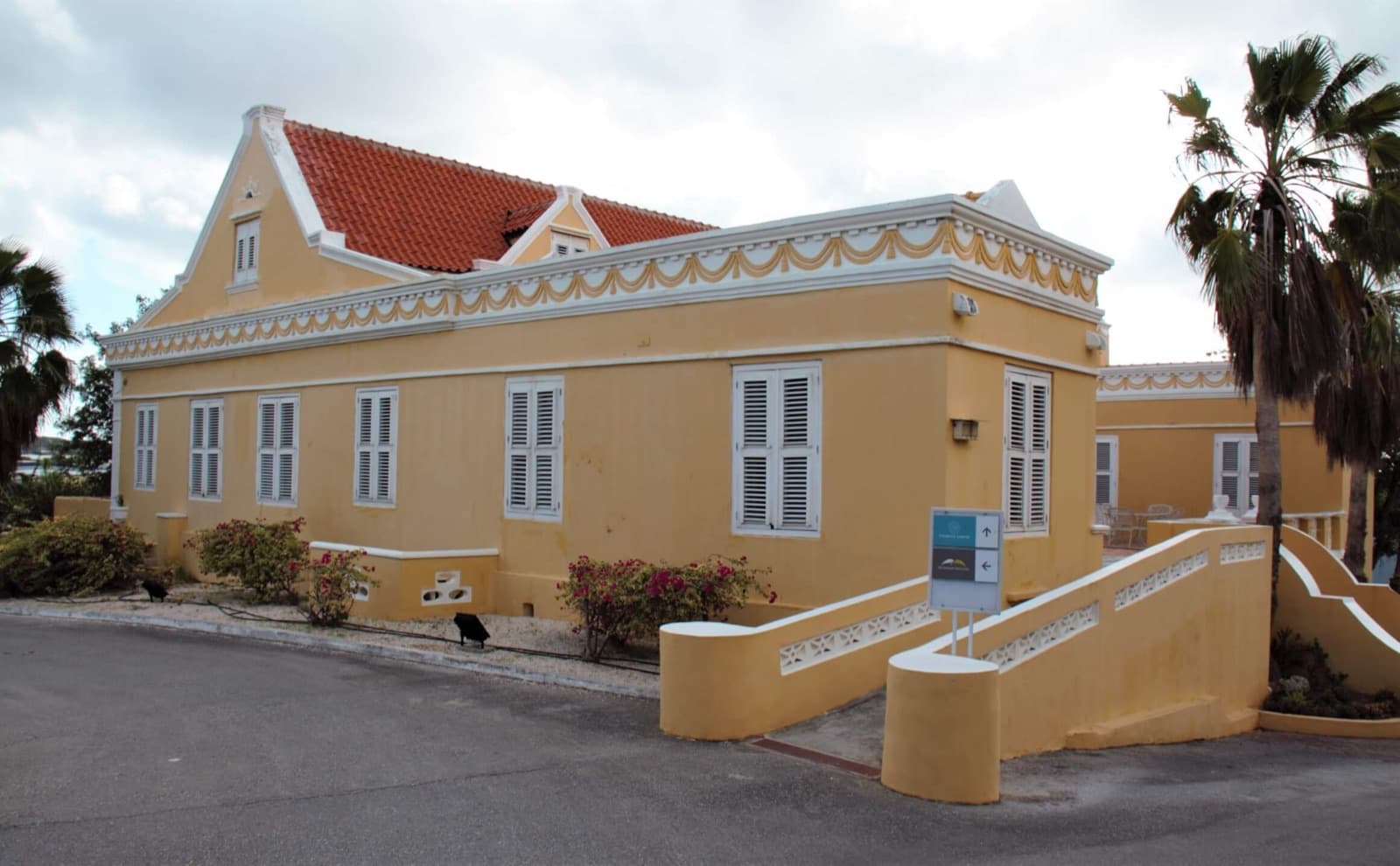
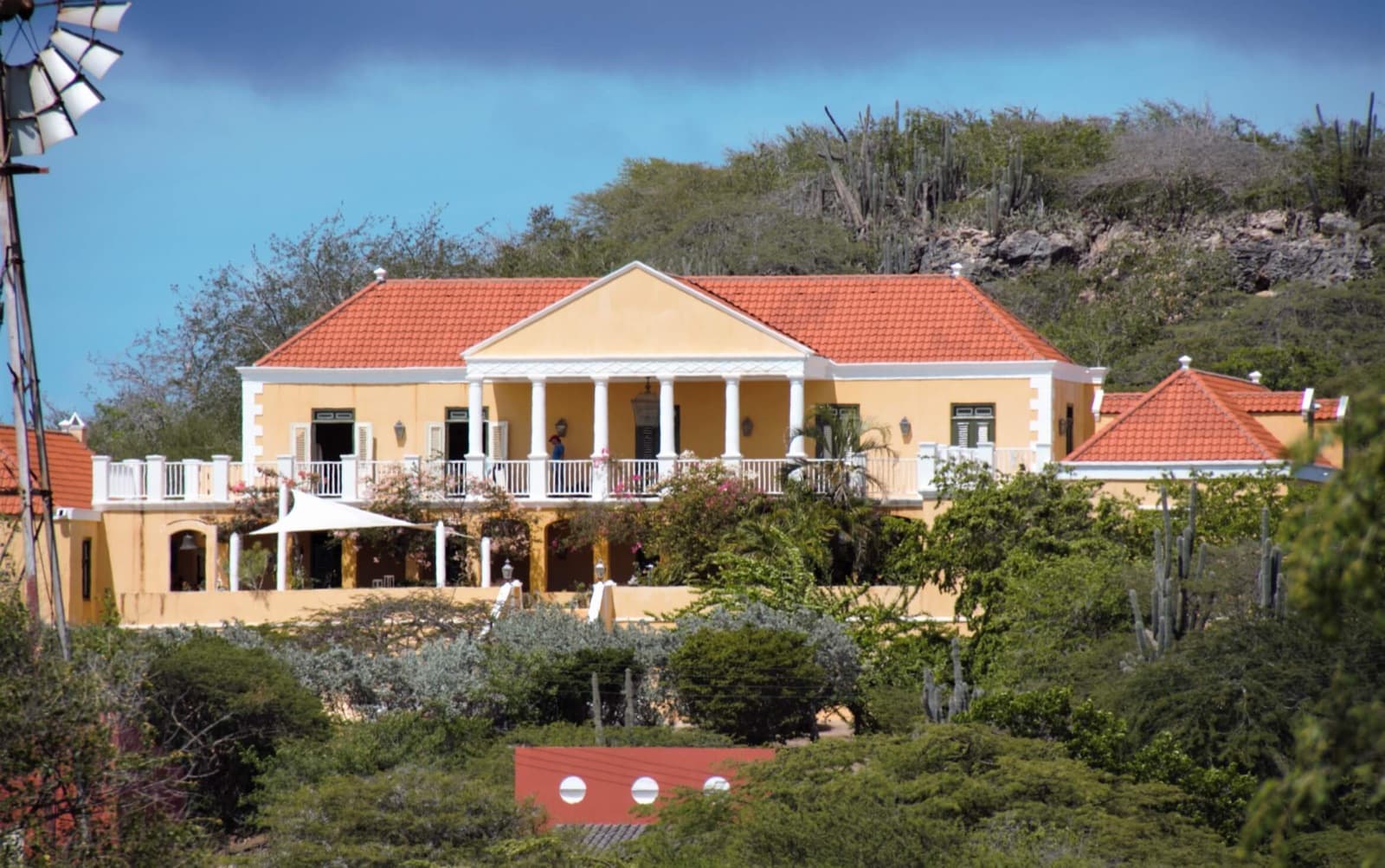
💡 Tip: The architectural resemblance to Brievengat is the thing to notice. Same baroque vocabulary, smaller scale — worth a visit specifically if you've been to Brievengat, for the comparison.

Landhuis Zuurzak (Sorsaka) — An Early Resort with Watchtowers

Landhuis Zuurzak (Sorsaka) — An Early Resort with Watchtowers

Zuurzak — locally Sorsaka after the soursop fruit — is a landhuis of unusual character, complete with flanking outbuildings that resemble small watchtowers. The estate lay in the eastern interior of the island, in an area traditionally known for salt and livestock rather than grand hospitality. That changed in the 19th and 20th centuries, when Zuurzak repeatedly reinvented itself. Like several country houses near the city, it served periods as a private getaway, then as a government-adjacent property. The current structure — with its distinctive ancillary buildings — has been preserved despite decades where maintenance was irregular. The Dutch cultural heritage archives hold architectural documentation that speaks to the site's perceived importance. Today Zuurzak stands quietly in its eastern setting, not a major tourist stop but a characteristic Curaçao landhuis in its own right. The symmetry of the main house and the small flanking structures gives visitors who pass an immediate sense of its original scale and ambition. Like many of the island's 78 surviving landhuizen, Zuurzak awaits its next chapter — whether as a boutique venue, private retreat, or part of a new cultural programme — a story played out again and again across the island over the past two centuries.

💡 Tip: Drive past for the flanking watchtower-style outbuildings — they are unusual and make the estate instantly recognisable from the main road.

Ruïne Choloma — Former Ostrich Farm

Choloma was split off from plantation Groot Sint Joris in 1893, a small estate roughly 1500 x 750 metres. Its first owners were freed enslaved people — a pattern rarer than it should have been, but present. In the first half of the 20th century the estate primarily farmed ostriches, an unusual specialty for Curaçao. Some former slave huts reportedly still stand on the grounds alongside the main landhuis (built 1896). The name itself comes from the island's pre-colonial indigenous period, a linguistic survivor from before Dutch or Spanish settlement.

💡 Tip: The pre-colonial indigenous origin of the name is the detail worth noting — not every Curaçao place name is from the Dutch or Spanish era.

Ruïne Duivelsklip — Slave Camp Turned Ruin

The ruins of Duivelsklip (also Diesklep) lie in the closed-off eastern part of Curaçao, in the area around Oostpunt. Two large sheds still stand; the landhuis itself is represented only by foundations and a single grave on the grounds. In the third quarter of the 17th century — the height of the island's slavery economy — Duivelsklip functioned as a slave camp, a term that captures one of the darker chapters of Curaçao's history. Detailed research into its later centuries continues, but its early use is documented.

💡 Tip: Oostpunt is privately owned and largely closed to casual visitors. Access requires permission. The site is less a tourist destination than a historical marker.

Ruïne Fuik — 18th-Century Grand Estate, Now Remote and Closed

Ruïne Fuik — 18th-Century Grand Estate, Now Remote and Closed

The ruins of Fuik lie deep in the closed-off eastern part of Curaçao. The landhuis, built around 1789, had a core with a saddle roof and dormer windows. Later the attic level was demolished and the building was given a lower roof; wraparound enclosed galleries ran around it. Two outbuildings still show volute-accented tops and a scrolled crowning. On small shield plaques the date 'March 1789' was once visible. Impressive fence posts with decorated tops stood at the southern entrance and near the house; copies are now in the Curaçaosch Museum. Plantation Fuik was consolidated with Oostpunt in the early 19th century, then later merged with Duivelsklip and Santa Barbara — a classic pattern of large-estate amalgamation.

💡 Tip: Fuik is on private Oostpunt land — not publicly accessible. The fence-post copies at the Curaçaosch Museum in Willemstad are the closest most visitors will get to Fuik.

Ruïne Klein Piscadera — Mango Plantation Fragment

Plantation Klein Piscadera was over 200 hectares and grew mangoes. It was originally two separate plantations — Klein Piscadera and Ravenslot — later merged into one. The landhuis consisted of three adjoining blocks along their long sides, each with a saddle roof. The eastern block had a gallery along its long side; there were no dormer windows. Today the structure is a ruin; the Ravenslot component has likewise disappeared. The mango orchards are long gone. It sits within the western Willemstad peripheral zone that has been heavily developed in recent decades.

💡 Tip: The nearby Groot Piscadera (still intact) offers a useful comparison — same plantation name group, very different preservation outcome.

Ruïne Mina Scharbaai — Buitenverblijf to Bakery to Ruin

Mina Scharbaai is the ruin of what was likely a buitenverblijf — a country retreat with a garden. Named after a former owner, Wilhemina Scharbaai. The landhuis had a saddle-roofed core with two dormer windows on every side, and lean-to galleries along two elevations. The roofs have all fallen in; only walls remain. Remarkably, as recently as the 1970s a small bakery and shop still operated at the site — one of the more unexpected late uses of an increasingly derelict landhuis. Its neighbours are Morgenster and Veeris in the eastern Willemstad peripheral area.

💡 Tip: Observe from the road only. Structural ruins are unsafe; the 1970s bakery history is a small reminder that ruins often had a late productive chapter before final collapse.

Ruïne Newtown / Jeremi — Built for a Manganese Mine That Didn't Deliver

Jeremi — also Newton or Jeremi-Newton — is not really a classical landhuis. Built in 1880 on the orders of John Godden to support a possible manganese mining operation, the long two-storey building has a saddle roof and a style completely unlike any other estate on Curaçao. Godden called it Newton; the local name Jeremi (from the nearby bay) won out. The manganese deposit quickly disappointed, and the house was abandoned. Later it served briefly for scouting. Today the building is uninhabitable — parts of both the floor and the roof are missing. It is a 19th-century industrial-era structure with the wrong architecture for the Caribbean climate, slowly losing its battle with time.

💡 Tip: Combine a visit with Playa Jeremi beach — the bay and the ruined 'landhuis' share a landscape. The architectural anomaly is the reason to stop.

Ruïne Noordkant — WIC Cattle Plantation, Briefly a Slave Camp

Around 1700 the 593-hectare plantation Noordkant belonged to the Dutch West India Company. Its primary activity was livestock. In the third quarter of the 17th century — before the WIC ownership — the site operated for a period as a slave camp, adding Noordkant to the uncomfortable list of early-colonial sites with that history. The 18th-century landhuis has a core with saddle roof and four dormer windows, galleries with lean-to roofs on both sides, and separate kitchen, mangasina, and reservoir buildings attached. One gable shows the year 1857, commemorating a major renovation. Further renovation happened in 1987. Despite this, the building is now in extremely poor condition.

💡 Tip: The 1857 gable date is a useful cross-reference — most Curaçao landhuizen dates are earlier. Noordkant's 19th-century renovation date signals the estate's persistence well after the plantation economy shifted.

Ruïne Patrick — Three Parts, Three Graves, Several Reservoirs

Plantation Patrick was 388 hectares and consisted of three parts: Padiki, Patrick, and Striebeek. Its income came from dividivi harvesting, livestock, lime burning, fruit trees, and charcoal production — a broad diversification rather than single-commodity focus. Today the main ruin sits in the western rural zone near Barber and Dokterstuin. Roughly 500 metres north of the ruin lies the foundation of an earlier landhuis; 125 metres east of that foundation stands the ruin of a mangasina. Remains of several reservoirs survive across the site. Three graves are also recorded on the grounds. Specific historical information about the landhuis itself is limited; research continues.

💡 Tip: The three graves on the site are a solemn reminder that these were working homes, not just commercial properties. View from the public access points only.

Ruïne Pos Spañô — Still in Research

Pos Spañô is one of the 17 ruins catalogued on Curaçao. Specific information about its founding date, owner sequence, and economic activities remains limited as research continues. The name — Papiamentu for 'Spanish well' — suggests the presence of a water source with Spanish-era heritage, consistent with other Papiamentu 'Pos-' names on the island (Pos Cabai, etc.). For now this entry marks the site's place in the authoritative catalogue while the details are still being worked out.

💡 Tip: One of the less-accessible ruins. Worth noting its place in the complete catalogue rather than planning a dedicated visit.

Ruïne Raphael — Another Entry Awaiting Research

Landhuis Raphael is one of the 17 documented ruins on Curaçao. Detailed historical information about the founding, owners, and specific activities remains to be confirmed by ongoing archival research. Its neighbours — Mina Scharbaai and Veeris — place it in the eastern central peripheral zone of Willemstad, among a cluster of smaller estates many of which are in various stages of preservation. Raphael's presence on the list confirms its place in the catalogue; the fuller story awaits scholarly attention.

💡 Tip: View from the road. Like several of the lesser-documented ruins, Raphael is primarily interesting as part of the complete 17-ruin catalogue context.

Ruïne Rif (Rif Sint Marie) — Falling Apart, Restoration Begun

Rif (also Rif Sint Marie, Klein Santa Marie, or Santa Marie) is a T-shaped landhuis dating from around 1840. The original saddle roof had dormer windows; a nearly continuous lean-to-roofed gallery wrapped the structure. On the southwest side two outbuildings connected to the house served as kitchen and service rooms, each with its own saddle roof. A large terrace had three staircases. Photographs from 2018 show only one of the probable six original dormer windows still standing; shortly afterward even that one collapsed. As of mid-2025 the landhuis is officially declared inaccessible due to collapse risk. In 2026 a restoration was begun. A Lakeview Residence development is also planned for the adjacent grounds — a 2020s-style mixed-heritage-and-new-construction approach that is increasingly common on Curaçao.

💡 Tip: Restoration was underway as of early 2026. Check locally for progress — Rif is one of the more actively-changing sites in the ruin catalogue.

Ruïne San Pedro — Information Still Being Researched

San Pedro (Sint Pieter) is one of the 17 catalogued ruins on Curaçao. Detailed historical information about the landhuis — founding date, ownership, economic activities — remains to be confirmed by continuing archival research by the Landhuizen van Curaçao project. Its neighbours in the catalogue are Ascencion and Fontein, placing it in the western rural zone of the island. The entry exists to secure its place in the complete 17-ruin catalogue.

💡 Tip: Low-priority visit. Worth knowing about for completeness rather than for any specific historical draw as yet documented.

Ruïne Santa Catharina — Cotton, Beans, Briefly a Retirement Home

Ruïne Santa Catharina — Cotton, Beans, Briefly a Retirement Home

Plantation Santa Catharina was 604 hectares — one of the larger estates on Curaçao. Cotton, beans, maize, and peanuts were cultivated; livestock was raised. In the 20th century the landhuis served briefly as a retirement home before falling into its current state. The early-19th-century landhuis has a core with a saddle roof (no dormer windows) and lean-to-roofed galleries along both long sides. An arch once carried the name painted above the terrace staircase; the arch has disappeared over the years. Only the walls remain, standing open to the sky — which is exactly why photographers seek it out. It is one of the more atmospheric ruins on Curaçao, with its yellow walls, cactus-colonised interior, and wood-beamed roof partially collapsed. Located in Banda Abou, no entry fee.

💡 Tip: Go in late afternoon — the low sun through the empty window frames is the signature image. Respect the structure; photograph from outside the walls.

Ruïne Sint Hyronimus — Accessible Only by Owner Permission

Sint Hyronimus (also San Hironimo, Seiroma, Ciroma, or Leliënberg) is one of the less-documented ruins on Curaçao. The site is only accessible with permission of the owner. No detailed historical information about the landhuis is currently published; ongoing research continues. Its neighbours — Paradera and Wacao — place it in the western rural zone of the island. The entry exists to secure its place in the complete 17-ruin catalogue while the archival work proceeds.

💡 Tip: Private access only. Not a visit to plan unless you've arranged permission with the current landowner in advance.

Ruïne Zevenbergen — Walls, Arches, Indigo Vats

Landhuis Zevenbergen — also 'Shete Seru' (seven hills in Papiamentu) — had two storeys. Outside the terrace stood the kitchen with a separate oven. On parts of the plastered walls, arched decorative elements are still recognisable. Six hundred metres north of the landhuis ruin, not far from Seru Gracia, stood large mangasinas, a well, and indigo vats — parts of which are still present. The plantation's full area has been consolidated into the Christoffelpark along with the plantations Savonet and Zorgvlied. Plans exist to eventually open the ruin to the public; a few years ago the site was thoroughly cleaned for this purpose. Whether those plans ever formally materialise remains unclear.

💡 Tip: The indigo vats 600 metres north of the landhuis ruin are the hidden gem here — evidence of the plantation's 18th-century dye-production economy. Access may be limited.

Ruïne Zorgdenal — Research Pending

Zorgdenal (also sometimes spelled Zorgendal) is one of the 17 catalogued ruins on Curaçao. The name — literally 'worry-valley' in Dutch — has an unusual melancholy to it, though whether it reflects some specific historical event at the estate or was just an owner's gloomy humour is unclear. Detailed historical information about the landhuis, its ownership, and economic activities remains to be confirmed. Its entry in this catalogue marks its presence and maintains the complete 17-ruin record.

💡 Tip: Limited visible interest currently. Worth noting as part of the full catalogue rather than as a specific destination.

Ruïne Zorgvlied — Absorbed Into Christoffelpark

Zorgvlied was a significant plantation estate in Curaçao's north-west. In 1830 it was bought by Matthias van der Dijs, owner of Savonet, to add to his holdings — one of the estate consolidations that concentrated landholding in the western countryside. Today the grounds of Zorgvlied, along with Savonet and Zevenbergen, make up the Christoffelpark, the 2,000-hectare national park that protects the endangered Curaçao deer (biná) and preserves the island's largest remaining tract of original dry forest. The landhuis itself is a ruin, absorbed into the park's landscape. The ecological continuity is, in a sense, the plantation's final transformation: from agricultural operation to biodiversity reserve.

💡 Tip: Visiting Christoffelpark gives you access to the broader Zorgvlied landscape — hiking trails pass near the ruin. Start at Savonet Museum for context.

Sobre os nossos safaris Seafari

How do I book a Seafari tour?+
Book directly on seafariadventurescuracao.com — select your tour, pick a date, fill in your details, pay securely, and receive instant confirmation. No booking fees. Cruise passengers: we match your ship schedule and guarantee on-time return.
What's included in a Seafari tour?+
All our tours include professional snorkeling equipment, drinks (soft drinks, beer, signature Seafari cocktail), snacks or lunch depending on the tour, sun shade on the boat, and a multilingual guide. Snorkel vests are free on request. You only bring swimwear, towel, and sunscreen.
What if the weather is bad?+
Our Rupert 50 RIB handles moderate chop comfortably. For genuinely dangerous weather we reschedule or refund 100%. You get a call by 7 AM on the tour day if we need to adjust. Curaçao weather is stable year-round — cancellations happen less than 5% of the year.
Is Seafari suitable for children?+
Yes. Children 6+ are welcome on all standard tours. The boat has stable RIB hulls (no seasickness for most), life vests in all sizes, and our guides are trained in family snorkel introductions. For children under 6 we recommend a private charter for flexibility.
Can I book a private charter?+
Yes — the Rupert 50 is available for private charter for groups of 2-36. Design your own route, pick your own stops, set your own pace. Contact us via the Private Charter form and we'll quote a fixed price within 24 hours.
What's the cancellation policy?+
Free cancellation up to 48 hours before departure — full refund, no questions asked. Within 48 hours: 50% refund. If WE cancel (weather, mechanical, safety): 100% refund or free reschedule. Travel insurance is recommended for cruise passengers.

Viva isso pela água

A costa mais bonita de Curaçao só se vê pelo mar. Nossos sea-safaris levam você a baías escondidas, paraísos de snorkel e lugares onde nenhuma estrada chega.

Ver nossos passeios