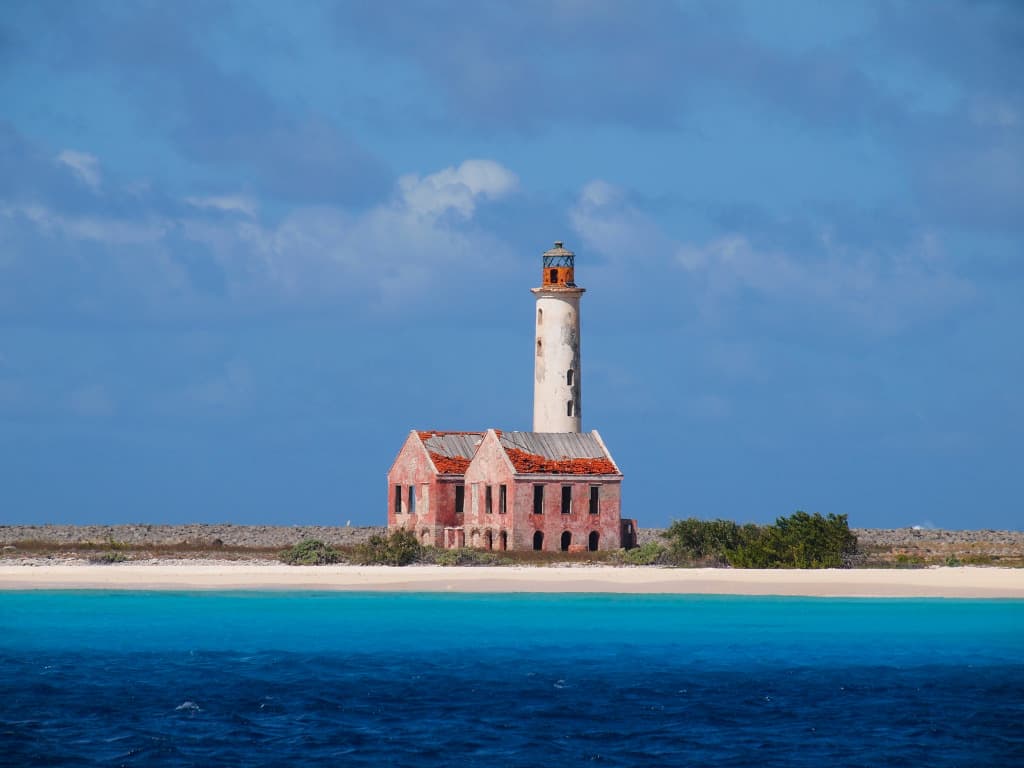
Fifteen miles off the southeastern tip of Curaçao, a flat, windswept island rises barely three metres above the sea. Klein Curaçao, 'Little Curaçao', is just 1.7 square kilometres of sand, rock, and silence. There are no hotels, no roads, no permanent residents. What there is: a crumbling coral-pink lighthouse, the rusting skeleton of an oil tanker half-swallowed by the surf, and white-sand beaches with very clear water.
The island's history reads like a maritime novel. The Dutch arrived in 1634 and used it as a quarantine station for ships arriving with infectious diseases. In 1871 a British mining engineer named John Godden discovered rich phosphate deposits, left behind by thousands of nesting seabirds, and for fifteen years the mineral was harvested and shipped to Europe as fertiliser. The mining lowered the island's surface by roughly three metres. The Prince Hendrik Lighthouse was first built in 1849 to warn ships away from the treacherous currents, destroyed by a hurricane in 1877, rebuilt in 1879, and once more in 1913. Its keepers lived in adjoining rooms without running water or electricity. Today the abandoned lighthouse, its coral-pink paint peeling in the salt wind, has been fitted with a solar-powered LED beacon that still flashes every fifteen seconds. On the windward shore, the wreck of the Maria Bianca Guidesman, an oil tanker that ran aground in the 1960s, is slowly being reclaimed by the sea.
The reefs around Klein Curaçao are home to hard and soft corals, tropical fish and nesting sea turtles. Hawksbill, loggerhead, and green turtles all breed on the island's beaches, making it one of the most important turtle nesting sites in the Dutch Caribbean. The island was designated a protected Ramsar wetland in 2018, and conservation efforts by the CARMABI research station continue to restore vegetation after decades of damage. Off the leeward side the water is usually clear, and the reef begins just steps from the shore.
Island Tip
The crossing from Marichi Pier takes about 35 minutes on the Rupert 50, depending on conditions. Bring plenty of sunscreen: there is little natural shade on the island. The northern beach has calm, sheltered water for snorkelling, while the southern windward side is too rough for swimming but good for a walk.