Back to Travel Guide

Species Guide

The marine and land wildlife of Curaçao — what you can see, where to see it, and when.

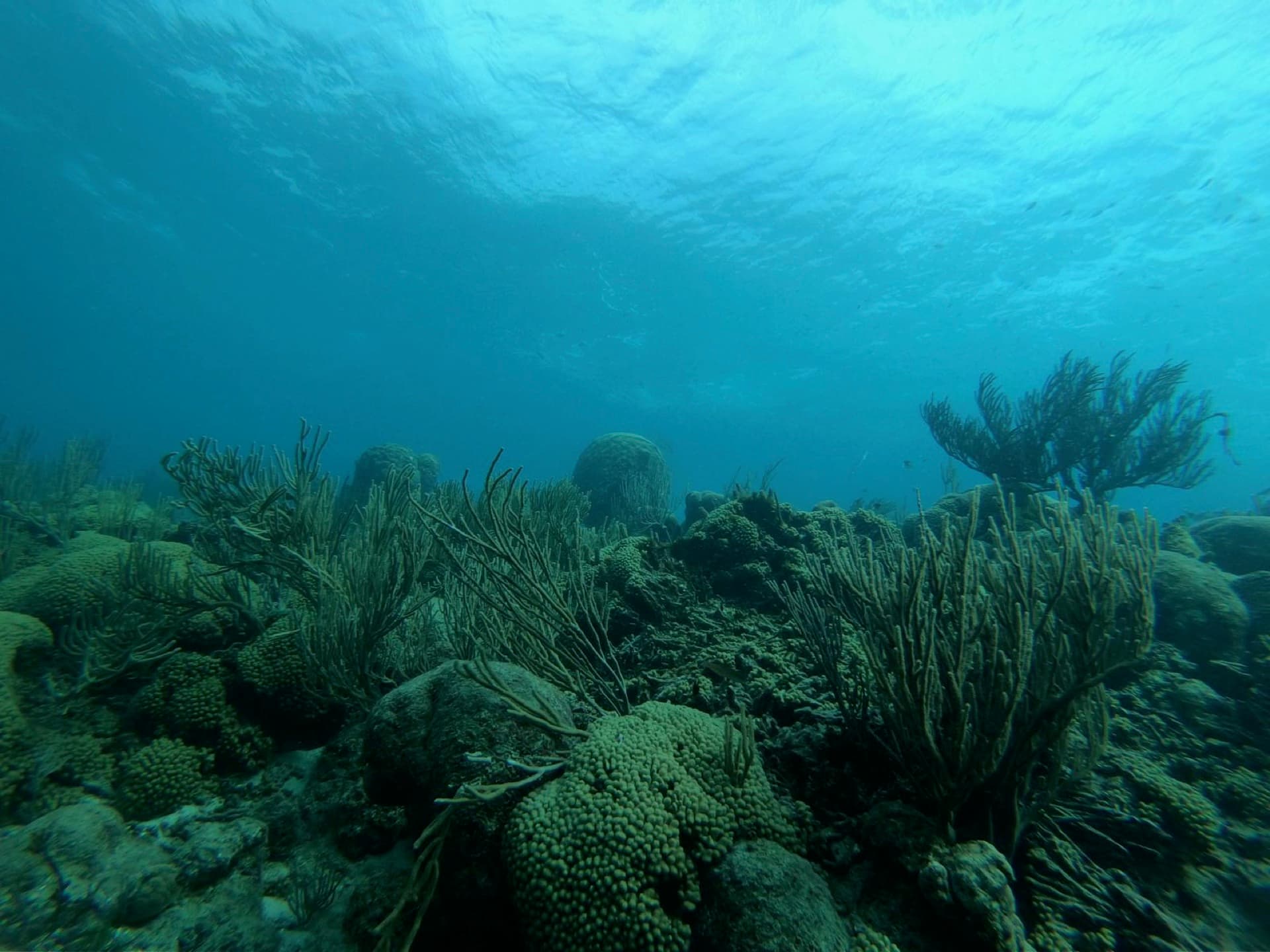
Curaçao's coral reefs host over 400 species, and the island's dry-forest interior adds flamingos, parrots, iguanas, and more. This guide covers 30+ of the most visible and distinctive species — what they look like, where to spot them, and what makes each one worth looking for.

Green Sea Turtle (Chelonia mydas)

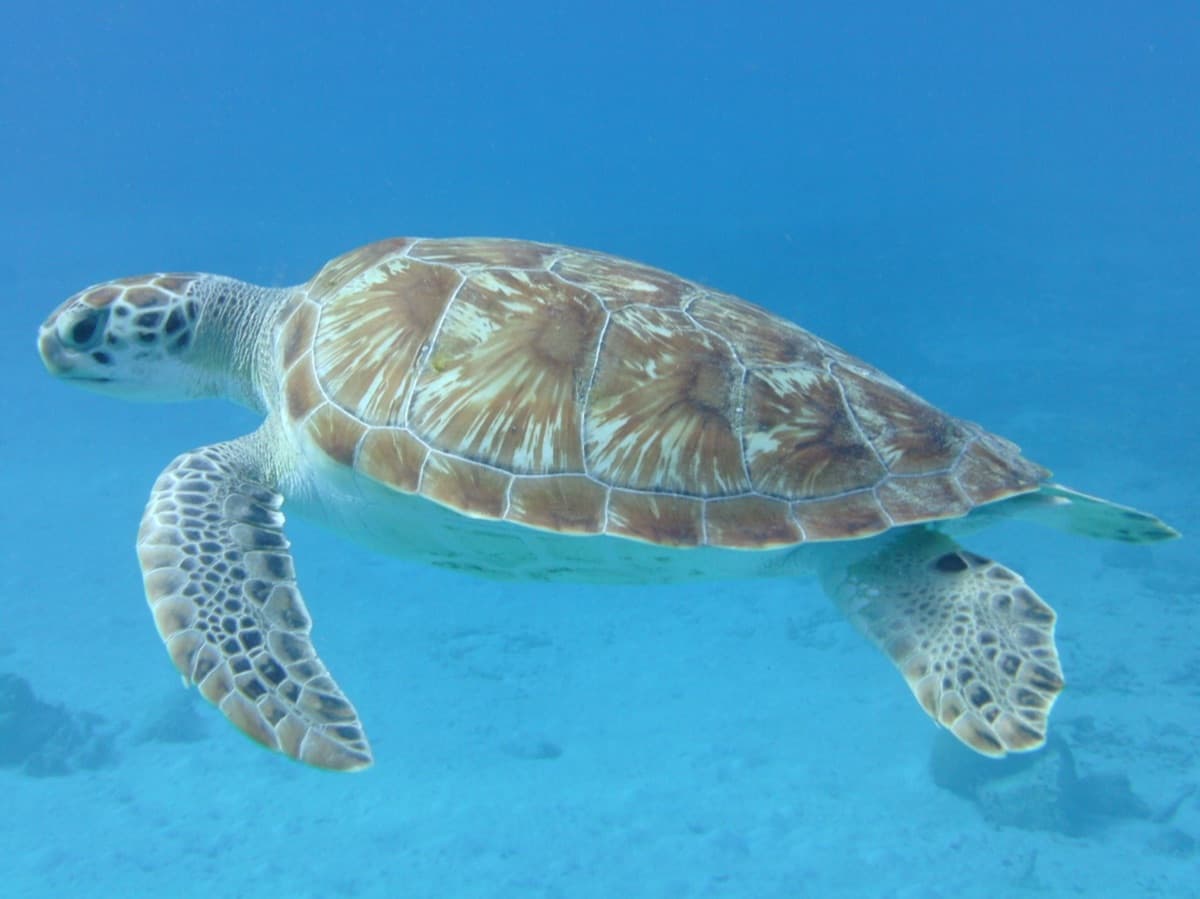
Green Sea Turtle (Chelonia mydas)

The green sea turtle is Curaçao's most commonly sighted turtle species, particularly at Playa Piskado (Turtle Beach) where individuals feed on sponges and fishermen's scraps daily. Adults can exceed 1 metre in shell length and weigh 150 kg. They're herbivorous as adults — mostly sea grass and algae — which is the 'green' in the name (the fat layer turns greenish from chlorophyll). They surface every 5-10 minutes to breathe during active foraging. Protected species; no touching. Commonly seen: Playa Piskado, Playa Lagun, Alice in Wonderland (Playa Kalki).

💡 Tip: Green turtles swim with a sculling motion using both front flippers simultaneously. Hawksbills flap alternately. That's how to tell them apart from above.

Hawksbill Turtle (Eretmochelys imbricata)

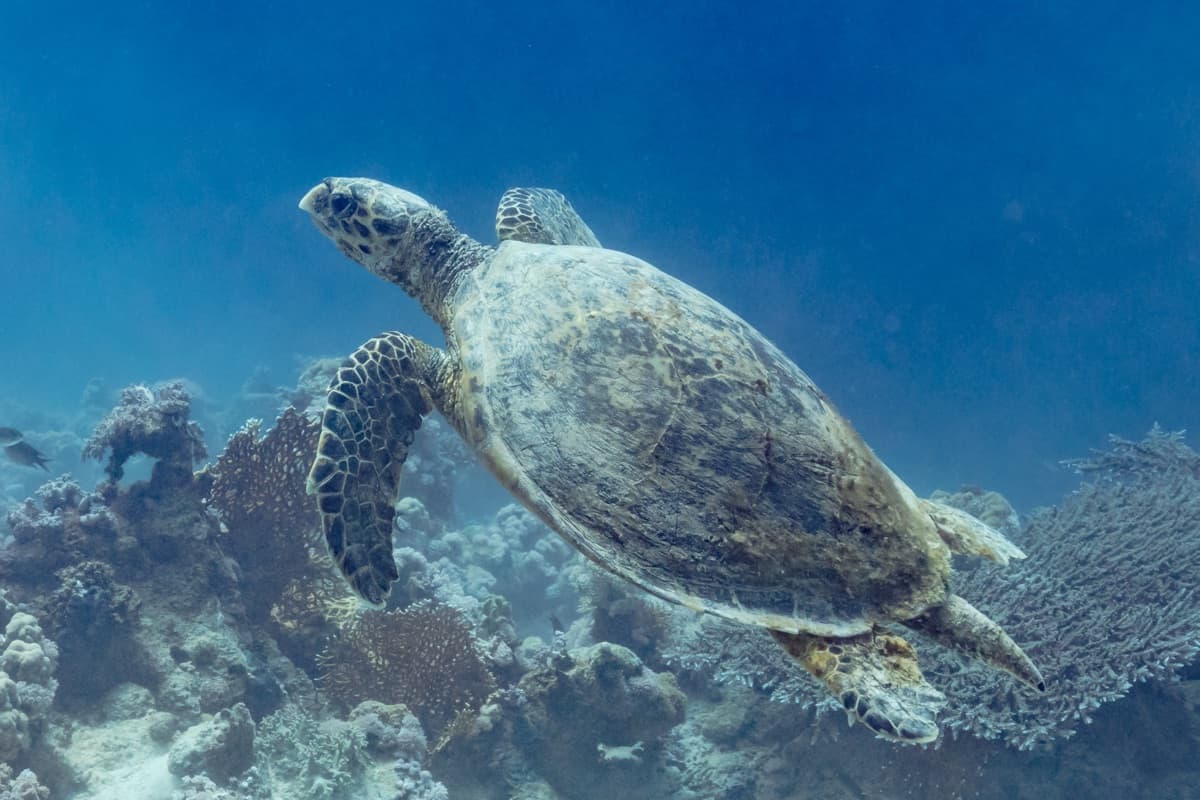
Hawksbill Turtle (Eretmochelys imbricata)

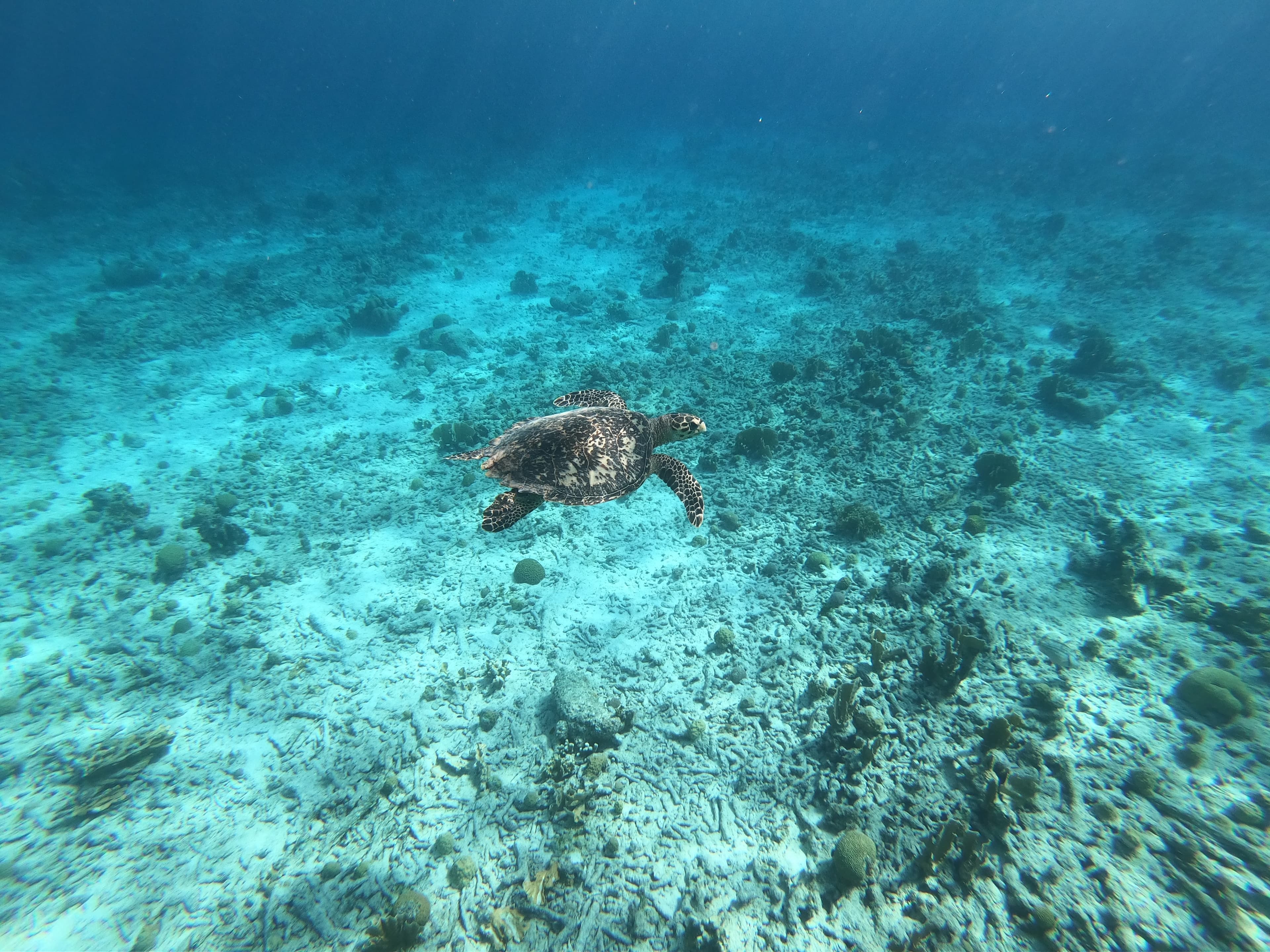
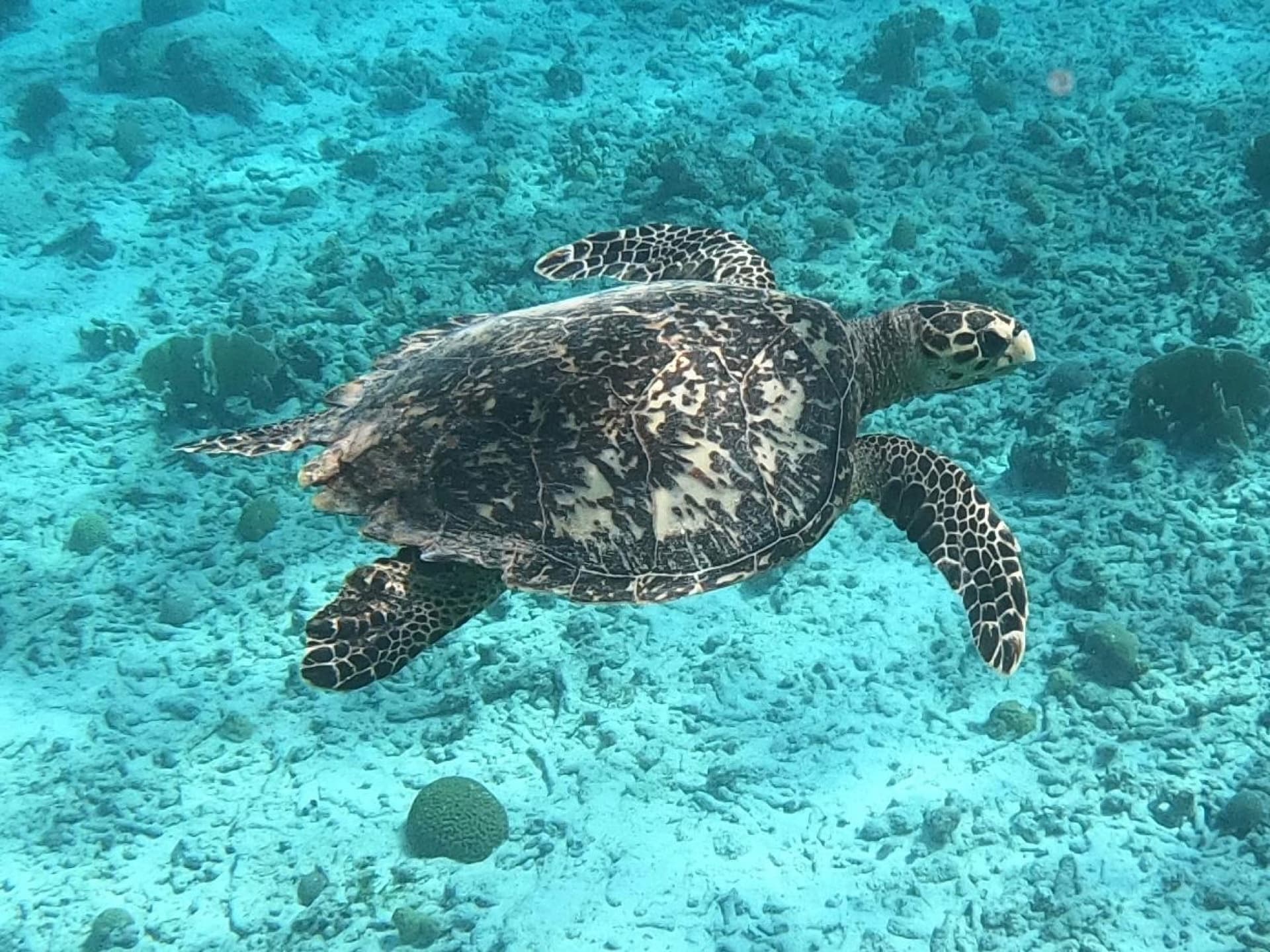
The hawksbill is the more elusive of Curaçao's regularly-sighted turtles — smaller than the green (up to 90 cm shell length), with a distinctive pointed 'beak' and overlapping scutes on the carapace. They're specialists: they eat sponges almost exclusively. On Curaçao's reefs you'll find them methodically biting chunks from barrel sponges and tube sponges at 6-15 metres. Critically endangered globally; seeing one is a real encounter. Commonly seen: Playa Lagun, Santa Martha, Alice in Wonderland, Porto Mari outer reef.

💡 Tip: Their amber-and-brown shell pattern was historically harvested for 'tortoiseshell' — jewellery, eyewear, carvings. The species is protected everywhere now; international trade is banned.

Loggerhead Turtle (Caretta caretta)

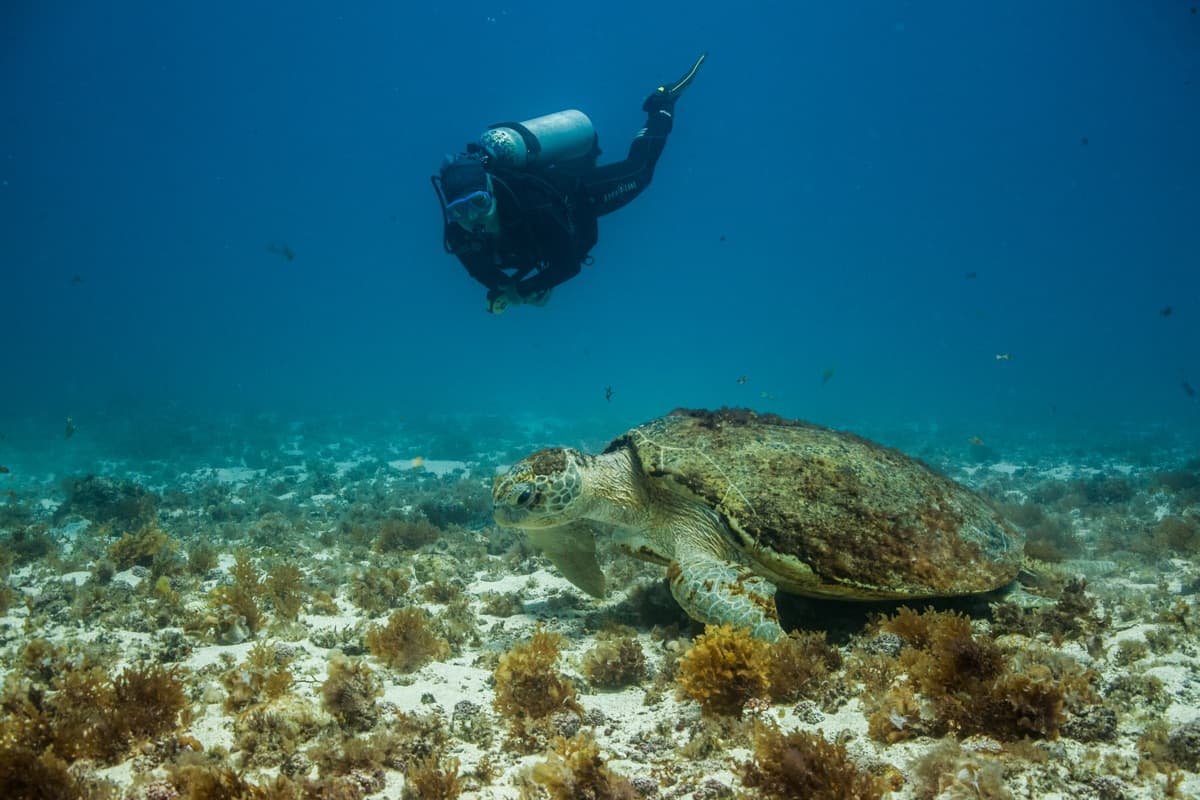
Loggerhead Turtle (Caretta caretta)

The loggerhead is the rarer visitor of Curaçao's three turtle species — larger than either green or hawksbill (up to 110 cm shell length) with a huge head and powerful jaws adapted to crushing molluscs and crustaceans. They're carnivorous, unlike the mostly-herbivorous green. Sightings are less predictable; occasional encounters on the offshore reefs of Klein Curaçao and the far north coast. Commonly seen: Klein Curaçao outer reefs, occasional at Watamula.

💡 Tip: The head size relative to the body is the quick ID — loggerheads look 'big-headed'. Greens and hawksbills have proportionally smaller heads.

Spotted Eagle Ray (Aetobatus narinari)

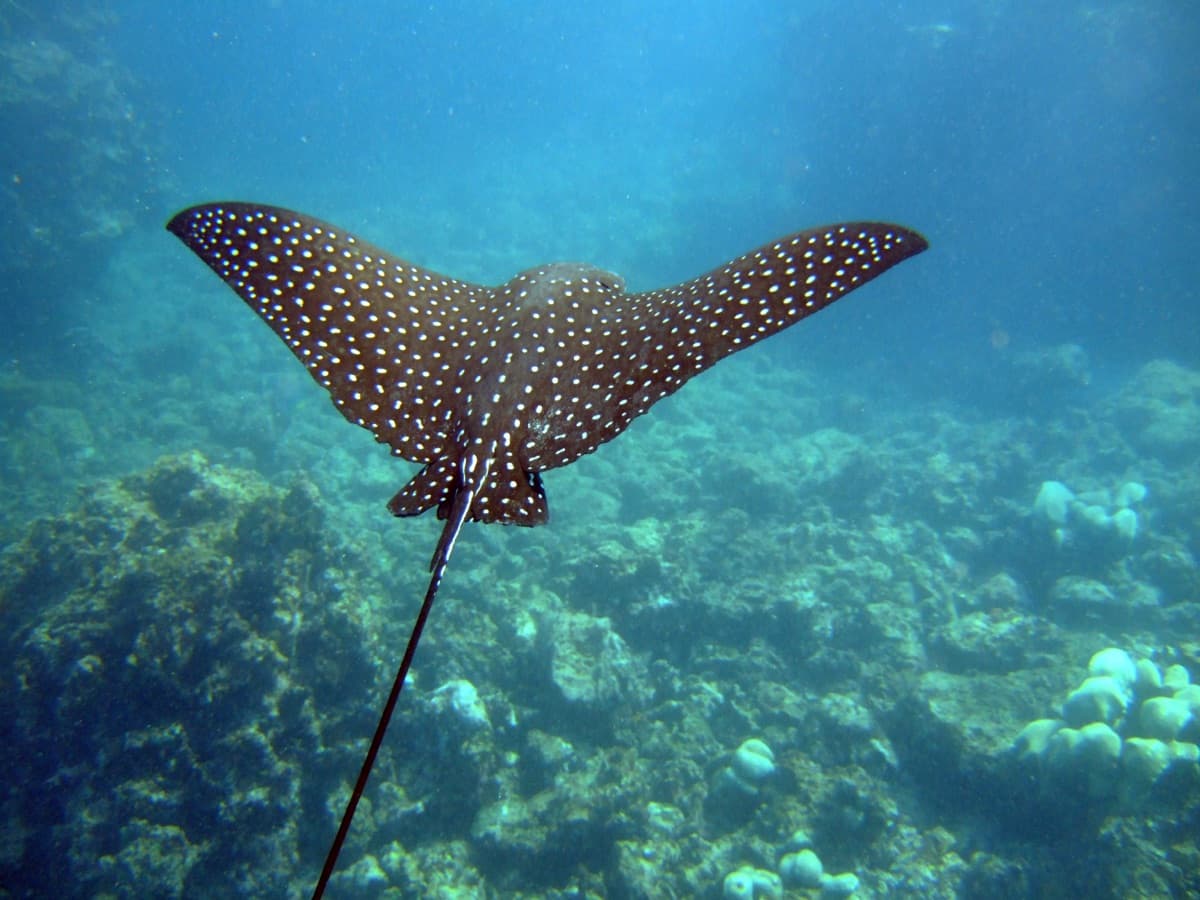
Spotted Eagle Ray (Aetobatus narinari)

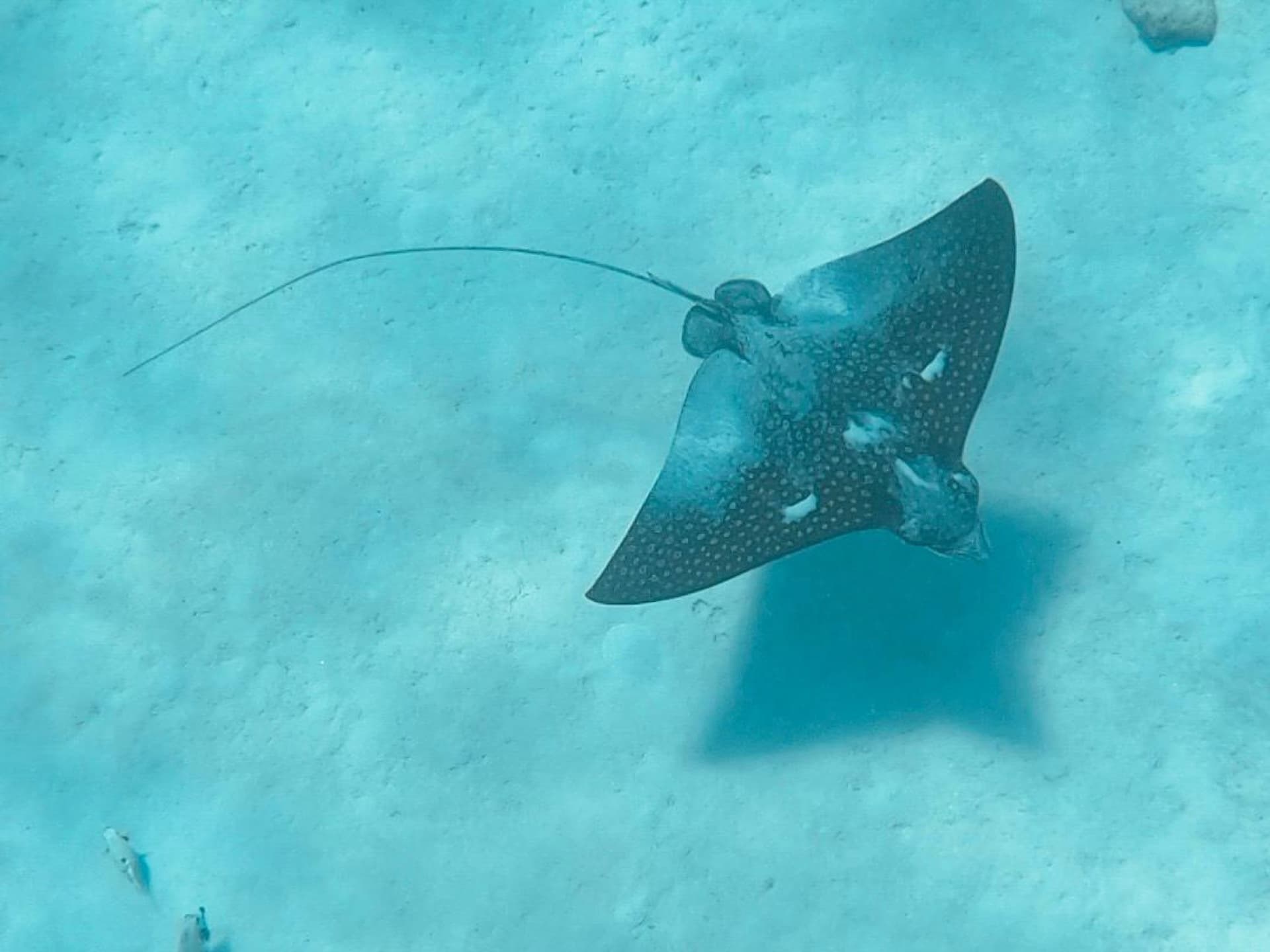
The spotted eagle ray is Curaçao's most photogenic pelagic — up to 3 metres wingspan, distinctive white-spotted dark back, and a graceful gliding flight pattern above the sand between reef zones. They often travel in small groups of 2-5 individuals, sometimes larger schools. They feed on molluscs and crustaceans in the sandy areas between reef formations. Unlike stingrays, eagle rays rarely rest on the bottom; they're almost always in motion.

💡 Tip: Best sightings happen along the wall edges at 15-25 metres where they cruise the sand. Slow approach from the side; they're shy of sudden movements from above.

Southern Stingray (Hypanus americanus)

Southern Stingray (Hypanus americanus)

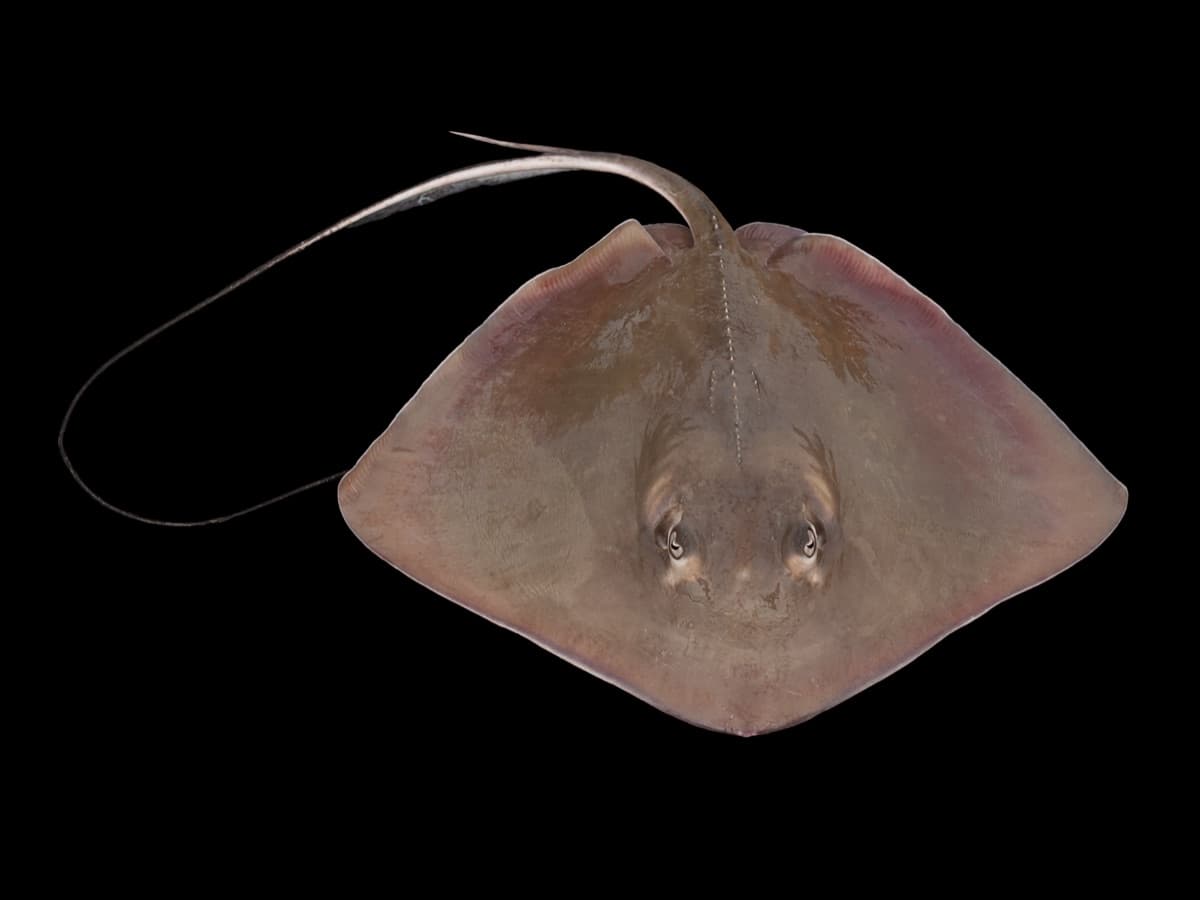
The southern stingray is a reliable find on Curaçao's sandy bottoms — flat, disk-shaped, up to 1.5 metres across, often half-buried in sand with only the eyes and spiracles exposed. They use their mouths on the underside of their bodies to vacuum up molluscs, crustaceans, and small fish from the sediment. The tail carries a venomous spine used only in self-defence; give them space. Commonly seen: Porto Mari sand channel, Director's Bay, Alice in Wonderland.

💡 Tip: Look for 'dig marks' in the sand — craters where stingrays have been feeding. The ray is often still nearby, just buried.

Atlantic Tarpon (Megalops atlanticus)

Atlantic Tarpon (Megalops atlanticus)

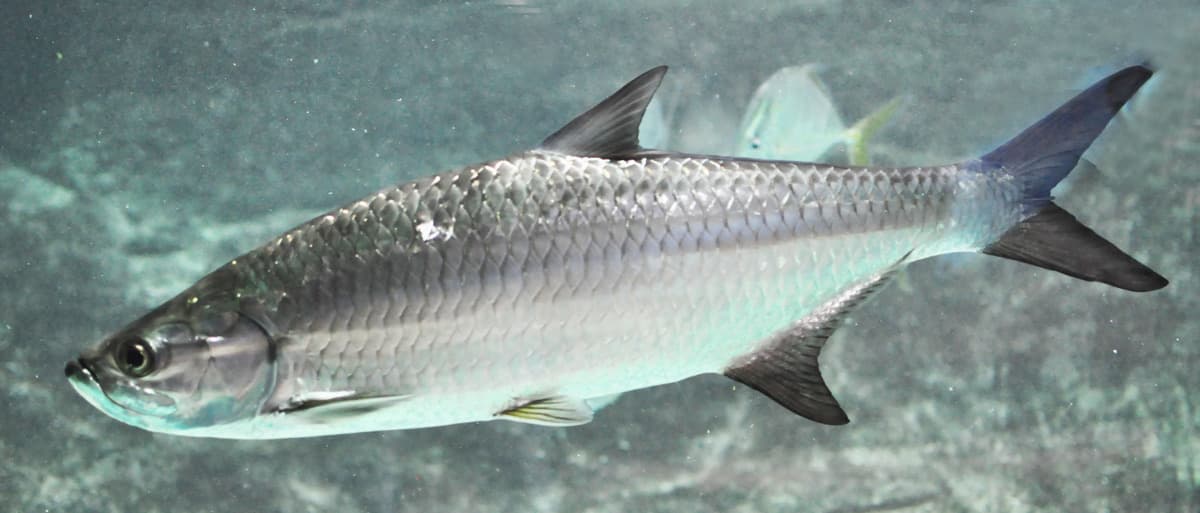
The tarpon is the silver giant of Curaçao's south coast reefs. Adults reach 2 metres and 150 kg, with massive shining scales and a distinctive upward-pointing lower jaw. Schools of tarpon use specific reef sites as daytime holding stations — Tarpon City and Tarpon Bridge are named for this. Divers who hover calmly can be surrounded by a school of 50+ fish, each the size of a person. Primarily nocturnal hunters; during daylight they cruise slowly along reef walls.

💡 Tip: Tarpon City and Tarpon Bridge on the south coast (boat-access) are the reliable sites. Stay calm and still — they'll come close.

Great Barracuda (Sphyraena barracuda)

Great Barracuda (Sphyraena barracuda)

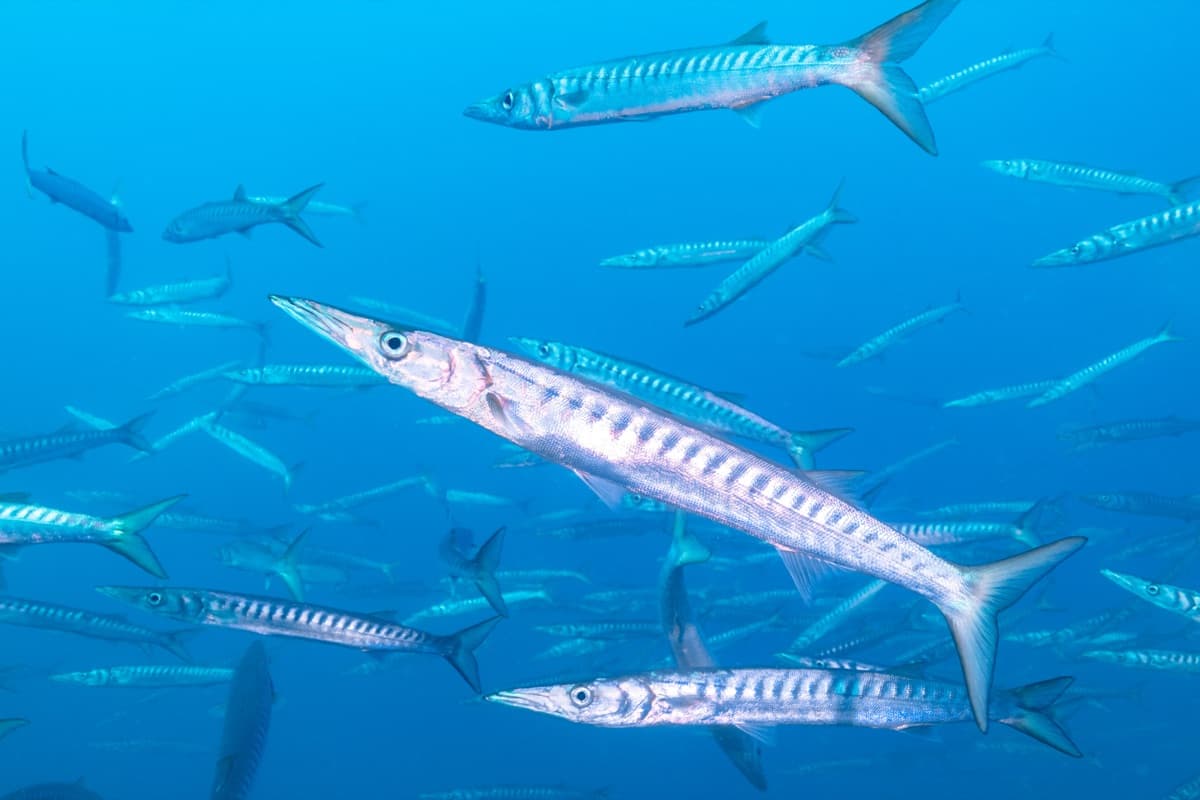
The great barracuda is Curaçao's most common apex predator — lean, silver, up to 1.5 metres long, with a prominent lower jaw showing sharp teeth. Often seen hovering motionless in mid-water or slowly cruising alongside divers. Despite reputation, unprovoked attacks on humans are vanishingly rare. They hunt by ambush, attacking smaller fish with a lightning burst of speed. Solo adults are most common; juveniles form small schools.

💡 Tip: Don't wear shiny metal jewellery on the reef — barracudas can mistake flashes for prey. Not dangerous, but they will investigate.

French Angelfish (Pomacanthus paru)

French Angelfish (Pomacanthus paru)

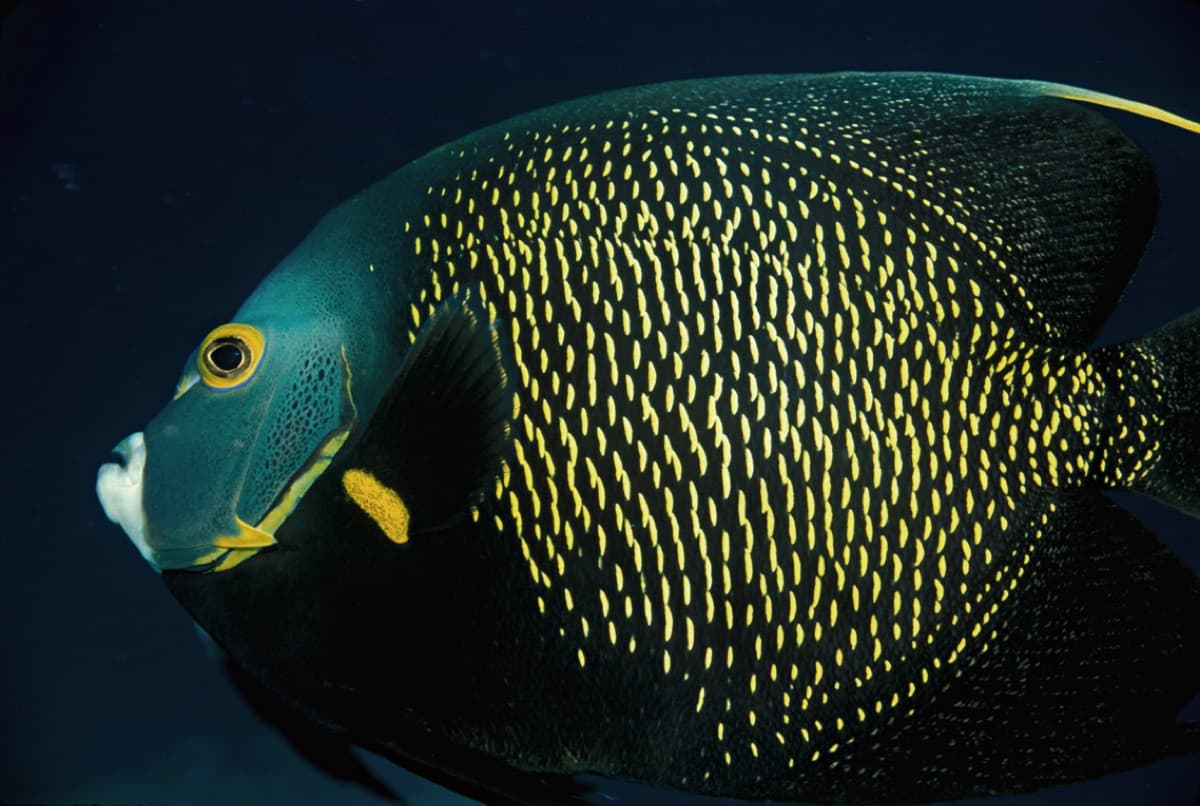
The French angelfish is one of the most recognisable reef fish on Curaçao — disk-shaped, deep black with each scale tipped yellow-gold, giving a speckled metallic appearance. Adults reach 40 cm. They often travel in pairs (mated for life) and patrol the reef for sponges, tunicates, and algae. Comfortable around divers; they'll often approach curiously. Juveniles are black with bright yellow vertical bars — totally different appearance.

💡 Tip: Watch for pairs moving together — the fact they're paired is a rare reef behaviour. Photograph both in one frame if possible.

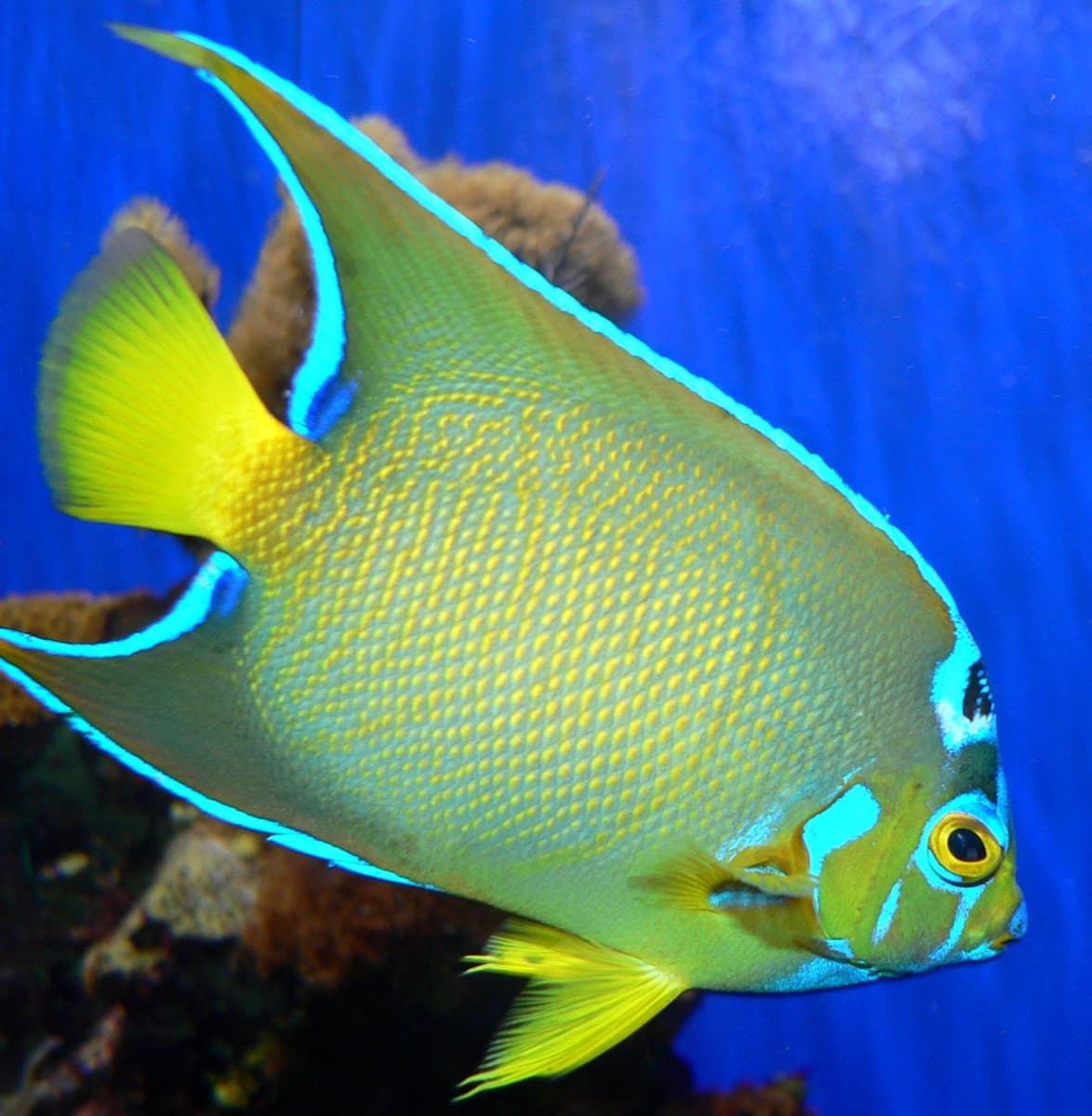
Queen Angelfish (Holacanthus ciliaris)

Queen Angelfish (Holacanthus ciliaris)

The queen angelfish is the more colourful cousin of the French — electric blues and yellows across the body, a distinctive crown-shaped blue marking on the forehead, and long filaments trailing from the dorsal and anal fins. Adults reach 45 cm. Territorial; they patrol a specific section of reef and will defend it against other queens. Feed on sponges, tunicates, and algae. Commonly seen on shallower healthy reefs.

💡 Tip: The 'crown' marking on the forehead is the identification shortcut. French angelfish has no crown; queen angelfish always does.

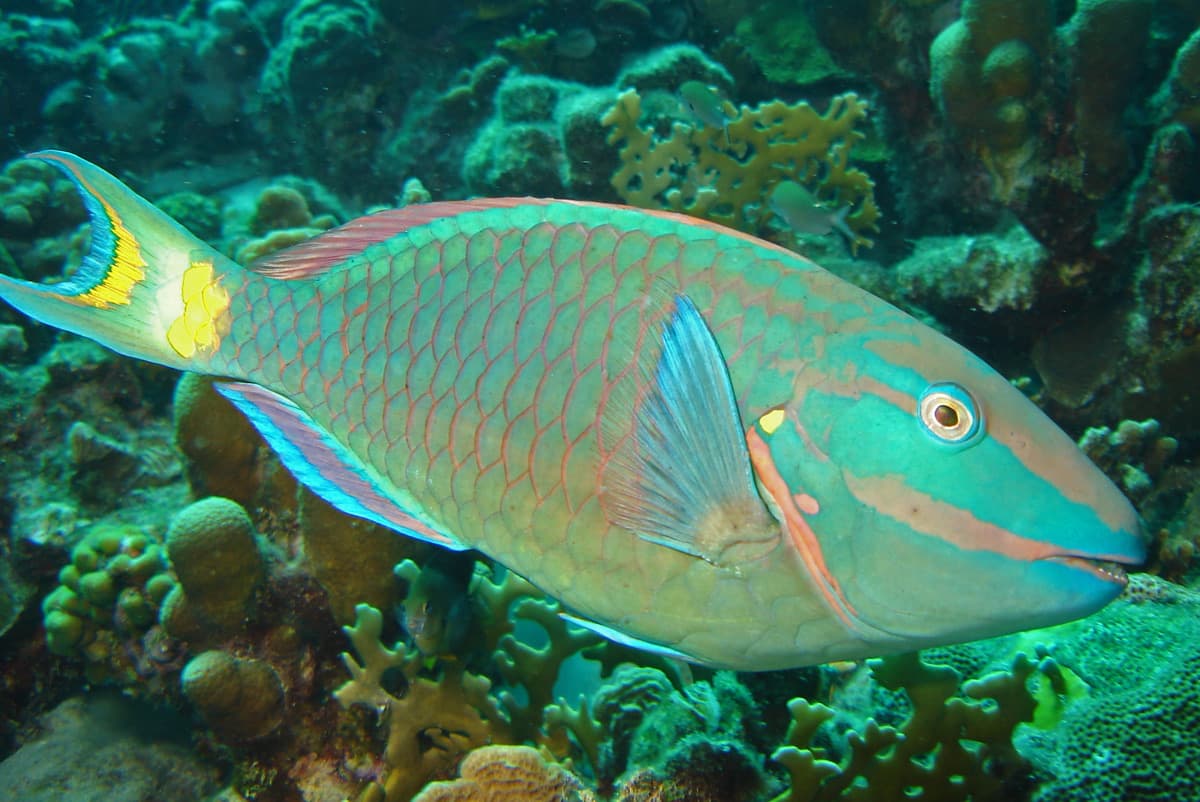
Stoplight Parrotfish (Sparisoma viride)

Stoplight Parrotfish (Sparisoma viride)

The stoplight parrotfish is a colourful contributor to the Caribbean reef — adults show bright blue-green bodies, pink bellies, and a yellow spot near the tail (the 'stoplight'). Up to 60 cm long. Parrotfish use beak-like fused teeth to scrape algae and coral polyps off reef surfaces, producing sand as a byproduct — literally a single parrotfish can produce 100 kg of sand per year. They change sex during their lifetime (female to male). Hear them biting coral during dives; the sound is unmistakable.

💡 Tip: Sleep in mucus cocoons at night to avoid predators. Night dives at Director's Bay sometimes find them slumbering wrapped in slime.

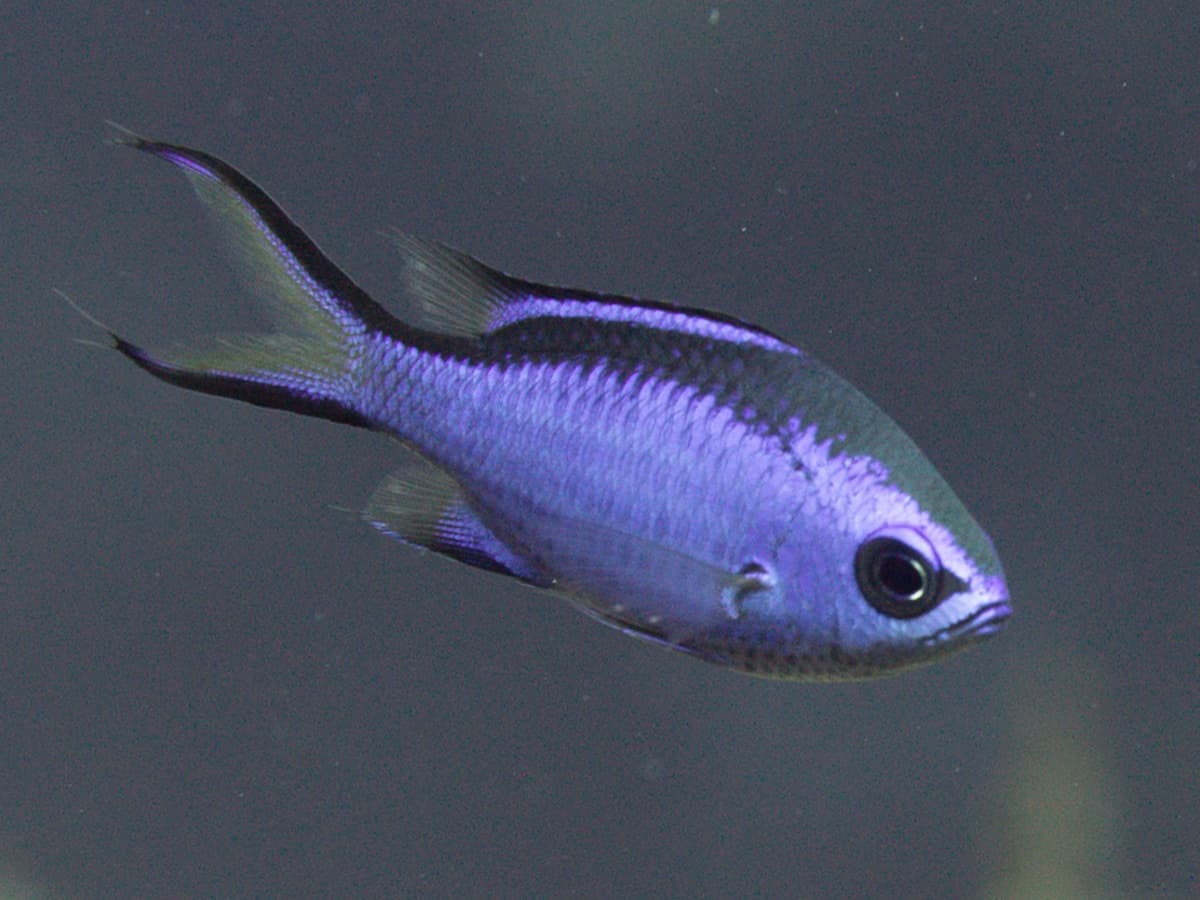
Blue Chromis (Chromis cyanea)

Blue Chromis (Chromis cyanea)

The blue chromis is the small, electric-blue fish that forms dense schools hovering above Curaçao reefs. Each fish is only 10-15 cm long but they travel in schools of hundreds, creating a shimmering blue cloud in the water column. They feed on zooplankton drifting past the reef. A standard background element on nearly every Curaçao dive site — so common that divers sometimes stop noticing them, but they are iconic reef animation.

💡 Tip: When a blue chromis school suddenly dives for cover into the coral, look for a predator nearby — it's a real-time reef warning system.

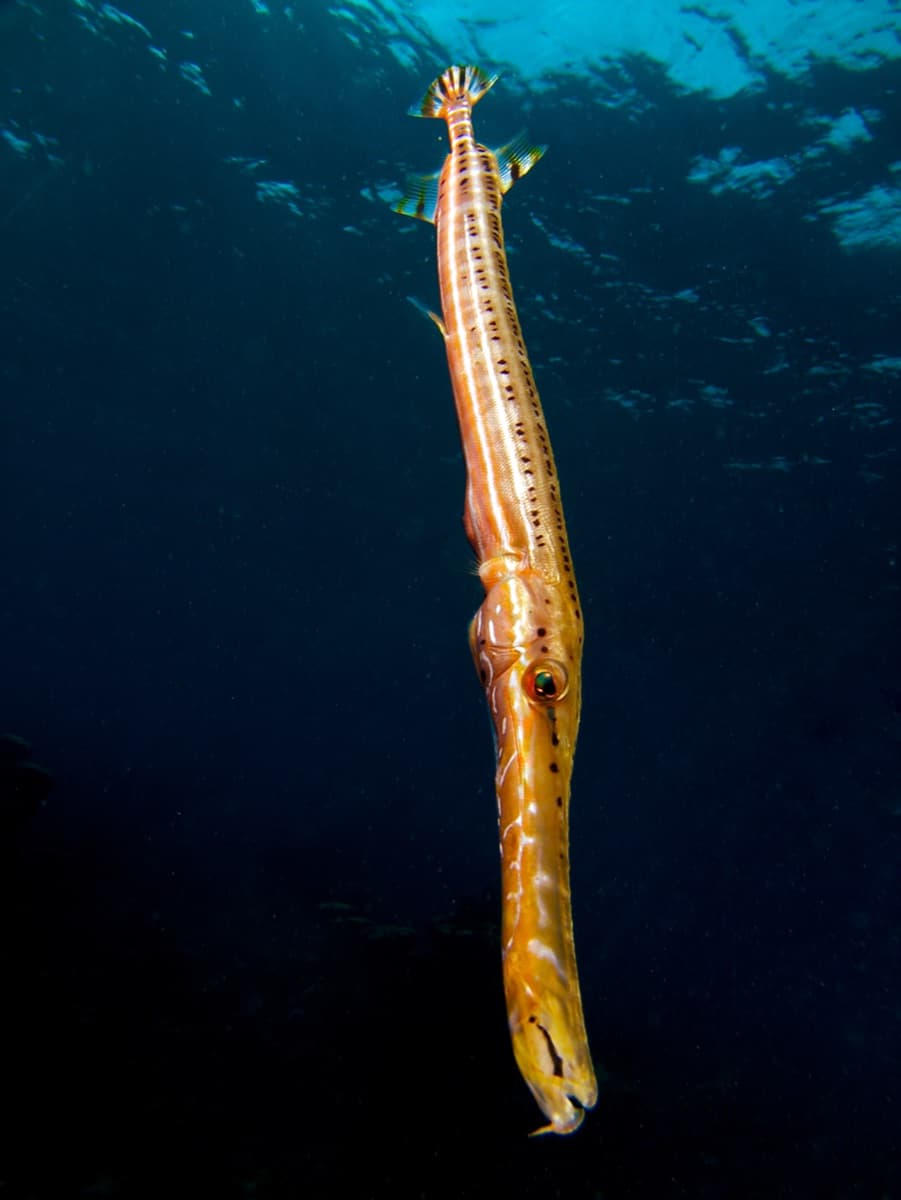
Trumpetfish (Aulostomus maculatus)

Trumpetfish (Aulostomus maculatus)

The trumpetfish is one of Curaçao's more bizarre reef residents — long, thin, with a trumpet-shaped mouth it uses to vacuum up small fish. Up to 1 metre long but only the thickness of a wrist, they often hover vertically amongst gorgonians and sea fans, hidden in plain sight. Colour varies from olive-brown to yellow; some individuals are striking bright yellow. They stalk prey by hiding alongside larger 'host' fish, using them as cover until they can ambush.

💡 Tip: Look vertically among sea fans and soft coral — you'll be surprised how often a trumpetfish is there. The yellow variant is a rare photo target.

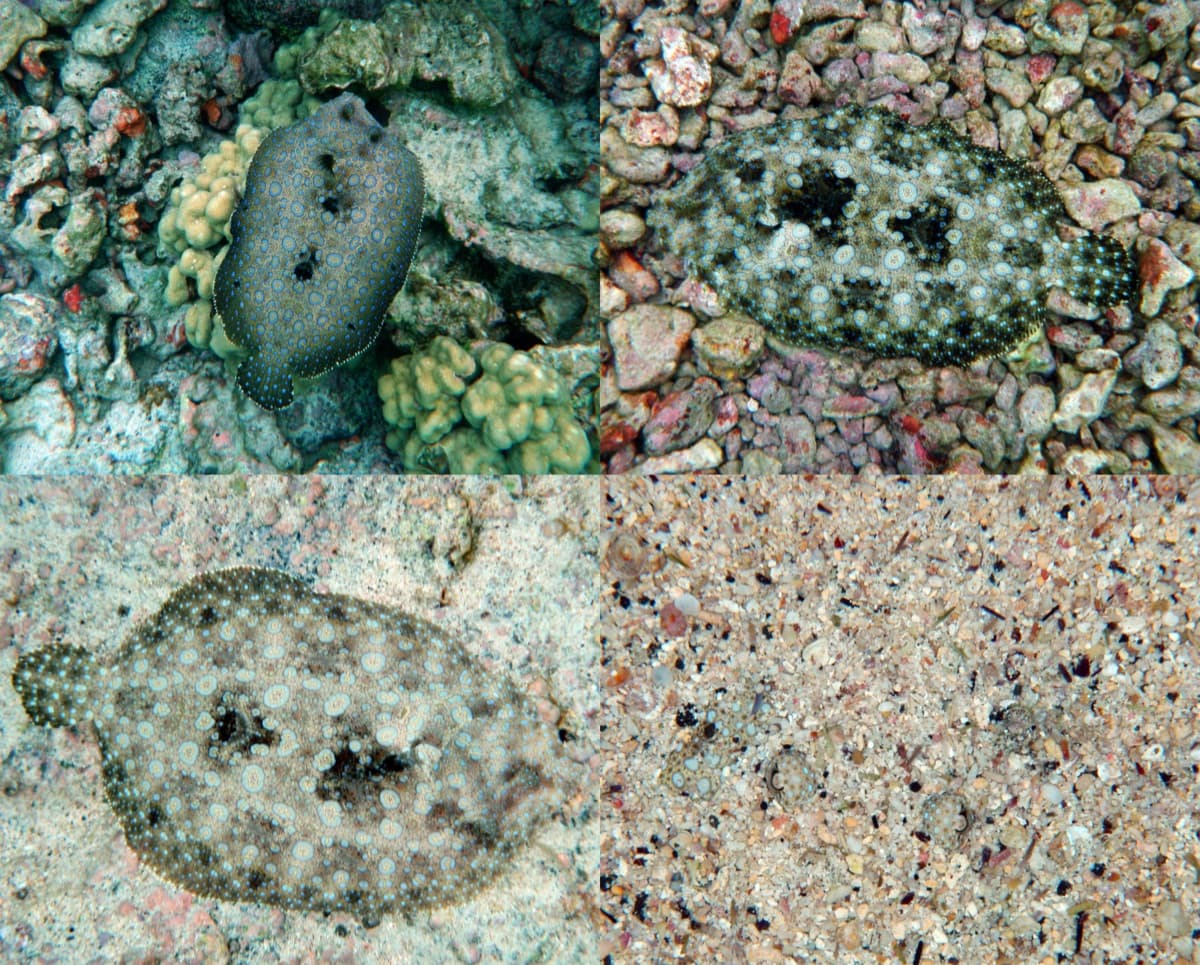
Peacock Flounder (Bothus lunatus)

Peacock Flounder (Bothus lunatus)

The peacock flounder is the master of disguise on Curaçao's sandy bottoms. Flat-bodied, up to 45 cm long, with both eyes on the top of its head (it lies on its right side). The skin has iridescent blue rings and spots that can instantly change colour to match the surrounding sand. Hunts small fish and crustaceans; moves in short bursts then stops and camouflages again. Easy to miss until they move.

💡 Tip: Scan the sand near the reef edge. A moving 'cloud' of sand often reveals a flounder that just relocated. Photograph quickly — they freeze and disappear.

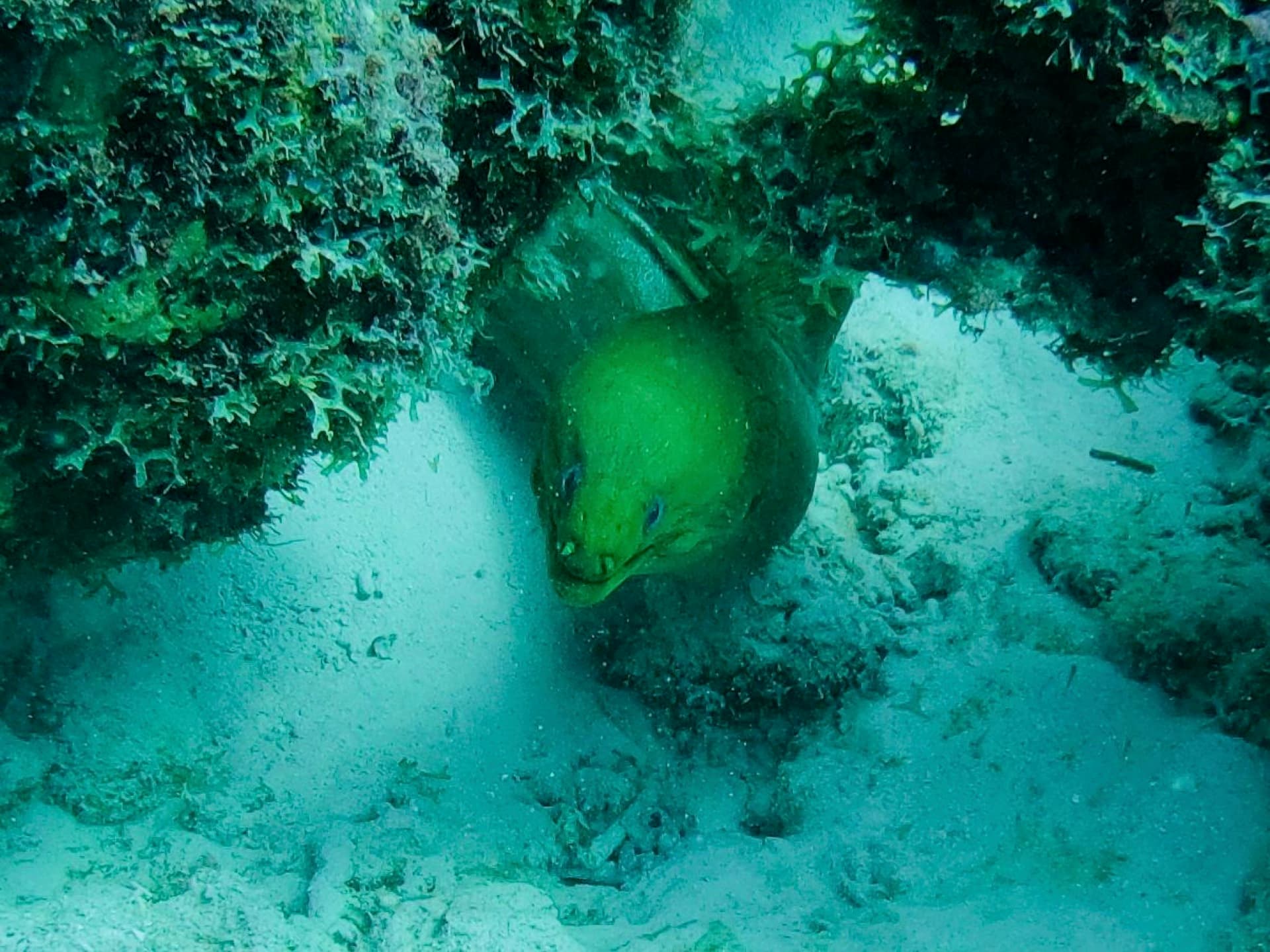
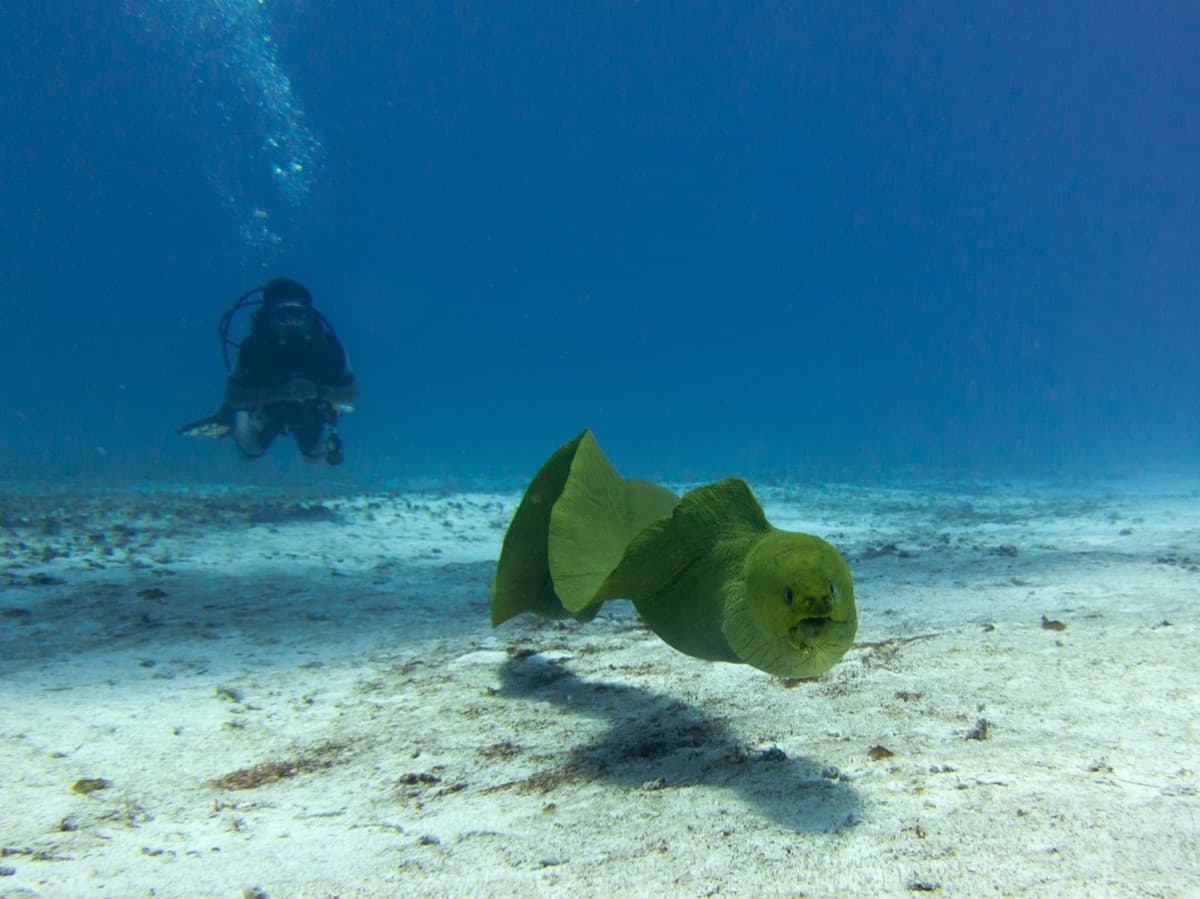
Green Moray Eel (Gymnothorax funebris)

Green Moray Eel (Gymnothorax funebris)

The green moray is the largest moray in Caribbean waters — up to 2.5 metres long, with a muscular green-brown body and an open-jawed resting posture that looks menacing but is just how they breathe (pumping water over gills). They hide in reef crevices during the day and hunt at night. The resident green moray at the Tugboat wreck is one of Curaçao's most photographed individuals. Not aggressive unless threatened; stay hands-off.

💡 Tip: The open mouth is not aggression — it's respiration. Give them 1 metre of space and they'll ignore you.

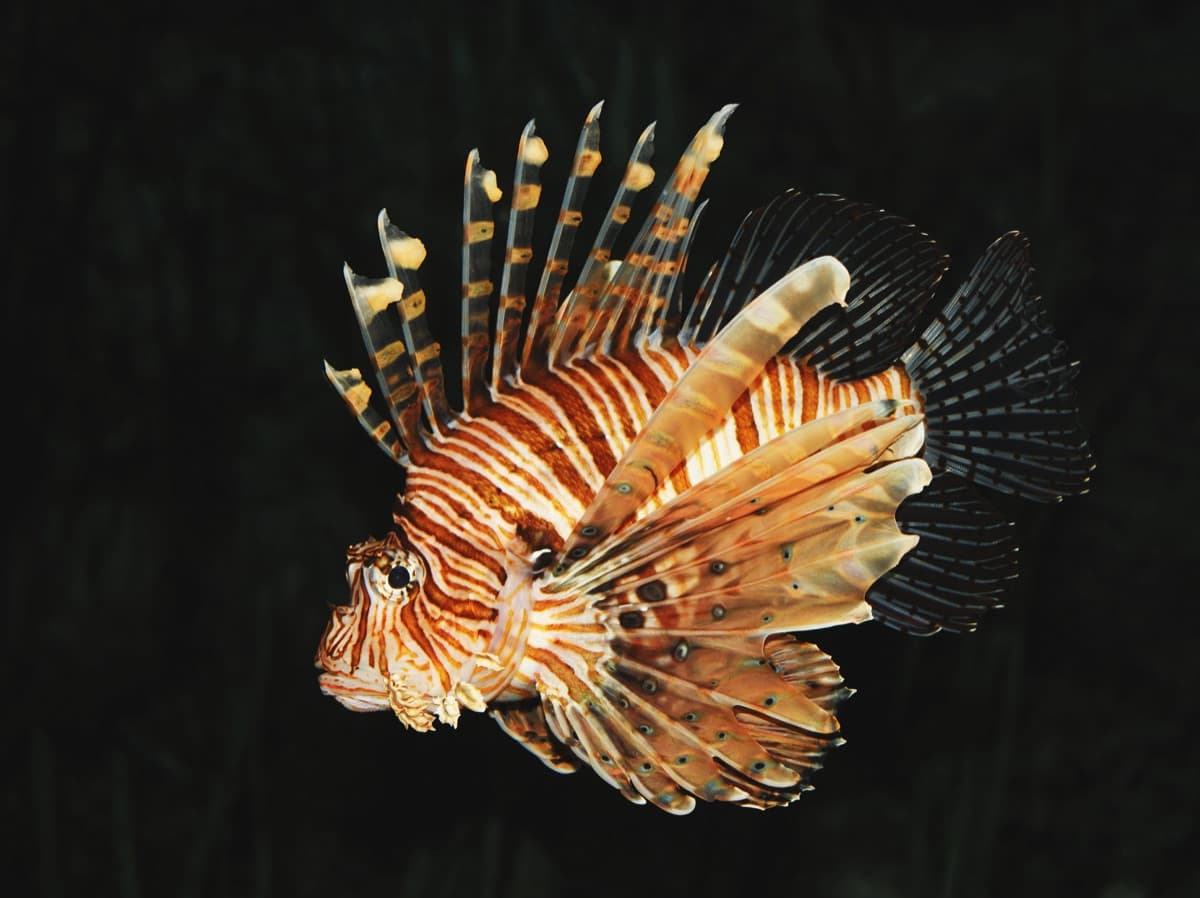
Lionfish (Pterois volitans) — The Invasive Threat

Lionfish (Pterois volitans) — The Invasive Threat

The red lionfish is an introduced species in Caribbean waters and a serious threat to Curaçao's reef ecology. Native to the Indo-Pacific, released accidentally in Florida decades ago, they've spread across the Caribbean with no natural predators. One lionfish can eat dozens of juvenile reef fish per day. Adults reach 35 cm, with dramatic spiny fins and striking red-and-white vertical stripes. The spines are venomous; don't touch. Curaçao has a 'Lionfish Hunter' diver certification allowing legal spear-fishing of lionfish to protect the reef. They're also excellent eating — many local restaurants serve lionfish ceviche.

💡 Tip: If you see a lionfish, report it to your dive shop — they pass sightings to licensed hunters. Do not attempt to spear one yourself without the certification.

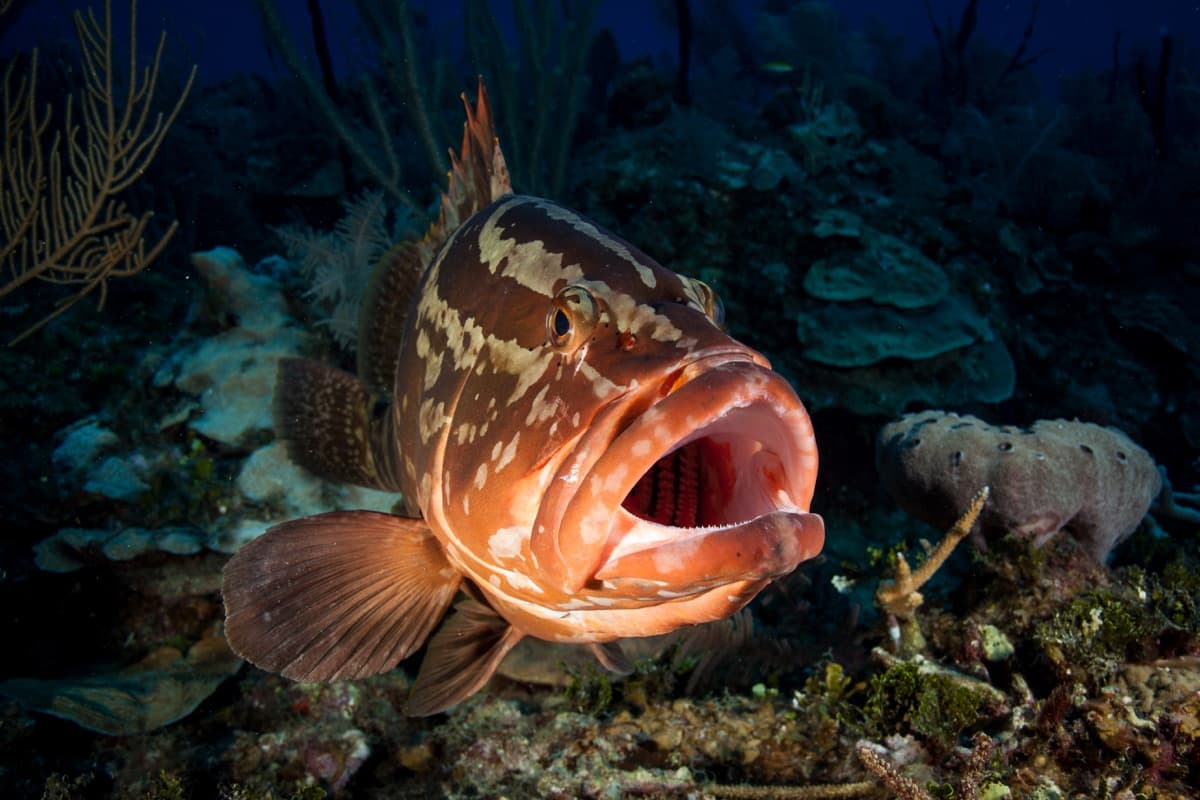
Nassau Grouper (Epinephelus striatus)

Nassau Grouper (Epinephelus striatus)

The Nassau grouper is Curaçao's most recognisable large reef fish — up to 1 metre long, with dramatic dark vertical bars, reddish-brown colouration, and often a distinctive 'saddle' marking on the tail. They're long-lived (up to 30 years) and slow-growing, which makes them vulnerable to overfishing; populations are now protected across much of the Caribbean. They hang out in rocky areas and reef overhangs. Seeing a large adult at close range is a classic Curaçao dive encounter.

💡 Tip: They're curious fish — hover calmly and they'll often swim right up. Don't chase; a calm approach gets closer encounters.

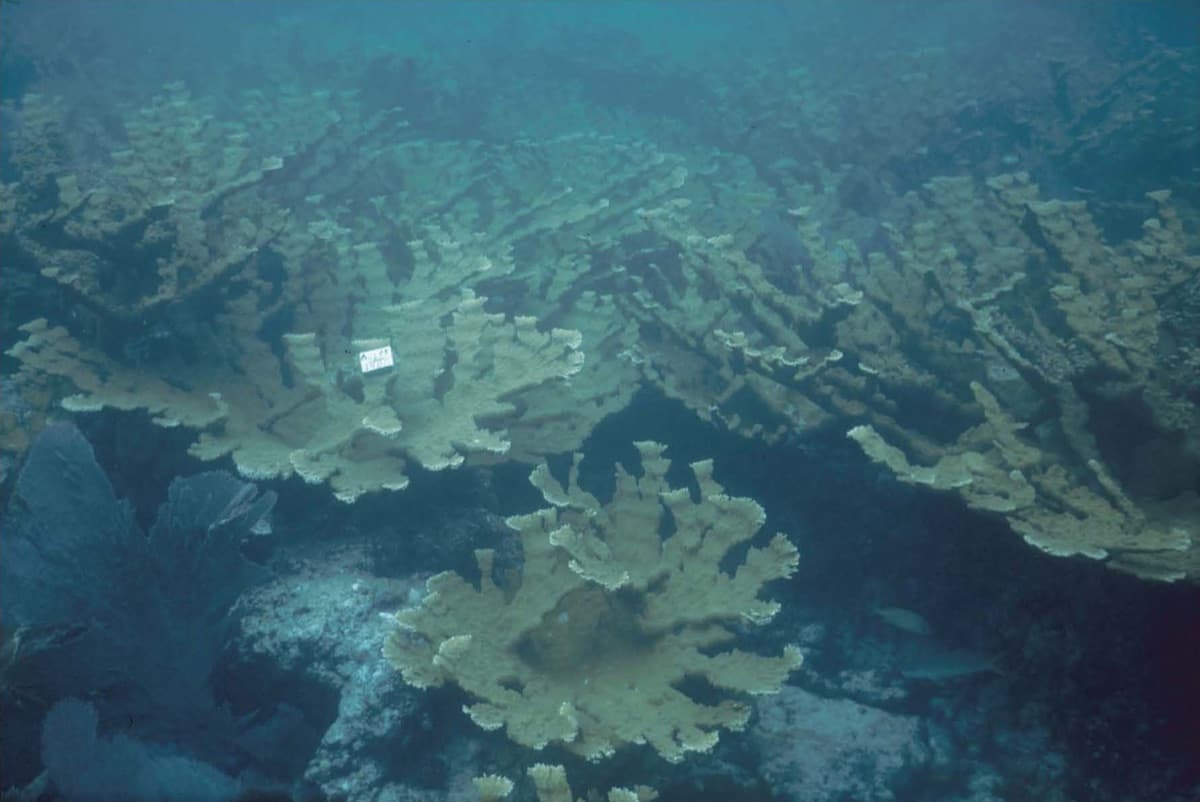
Elkhorn Coral (Acropora palmata)

Elkhorn Coral (Acropora palmata)

Elkhorn coral is one of the most important reef-building species in the Caribbean — but sadly one of the most endangered. The large branching colonies look like antlers (hence the name) and can exceed 4 metres across. Elkhorn has declined 97% across the Caribbean since 1980 due to disease, bleaching, and climate change. Curaçao is one of the few remaining Caribbean islands where mature elkhorn colonies still thrive, particularly at Alice in Wonderland (Playa Kalki) in the shallow zone. Seeing a healthy elkhorn colony is increasingly rare.

💡 Tip: Be especially careful with fins and gear near elkhorn — the species is critically endangered, and any physical damage matters.

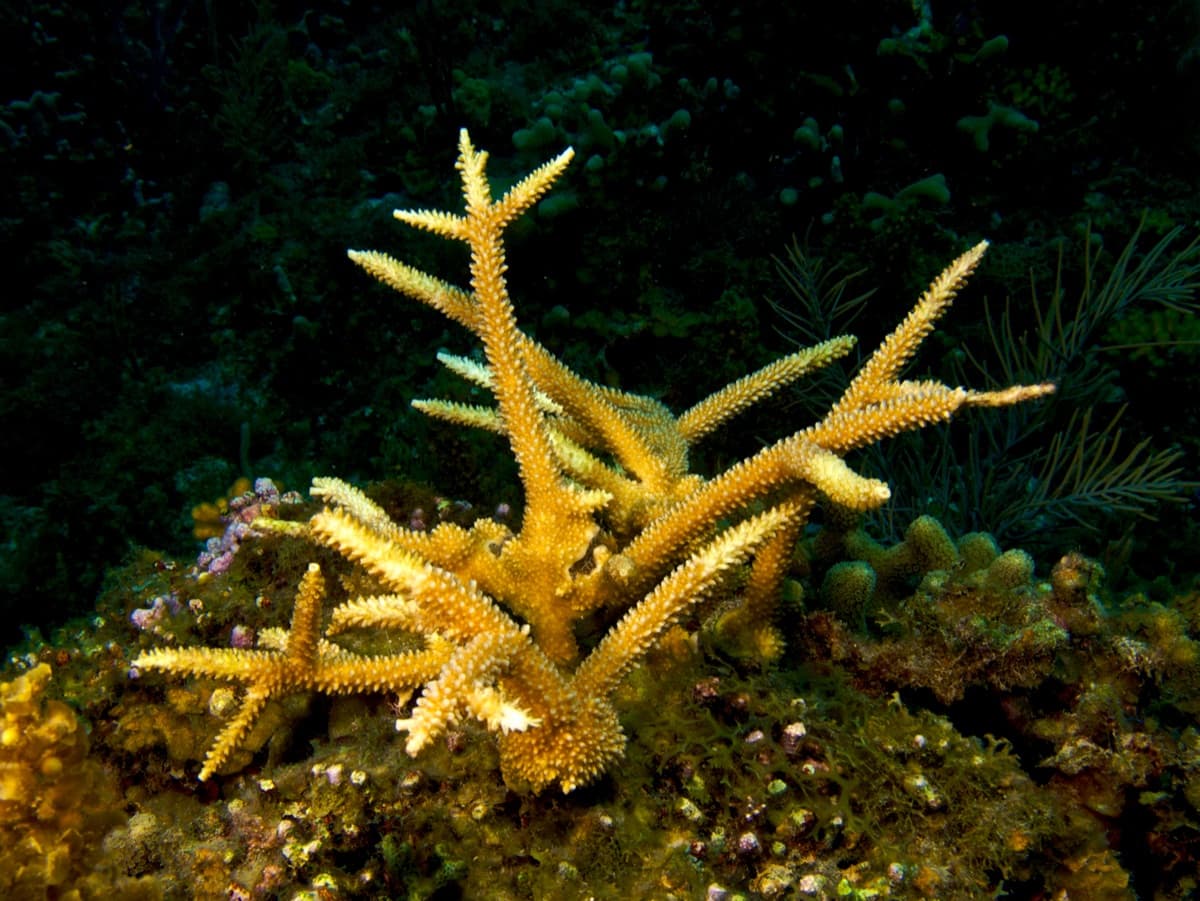
Staghorn Coral (Acropora cervicornis)

Staghorn Coral (Acropora cervicornis)

Staghorn coral is the elkhorn's thinner-branched sibling — dense thickets of pencil-thin branches forming in shallow reef zones. Like elkhorn, staghorn has declined catastrophically across the Caribbean (>90% loss) due to white-band disease and climate stress. Surviving thickets on Curaçao are precious — Alice in Wonderland, Playa Lagun, and Cas Abao all have staghorn zones. Provides critical habitat for juvenile reef fish; once lost, the habitat for many species disappears with it.

💡 Tip: Staghorn thickets are fish nurseries — slow down and look for small juvenile fish sheltered among the branches.

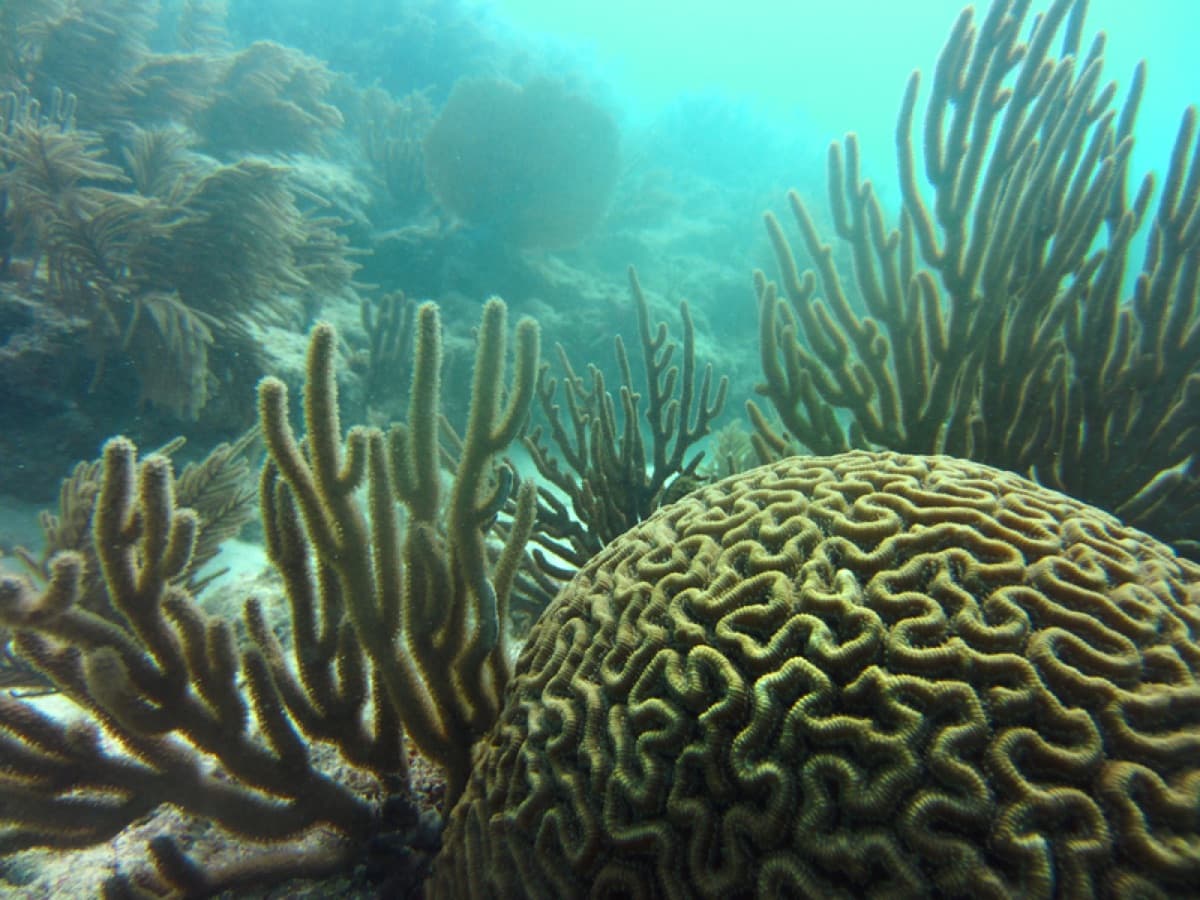
Brain Coral (Diploria labyrinthiformis)

Brain Coral (Diploria labyrinthiformis)

Brain coral colonies look exactly like their name — massive rounded boulders with a labyrinth-pattern surface that resembles a human brain. Slow-growing (about 1 cm per year) and long-lived (individual colonies can be centuries old). They form the structural backbone of many Caribbean reefs. Multiple species of brain coral exist on Curaçao's reefs; symmetrical brain coral (Pseudodiploria strigosa) is the most common. Look for them on nearly every Curaçao dive site at 5-15 metres.

💡 Tip: At night, the tiny coral polyps extend from the 'valleys' of the brain pattern to feed — a subtle but transformative visual shift. Night divers watch for this.

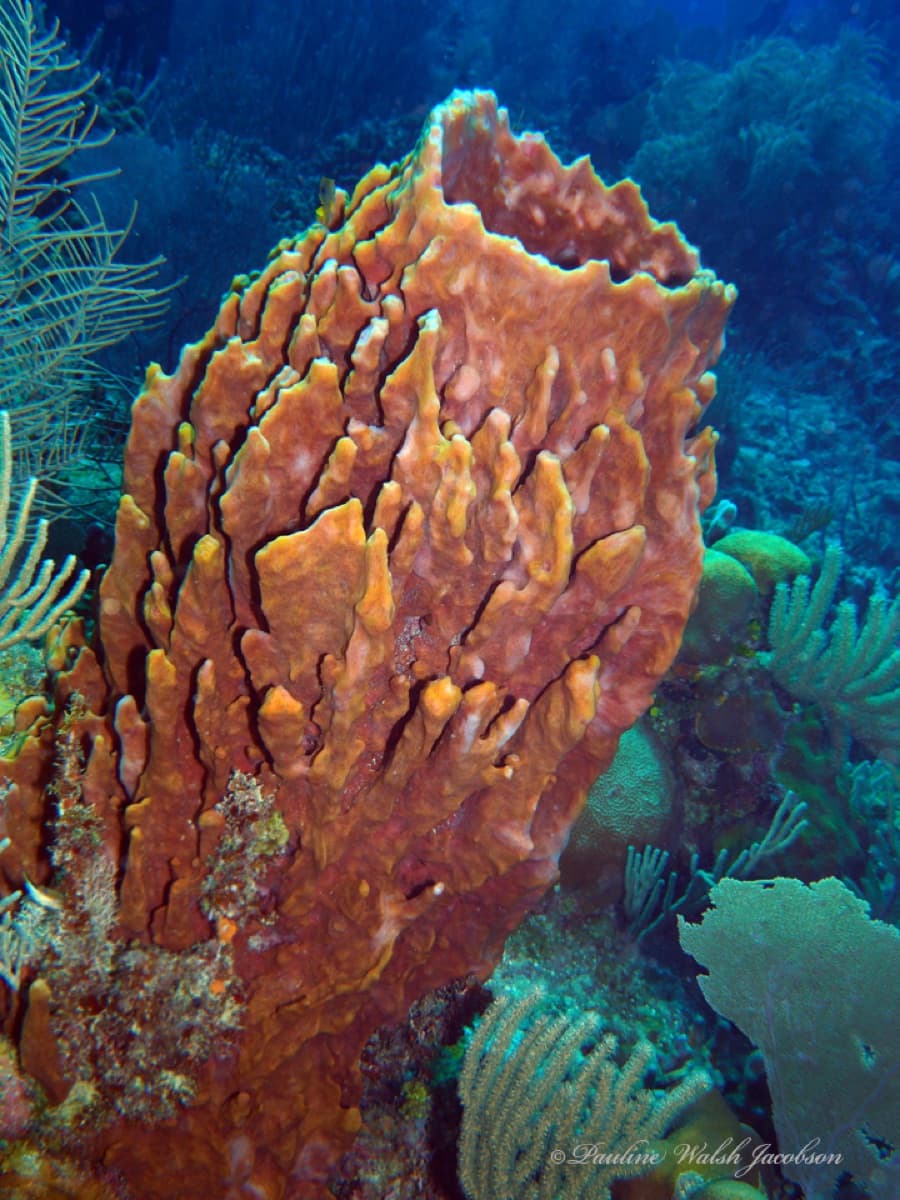
Giant Barrel Sponge (Xestospongia muta)

Giant Barrel Sponge (Xestospongia muta)

The giant barrel sponge is the largest sponge species in the Caribbean — some individuals exceed 2 metres in diameter and are estimated to be 500+ years old. Orange, cup-shaped, barrel-ish; they filter thousands of litres of seawater per day extracting plankton and bacteria. Sponge Forest on Curaçao's north-west coast is named for the dense population of these giants. Individual sponges have been given names by local dive guides. Hurt a barrel sponge and it doesn't recover; they grow at about 1 cm per year.

💡 Tip: Keep ALL gear (fins, computer, camera housing) away from barrel sponges — they are surprisingly fragile and extremely slow to recover.

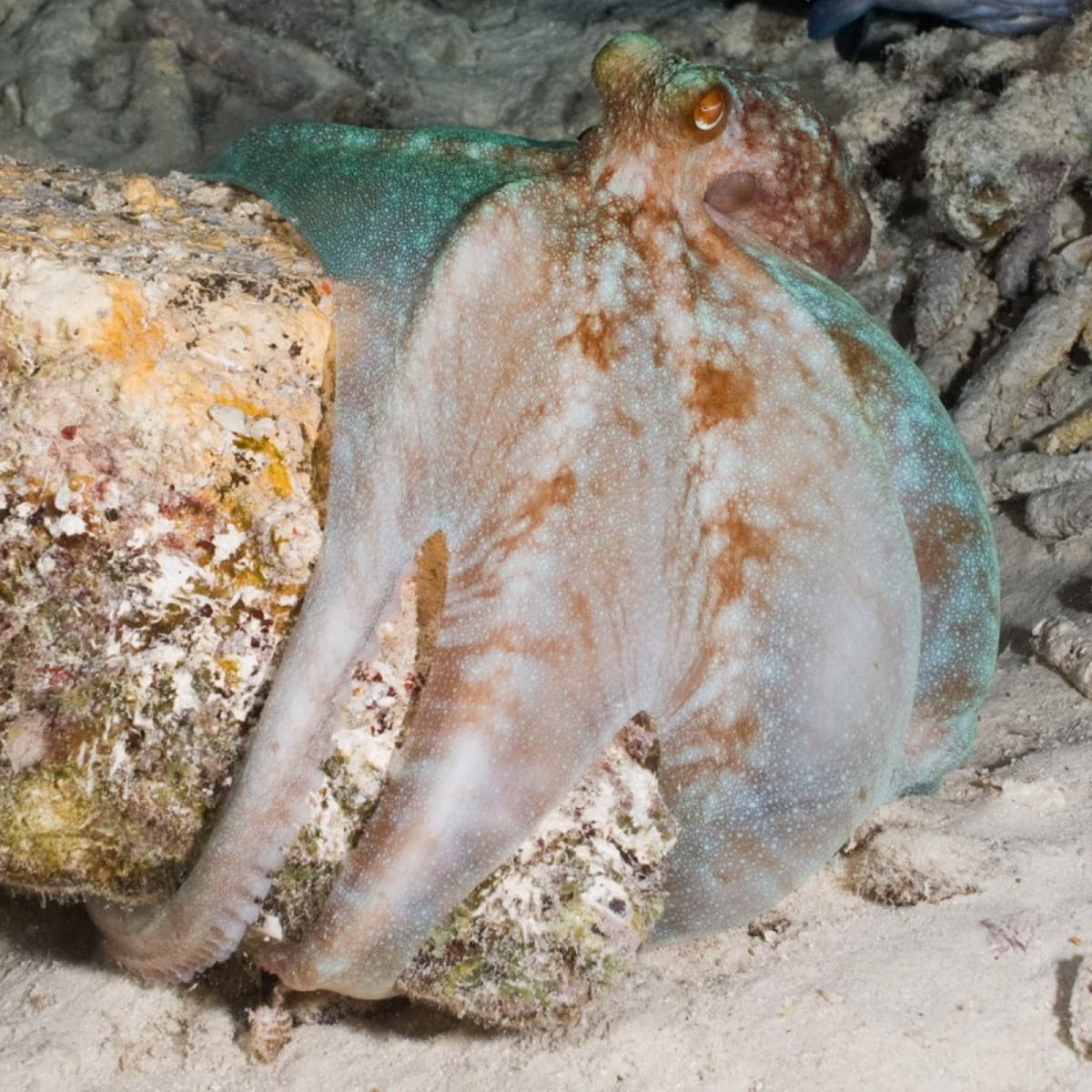
Caribbean Reef Octopus (Octopus briareus)

Caribbean Reef Octopus (Octopus briareus)

The Caribbean reef octopus is one of Curaçao's most fascinating night-dive sightings — small (arm-span up to 60 cm), highly intelligent, with colour-changing skin that can shift in milliseconds from pale white to rich red-brown. Nocturnal hunters; during day they hide in reef holes and rubble piles. At night they emerge to hunt crabs and small fish, using their eight arms with remarkable dexterity. Individual octopus have distinct personalities; some approach divers, others vanish instantly.

💡 Tip: Director's Bay night dives are the reliable sighting location. If an octopus approaches and 'touches' your dive torch, it's curiosity, not threat.

Caribbean Reef Squid (Sepioteuthis sepioidea)

The Caribbean reef squid is a smaller, diurnal cephalopod often seen hovering in small schools of 3-10 individuals just above the reef. They display rapid colour-change communication — within a single school, one squid might simultaneously flash bright colours to its neighbour while showing camouflage colouration to a potential predator on the other side. Each squid is only 15-20 cm long. Easy to approach slowly; they're curious and often pose for photos.

💡 Tip: Squid 'blush' when startled — the entire school flushing pink simultaneously. Move slowly to avoid triggering this; they're more interesting when calm.

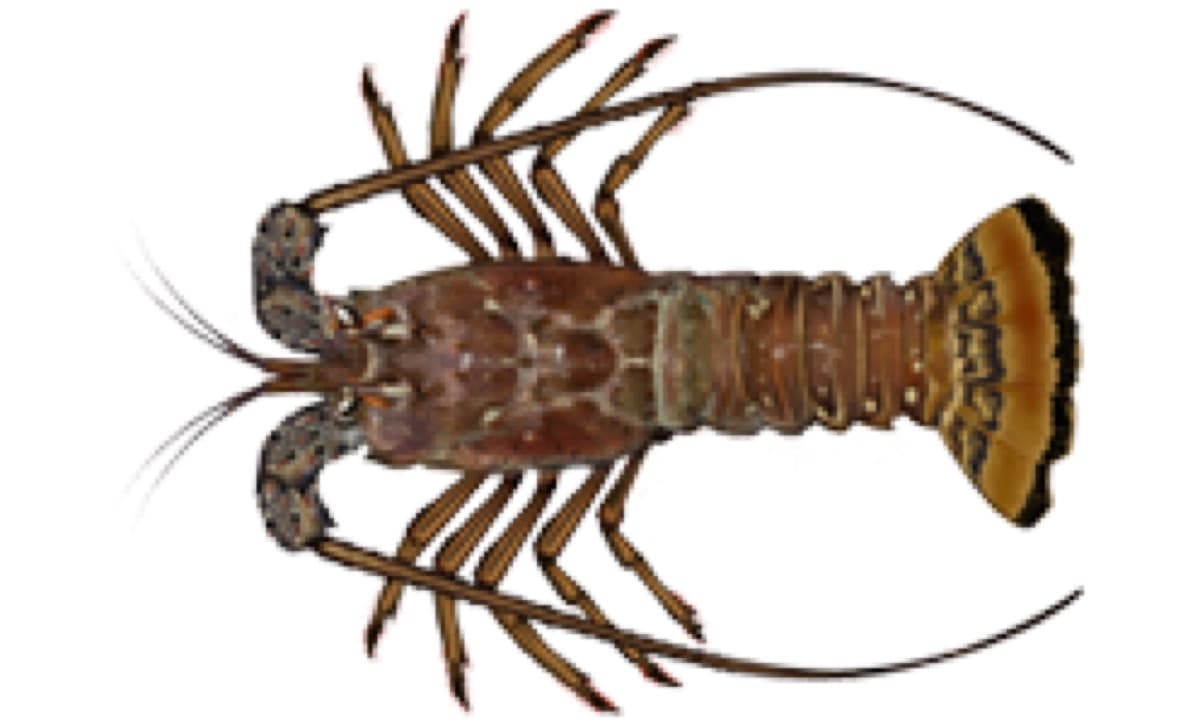
Caribbean Spiny Lobster (Panulirus argus)

Caribbean Spiny Lobster (Panulirus argus)

The spiny lobster is Curaçao's most common lobster — up to 60 cm body length, with two long antennae extending even further. Unlike American lobsters, spiny lobsters don't have the big front claws; they defend themselves with powerful tail-flips and spiny exoskeleton. Nocturnal; during day they hide in reef crevices with only antennae visible. Night dives reveal them walking the reef floor. Migrate in long single-file lines of dozens of individuals during certain seasons — a spectacular and rare sighting.

💡 Tip: Look for the twin antennae projecting from reef holes during daytime — often the only visible part of a hidden lobster.

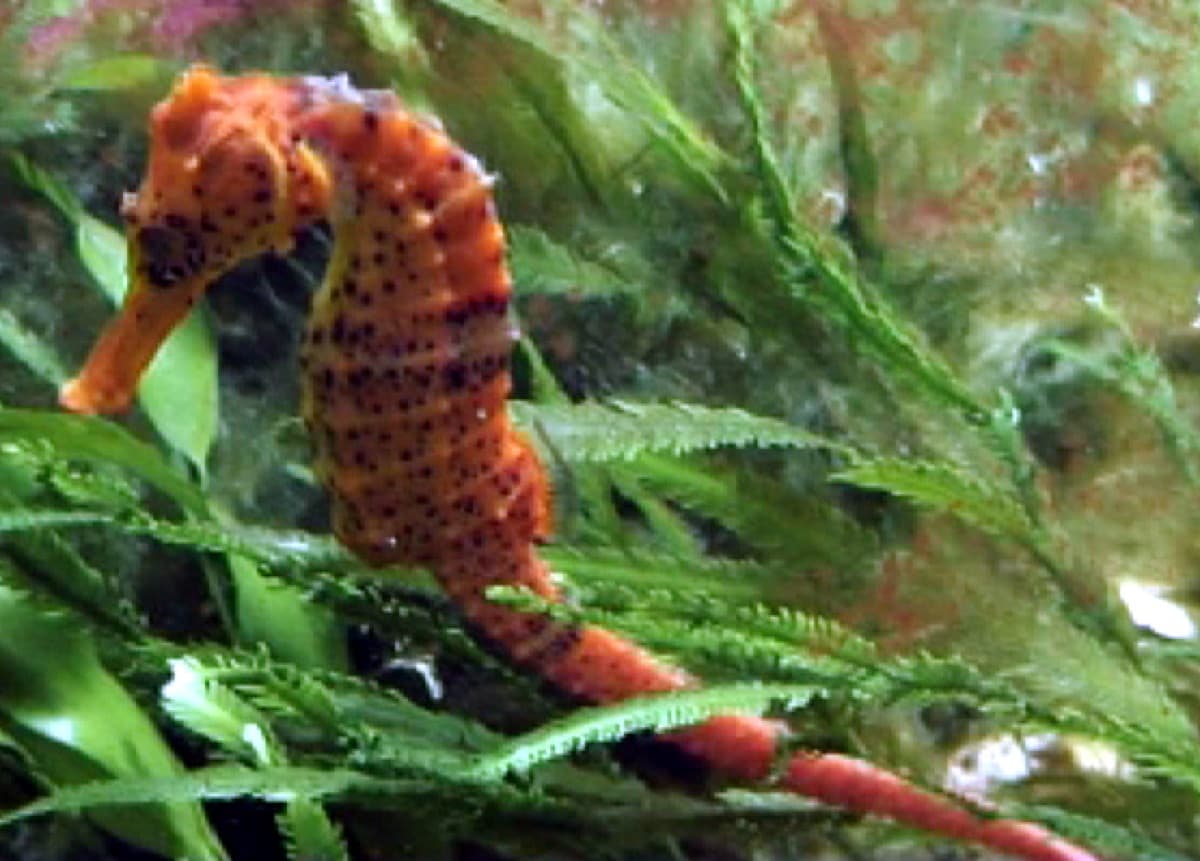
Seahorse (Hippocampus reidi)

Seahorse (Hippocampus reidi)

Seahorses in Curaçao are rare, cryptic, and thrilling to find. The longsnout seahorse lives in the mangrove root systems of Spanish Water and occasionally on the open reef. They grow to 15 cm, with variable colour (yellow, orange, brown, black depending on their surroundings), and cling to seagrass or coral with prehensile tails. Males incubate eggs in a brood pouch — one of the few species where males give 'birth'. Critically elusive; a guide doubles your chances of spotting one.

💡 Tip: Mangrove tours in Spanish Water with experienced guides have the highest seahorse encounter rate. Count on 30+ minutes of slow searching.

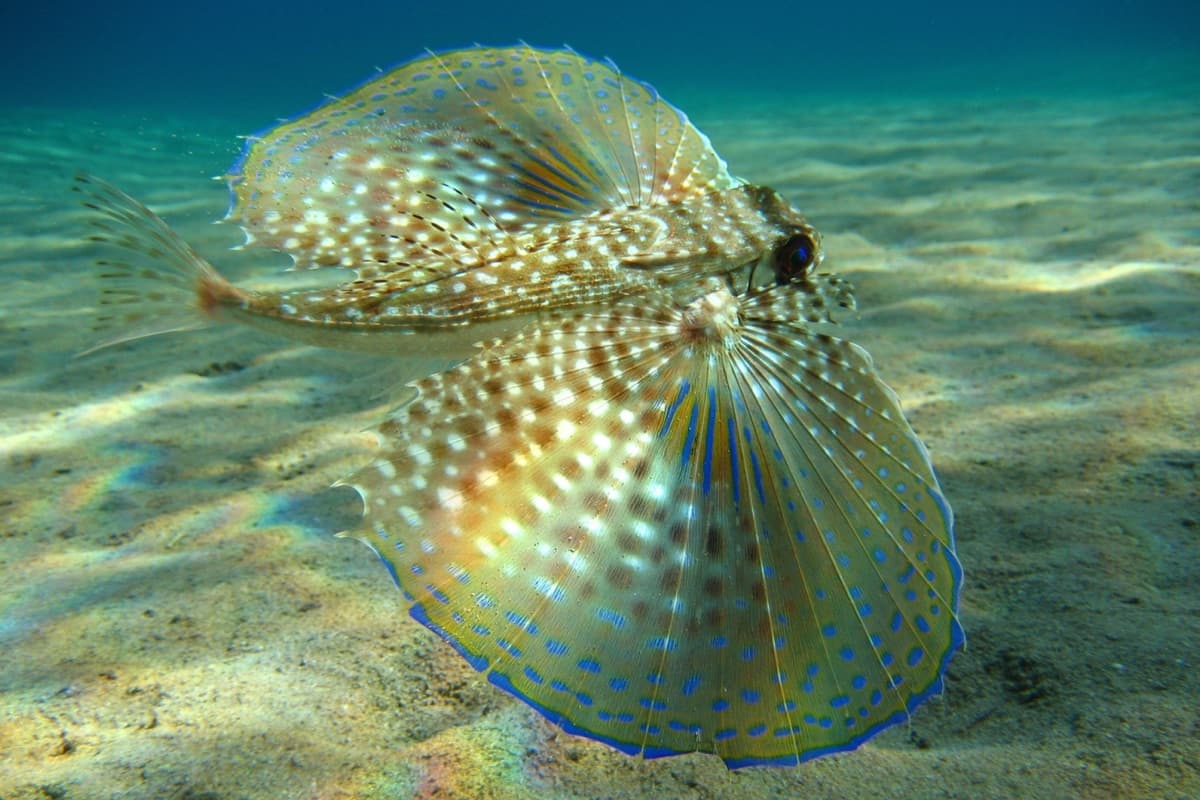
Flying Gurnard (Dactylopterus volitans)

Flying Gurnard (Dactylopterus volitans)

The flying gurnard is a strange bottom-dwelling fish with massive wing-like pectoral fins that spread to reveal blue-tipped rays when the fish is startled or courting. Up to 40 cm long, they walk on sandy bottoms using modified pelvic fins like little legs, feeding on crustaceans and small fish. The spread-fin display is extraordinary — an underwater rainbow fan. Relatively uncommon on Curaçao but spotted on sand channels and shallow reef edges.

💡 Tip: If you see a grey-brown fish 'walking' on the sand, approach very slowly. Any disturbance makes it fly off in a fin-spreading display.

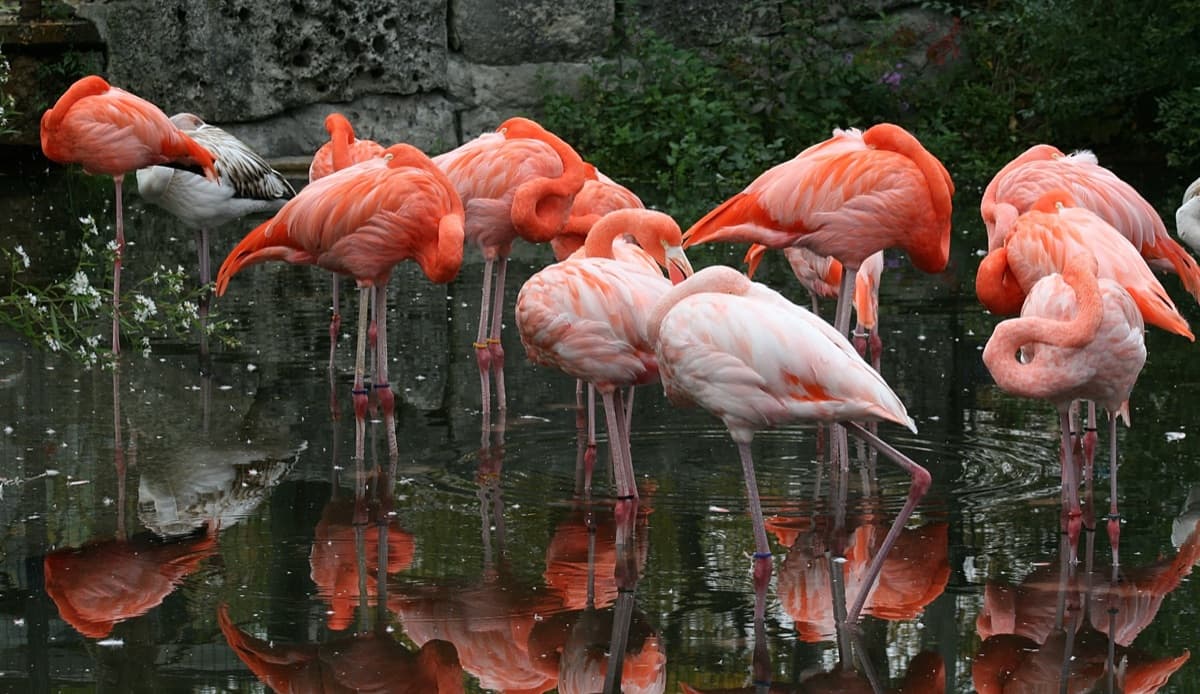
Caribbean Flamingo (Phoenicopterus ruber)

Caribbean Flamingo (Phoenicopterus ruber)

Caribbean flamingos are Curaçao's most recognisable non-marine wildlife. They feed in the salt pans and shallow inland bays, filtering algae and small crustaceans that give their feathers the distinctive pink colour. The best reliable viewing is at the Jan Kok salt pans, where small flocks wade year-round, but larger populations live mostly on Bonaire — Curaçao's flocks are smaller and fly between the two islands. Best photographed at sunset when the pink reflects in the pink-tinted water.

💡 Tip: Landhuis Jan Kok's restaurant terrace overlooks the flamingo feeding area. Dinner reservation there at sunset is the island's best flamingo-watching experience.

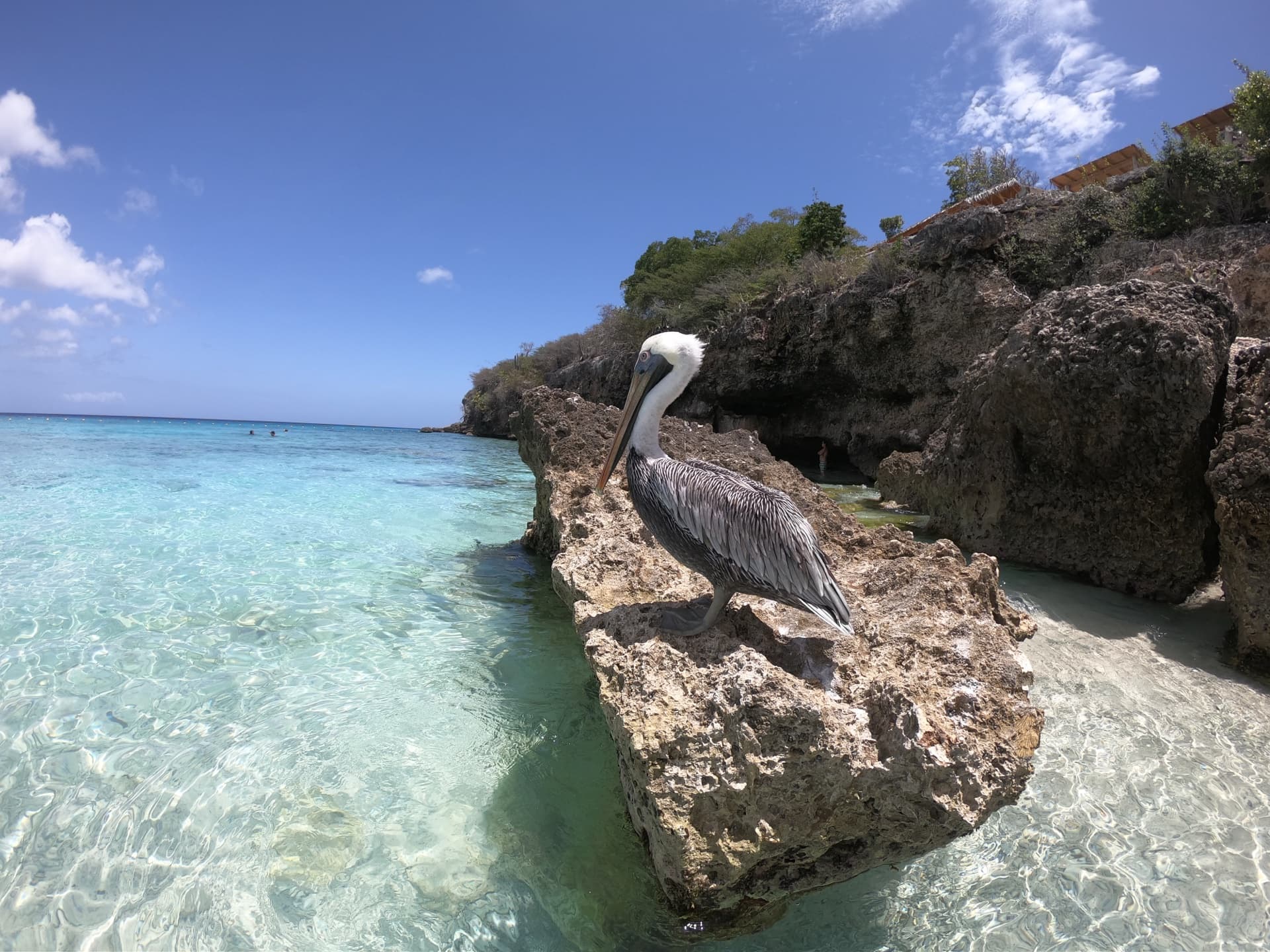
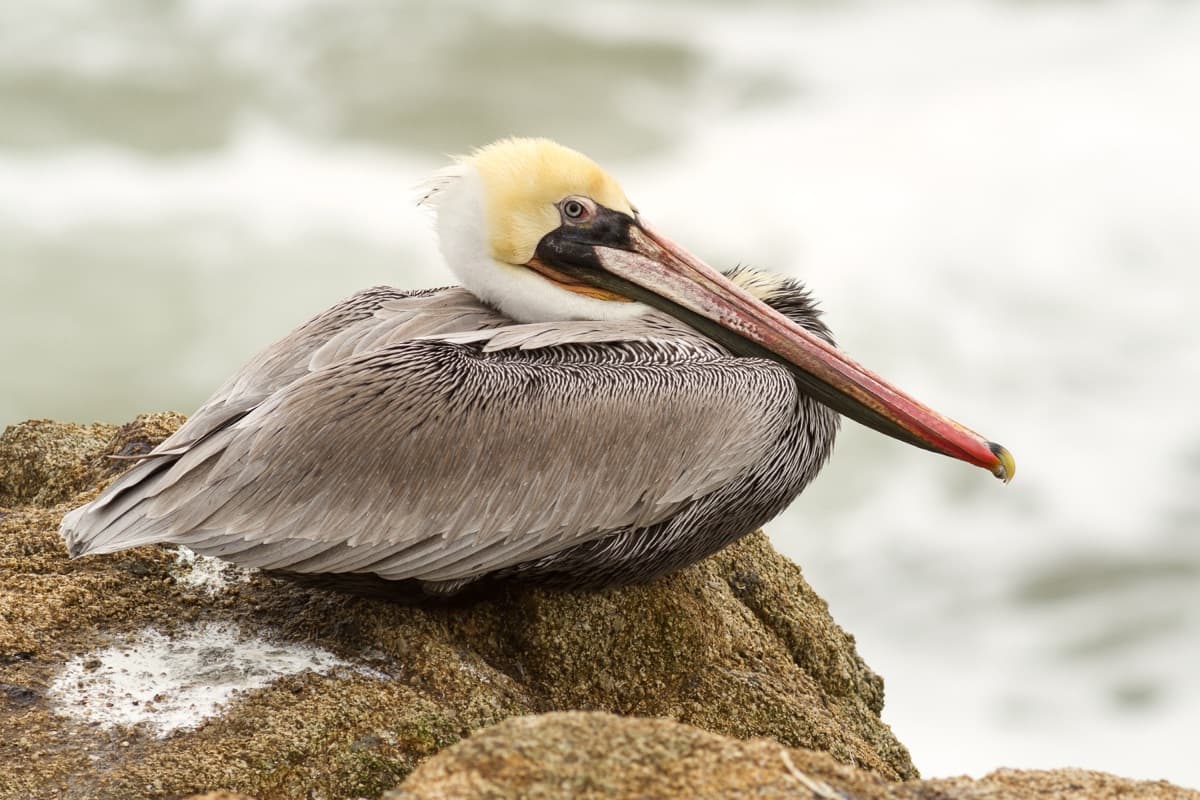
Brown Pelican (Pelecanus occidentalis)

Brown Pelican (Pelecanus occidentalis)

Brown pelicans are Curaçao's most dramatic coastal birds — up to 2 metre wingspan, with a spectacular plunging dive-fishing technique: they spot fish from the air, then drop bill-first from 5-10 metres to scoop prey into their expandable throat pouch. Resident populations along the entire coast. Often seen fishing near reef entries in the morning — frequently at the same dive sites where snorkellers enter the water.

💡 Tip: Watch the pelican dive patterns for fish schools — if pelicans are actively plunging in one area, there's a baitfish school visible from air, often also interesting for snorkel.

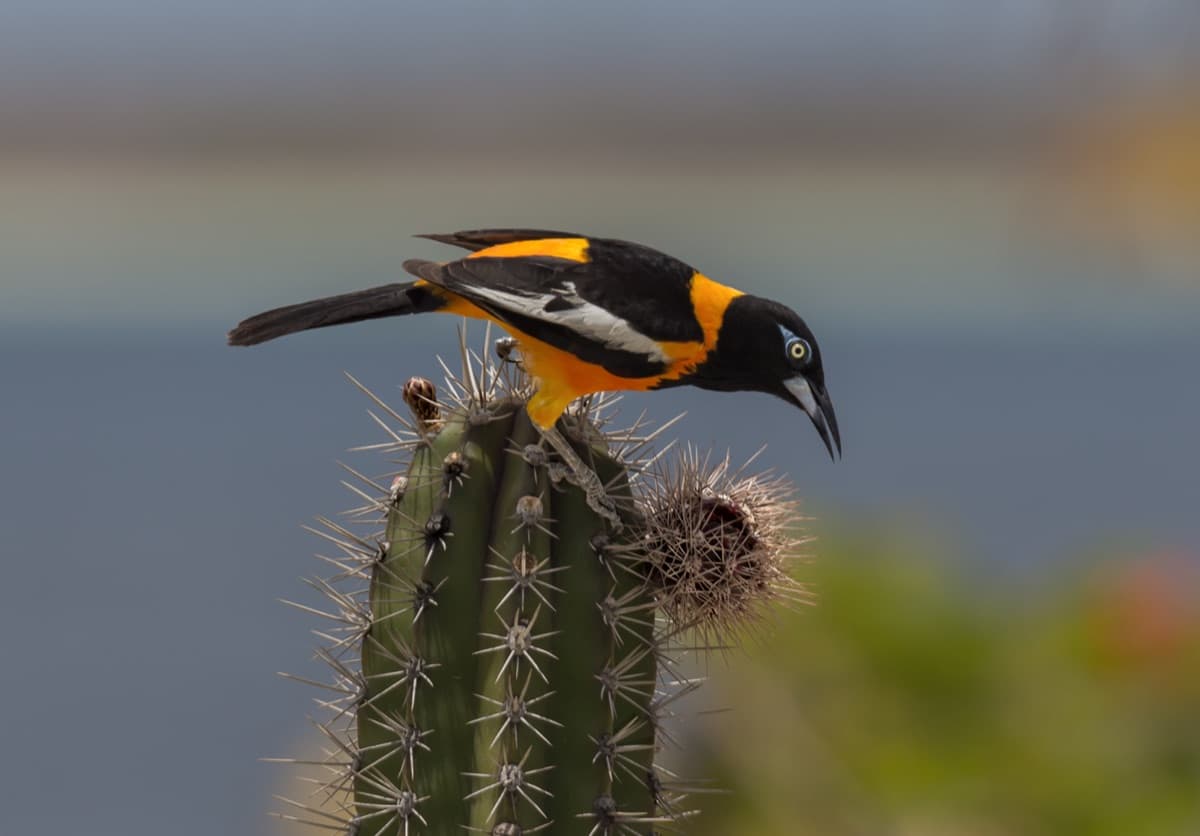
Trupial (Icterus icterus)

Trupial (Icterus icterus)

The Trupial is Curaçao's national bird — a striking black-and-orange songbird that is impossible to miss when it flies across the landscape. Males have a bright orange body, black head and tail, and distinctive white wing bars. They're loud, territorial, and often perch prominently on cactus tips or fence posts. Best sightings: Christoffel National Park, the dry cactus landscapes of the west coast, and the hills around Westpunt. A pair of Trupials often stays in the same territory for years.

💡 Tip: Listen before you look — the Trupial's song is a loud, whistling call that travels hundreds of metres. Follow the sound.

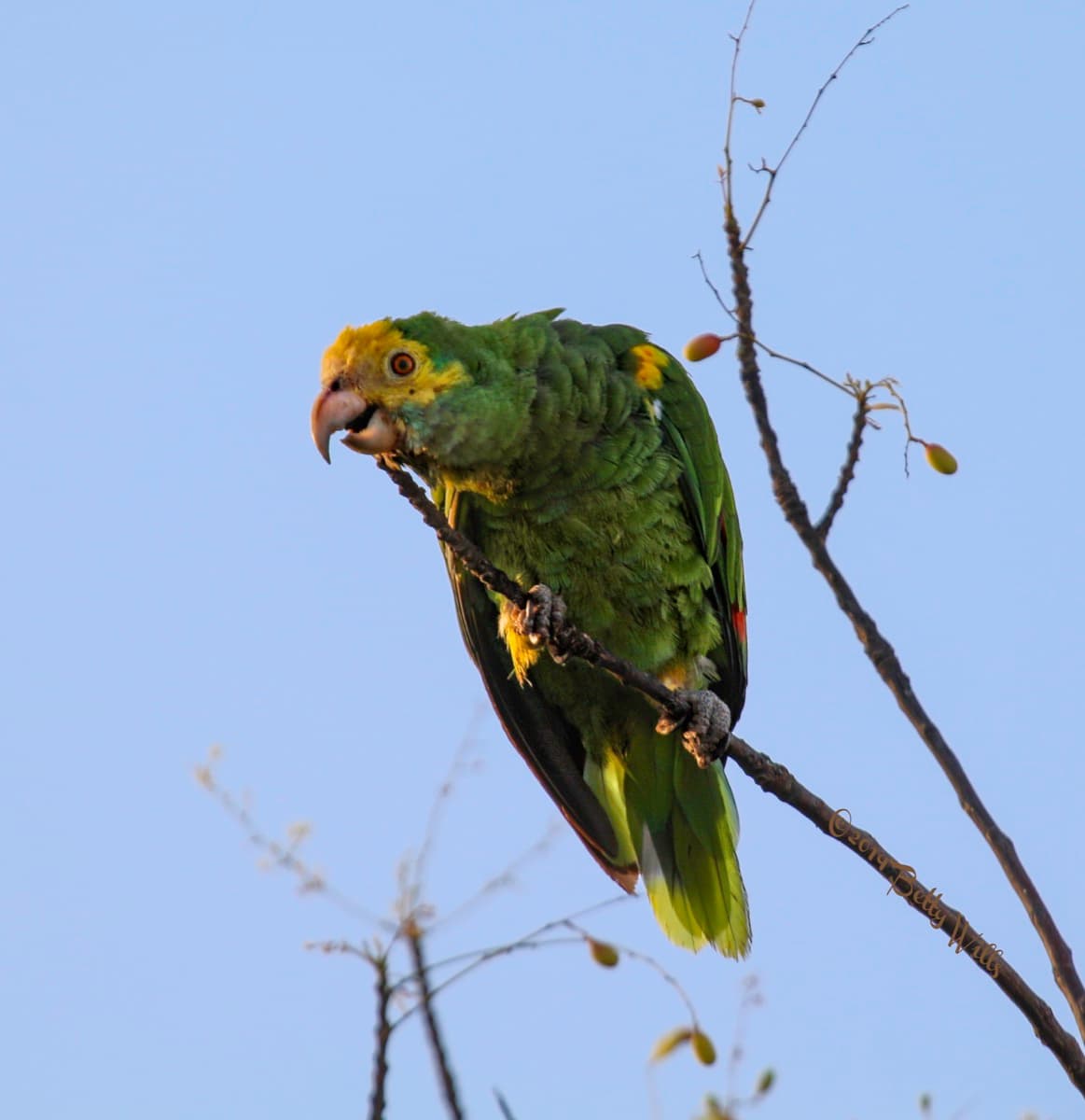
Yellow-Shouldered Parrot (Amazona barbadensis)

Yellow-Shouldered Parrot (Amazona barbadensis)

The yellow-shouldered parrot — locally called the Curaçao parrot — is the island's rarest endemic bird, critically endangered with only 700-900 individuals remaining in the wild. Medium-sized (around 33 cm), green body with yellow shoulders, blue on the wings, and a white forehead. They live primarily in the dry cactus landscape of Christoffel National Park and the surrounding hills. Conservation efforts are active; visiting the park supports protection programmes.

💡 Tip: Early morning (6-8 AM) and late afternoon (5-7 PM) in Christoffel Park are the best viewing times. They fly in small groups, usually calling loudly.

Bananaquit (Coereba flaveola)

Bananaquit (Coereba flaveola)

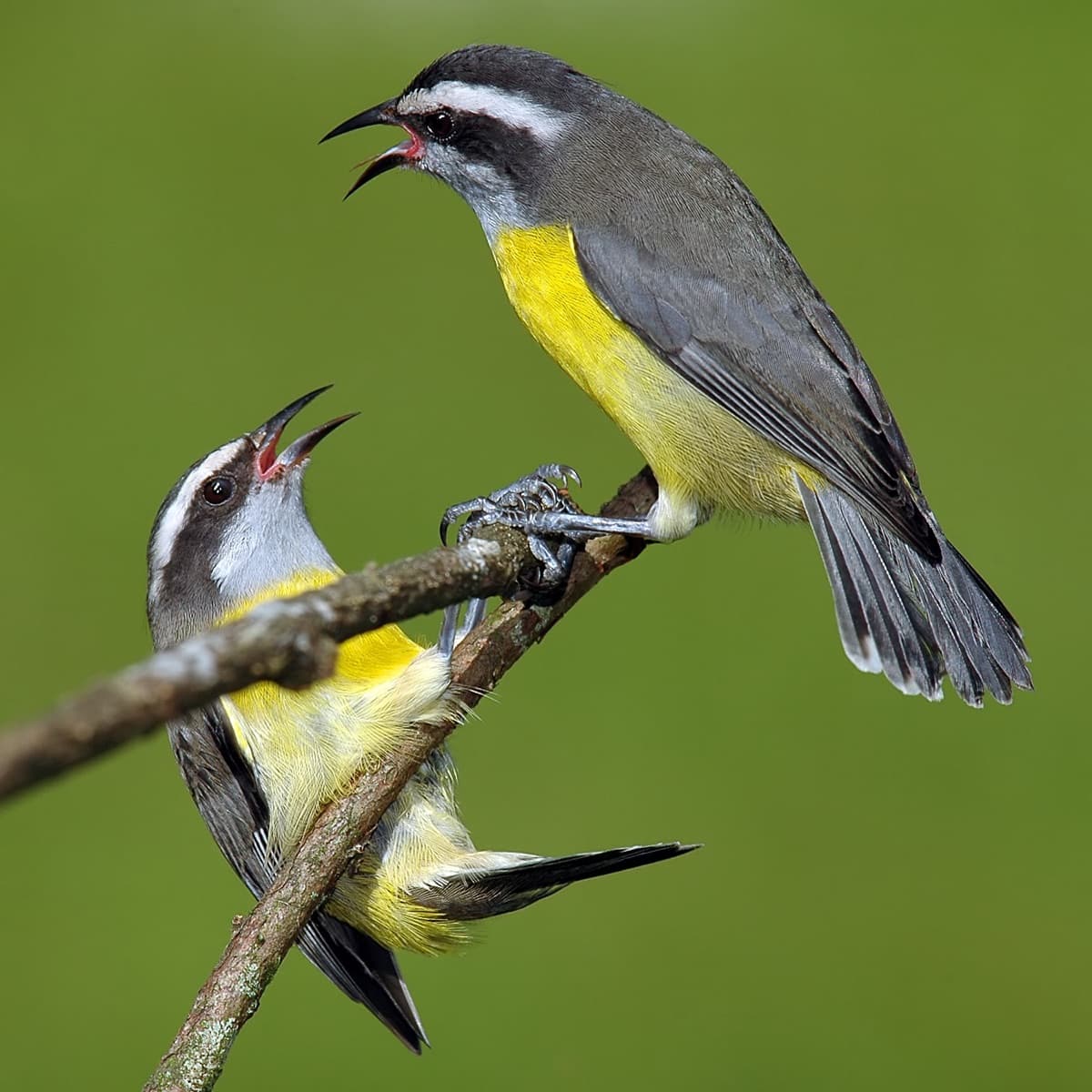
The bananaquit is the small, confiding bird you'll meet everywhere on Curaçao — black head with white eye-stripe, yellow belly, dark back. About 11 cm long. They're nectar feeders, moving between flowering plants with curved beaks adapted to reach deep into blossoms. Extremely common on hotel grounds, gardens, and terraces; they'll happily sip sugar water from open glasses if left unattended. One of the most accessible Caribbean birds for casual birdwatching.

💡 Tip: Leave a small dish of sugar water on your balcony and bananaquits will visit within hours. They're bold and unbothered by humans.

Green Iguana (Iguana iguana)

Green Iguana (Iguana iguana)

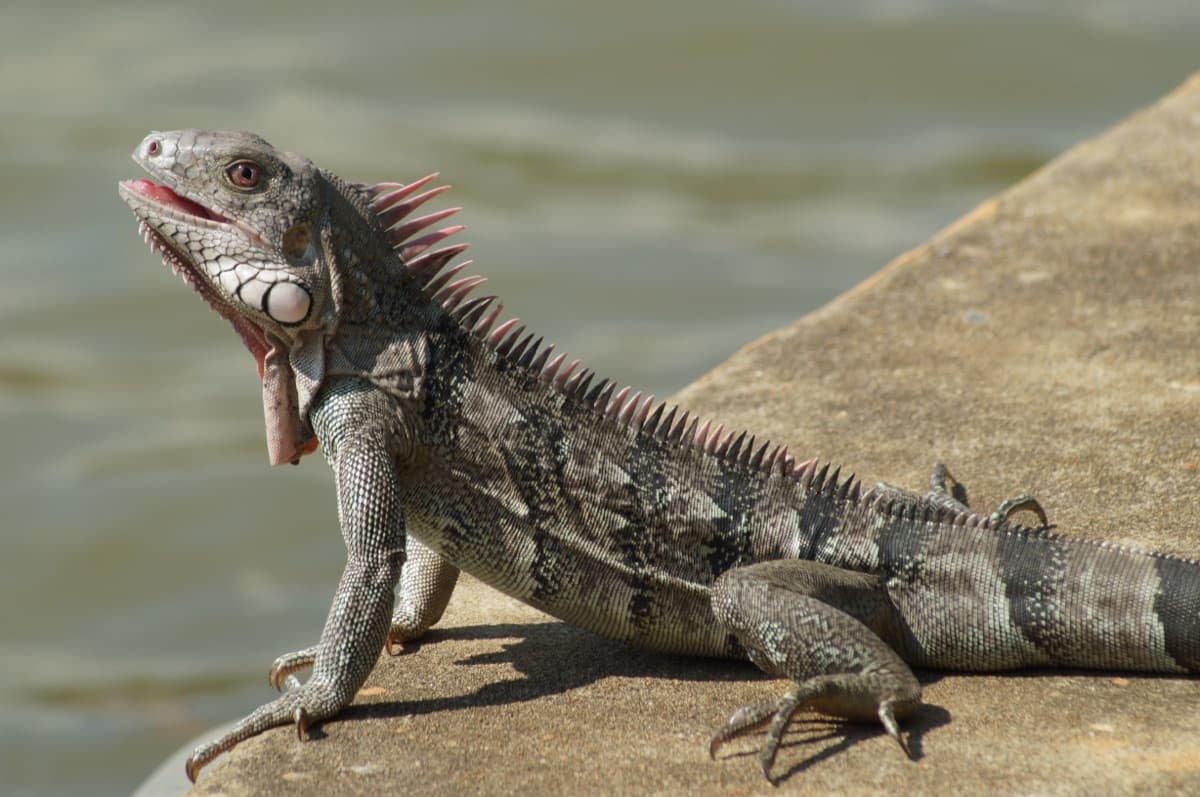
Green iguanas are Curaçao's most visible large reptile — often 1.5 metres long including the tail, with impressive spinal crests and loose skin folds under the chin. They're herbivorous, feeding on leaves and fruit, and are expert climbers often seen sunning on rocks or tree branches. Juveniles are bright green; adults shift to greyish-green with orange tones. On some parts of the island (Banda Abou, Christoffel Park area) they're hunted for food — iguana stew is a traditional Curaçao dish.

💡 Tip: The Curaçaosch Seaquarium and the restaurant at Landhuis Jan Kok both have resident tame iguanas — good for up-close observation.

Curaçao White-Tailed Deer (Odocoileus virginianus curassavicus)

The Curaçao white-tailed deer — locally called biná — is an endangered endemic subspecies of the North American white-tailed deer, surviving only in Christoffel National Park. The population is tiny (about 200 individuals), protected, and hard to spot during daytime. They're most active at dawn and dusk. The subspecies has been isolated on Curaçao for thousands of years and is genetically distinct from mainland white-tails. Conservation is a Christoffel Park priority.

💡 Tip: Early morning (6-7 AM) drives through Christoffel Park offer the highest chance of sighting. They cross the main park road at predictable points.

Bar Jack (Caranx ruber)

Bar jacks are silvery, torpedo-shaped fish growing to about 60 cm, with a faint dark stripe running from eye to tail and a bluish sheen along the back. No other jack species in Caribbean waters is more numerous, and they usually move in loose schools through the water column above the reef, though solitary fish turn up too. Their diet is mostly small fish and shrimp, rounded out with other invertebrates picked from the water column, and they tend to carry on regardless of divers working nearby. On Curaçao they gather in numbers at Halfway, also called Half Way West, between Kokomo Beach and Boca Sami, above the reef at Sponge Forest off Westpunt, and around the jetty at Playa Piskadó, often mixed in with snapper and schooling creole wrasse.

💡 Tip: Look up into open water above the reef rather than down into the coral. Bar jacks often share the water column with hunting barracuda and snapper, so a baitfish ball overhead is worth a second look.

Barred Hamlet (Hypoplectrus puella)

The barred hamlet is a small, deep-bodied fish growing to around 15 cm, with dark vertical bars over a pale to yellowish body. It belongs to a group of closely related hamlets that are notoriously hard to tell apart underwater, and barred, black, butter and yellowtail hamlets are all found sharing the same ground, including the shallow plateau and drop-off at Playa Hundu on the west coast. By day they root around the reef for shrimp and crabs, taking the occasional small fish, and stay close to the outer, ocean-facing edge of the reef. They are territorial enough that two of the same species are often seen squaring off over a patch of coral.

💡 Tip: Approach slowly and hold still, hamlets barely move once settled, which gives you the long look at the bar pattern needed to tell the species apart.

Bermuda Chub (Kyphosus sectatrix)

Bermuda chub are oval, silvery-grey schooling fish that can reach around 75 cm, cruising in loose groups over sand flats, seagrass and the fringes of the reef. Algae scraped off the reef surface makes up most of the diet, topped up with the odd crab or mollusc. Young chub are frequently found sheltering in drifting sargassum rafts, hitching a ride on the current that can carry them a long way from home. Close to Willemstad, they turn up above the reef at Oswaldo's Drop Off by the Sunscape resort, often mixed in with black durgon and bar jacks working the same water column.

💡 Tip: Watch for the loose, unhurried school moving just off the reef, chub rarely bolt for cover the way smaller schooling fish do.

Black Durgon (Melichthys niger)

The black durgon is a triggerfish with a deep, oval, near-black body reaching about 50 cm, edged with a pale blue line along the dorsal and anal fins. It gathers in loose aggregations, sometimes numbering in the hundreds, along outer reef crests and near drop-offs, picking plankton out of the water and grazing algae straight off the reef. On Curaçao's west coast it is a regular sighting in the water column at Witches Kitchen off Banda Abou. Close to Willemstad it also shows up above the reef at Oswaldo's Drop Off by the Sunscape resort, often alongside bar jacks and Bermuda chub.

💡 Tip: Keep a small distance rather than swimming straight into a durgon aggregation, like other triggerfish they can turn defensive if crowded near their patch of reef.

Black Grouper (Mycteroperca bonaci)

The black grouper is a solitary, heavy-bodied fish that can reach about 1.5 metres and 100 kg, with a lifespan that can pass 30 years. It is genuinely common in Curaçao's waters, yet an easy species to miss, since adults keep well clear of swimmers rather than lingering for a look. On the island's northwest coast, the undercut ledge running along Watamula Reef is one of the few spots where divers do occasionally find one, sharing the same overhang with green moray eels and dog snapper. Outside the occasional spawning gathering it hunts alone, picking off grunts and other smaller reef fish.

💡 Tip: Look along ledges and overhangs rather than open water, and expect it to hold back the moment it notices a diver rather than come for a closer look.

Caribbean Sharpnose Puffer (Canthigaster rostrata)

The Caribbean sharpnose puffer is a tiny, big-eyed pufferfish that rarely grows past 12 cm, favouring reefs with plenty of soft coral and sea fans. Unlike many puffers that hide until dusk, it forages by day, picking off small shrimp, crabs, snails, and worms from the reef surface. On Curaçao's northwest coast, sloping reef sites such as Watamula are described as regular habitat for small puffers like this one, turning up alongside boxfish on these coral-rich reefs. Each fish tends to hold its own patch of reef, and two sharpnose puffers crossing paths often end up in a brief territorial stand-off rather than swimming on together.

💡 Tip: It swims slowly enough to approach quietly for a closer look, but give a pair some room, since two together are often in the middle of a territorial dispute rather than socialising.

Cero (Scomberomorus regalis)

The cero is a slim, fast-swimming member of the mackerel family that patrols the open water just off Curaçao's reefs rather than sheltering among the coral itself, usually alone or in small loose schools. Adults can reach around 1.8 metres and typically hunt within the top 20 metres of water, taking squid and shrimp along with small schooling fish like silversides, anchovies, and herring. Local dive guides on the island list the cero, known here by its Dutch name makreel as well, among the handful of open-water fish divers and snorkellers regularly encounter while cruising a reef edge. It is also valued as a game fish.

💡 Tip: Scan the open blue water just off the reef edge rather than the coral itself; a fast, silvery shape passing through is more likely a cero than anything hiding in the reef.

Coney (Cephalopholis fulva)

The coney is a small, common grouper that tucks into reef caves and crevices by day across Curaçao, coming out after dark to hunt small fish and crustaceans. Adults reach about 43 cm and can live close to two decades. Every coney starts out female; some later change sex and become territorial males from around 20 cm. They tolerate a diver nearby but keep their distance if crowded. Along the outer reef slope beyond Jan Thiel Bay and among the Reef Balls at Playa Porto Mari, coneys and their look-alike cousin the graysby are commonly found low on the reef, while chromis hold in the water column above.

💡 Tip: A small reddish-brown grouper hovering just outside a crevice, not deep inside it, is more likely a coney than the similar-looking graysby.

Fairy Basslet (Gramma loreto)

The fairy basslet is a small reef fish, rarely longer than 8 centimetres, with an unmistakable two-tone body: violet-purple along the front half and bright yellow toward the tail. It shelters in caves, overhangs and crevices on vertical reef walls, often hanging upside down under a ledge as it picks zooplankton and small crustaceans out of the passing current by day, then withdraws into the same crack each night. On Curaçao it is often abundant along the wall at Santa Martha, near the old Airplane Wreck site, and on the drop-off east of Fisherman's Wharf, where the rock face can look carpeted with them.

💡 Tip: Look under overhangs and along the shaded parts of a wall rather than in the open, since fairy basslets rarely stray from the shelter of a crevice.

Flamingo Tongue Snail (Cyphoma gibbosum)

The flamingo tongue is a small sea snail whose actual shell is plain cream, but the living animal wraps it in a fleshy mantle patterned with bold orange-ringed spots, giving it the bright look it is named for until disturbed, when it withdraws the mantle and the colour disappears. It creeps slowly over gorgonian corals such as sea fans and sea whips, grazing on the living tissue and repurposing the coral's own toxins as its defence, rarely reaching more than 4 centimetres or moving far from the colony it is feeding on. On Curaçao they are regularly spotted on the sea fans of the shallow plateau at Sandy's Plateau, near Jan Thiel, among the soft corals and fire coral growing there.

💡 Tip: Scan slowly along sea fans and sea whips at eye level, since the snail moves too slowly to catch the eye and its mantle can be mistaken for part of the coral until you notice the orange rings.

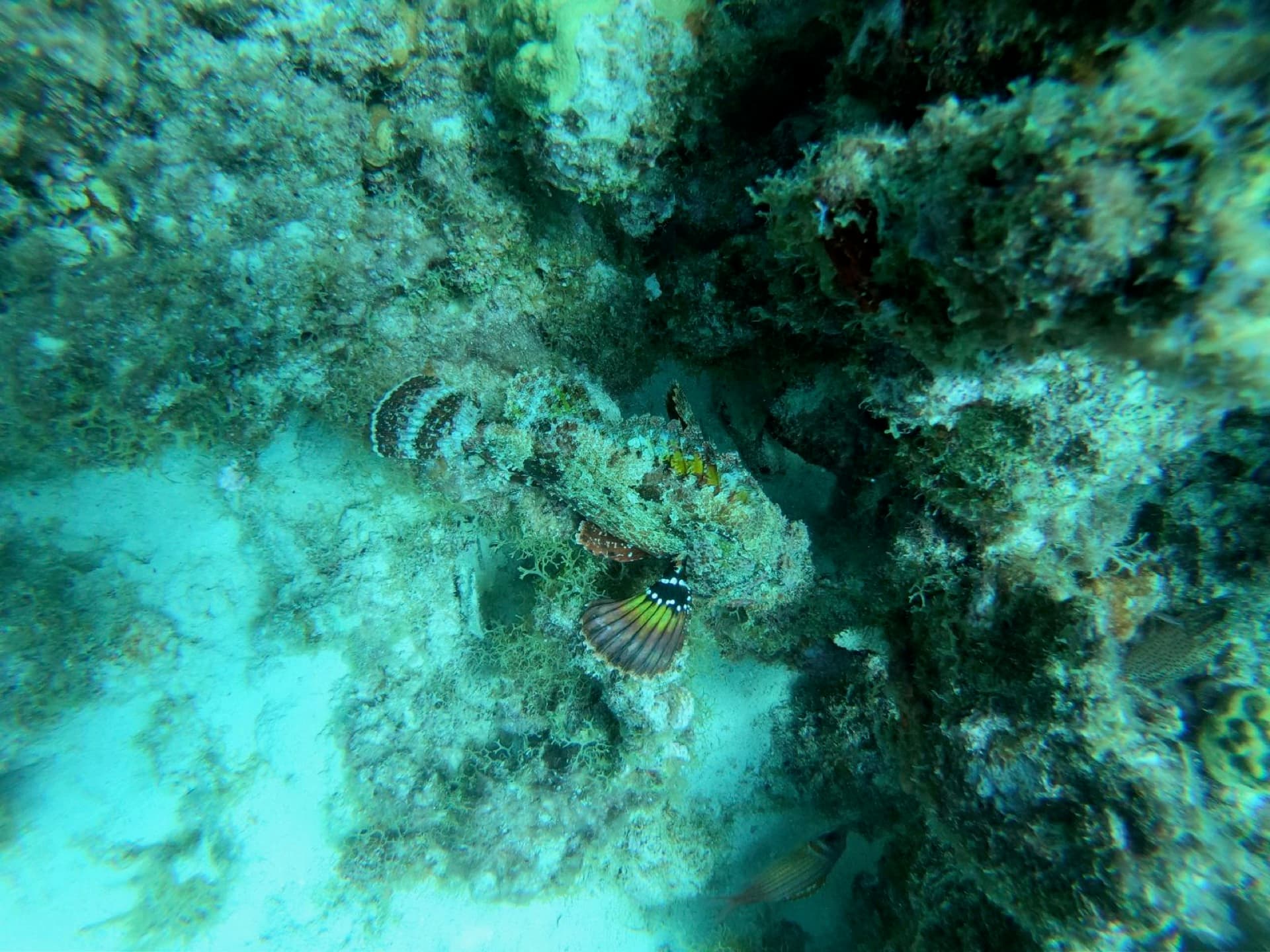
Spotted Scorpionfish (Scorpaena plumieri)

The spotted scorpionfish is a bulky, mottled reef fish, growing to around 45 centimetres, that relies on camouflage rather than speed: it lies motionless on sand, rubble or coral instead of swimming, blending in until a passing fish or crustacean strays close enough to be sucked in with a single vacuum-like gulp. On Curaçao it turns up as one of the reef's cryptic residents at sites such as Playa Lagun, where sand meets reef, and Playa Manzalina, at the Reef Balls of Playa Porto Mari, at the Halfway site between Kokomo Beach and Boca Sami, and around the Tugboat Saba wreck near Jan Thiel. It carries about a dozen venom-tipped spines along its dorsal fin, and most stings happen when a diver or snorkeller puts a hand or foot down without looking; the venom is rarely dangerous but causes sharp, lasting pain and swelling.

💡 Tip: Keep hands and fins off sand and rubble you haven't checked first, and if stung, rinse with seawater and immerse the area in water as hot as can be safely tolerated to ease the pain.

Goliath Grouper (Epinephelus itajara)

The goliath grouper is the largest grouper species found in Curaçao's waters, a heavy-bodied fish that can reach around 2.5 metres and several hundred kilograms, with a lifespan approaching 40 years. It is a solitary fish that sticks close to one small patch of reef rather than roaming widely, and an adult will hold that single ledge as a long-term territory, answering intruders with a loud booming "bark" from its swim bladder instead of fleeing. Because each fish sits on its own patch rather than schooling, finding one on Curaçao means finding its particular ledge, but a resident holding its ground is unmistakable once you notice its sheer bulk.

💡 Tip: Give a resident goliath grouper room and move calmly, since one guarding its territory has been known to charge divers that crowd it too closely.

Graysby (Cephalopholis cruentata)

The graysby is a small member of the grouper family found along Curaçao's reef, growing to about 40cm. By day it hides in reef caves, crevices and hollow sponges, staying out of sight until night, when it emerges to hunt small fish such as chromis, squirrelfish and gobies, along with crustaceans. Its mottled reddish-brown body with pale spots helps it blend against coral and sponge while it waits out the daylight hours. Some individuals have been observed hunting alongside moray eels after dark, likely taking advantage of prey the eel disturbs from cover. Barracuda, sharks and larger grouper are its main predators, one reason it depends so heavily on tight reef shelter by day.

💡 Tip: Check caves, crevices and sponge openings by day, or scan the reef base with a torch at night when it comes out to hunt.

Greater Soapfish (Rypticus saponaceus)

The greater soapfish is a stout, drab olive-brown fish reaching about 35cm, found in shallow reef terrain around Curaçao. It is usually alone, half-hidden at the base of a coral head or wedged into a crevice, and hunts small fish and crustaceans by night while staying nearly motionless through the day. Its name comes from the thick mucus coating its skin: when the fish is stressed or handled, that coating froths into a soapy lather that helps keep predators such as sharks and eagle rays at bay. Divers usually only notice it when a torch beam catches it tucked against the reef base.

💡 Tip: Never handle a soapfish or let it touch bare skin; its mucus coating lathers into a mild toxin when it feels threatened.

Honeycomb Cowfish (Acanthostracion polygonius)

The honeycomb cowfish carries a rigid, box-shaped shell of fused bony plates marked with the hexagonal pattern that gives it its name, leaving only the fins, eyes and mouth free to move. Adults reach around 50cm and are seen over Curaçao's reef, moving slowly and deliberately rather than darting for cover, since the shell itself is the fish's main defence against predators, chiefly sharks. It typically forages alone by day, picking sponges, tunicates and small shrimp off the bottom. Its unhurried pace and low profile make it one of the easier reef fish to approach without disturbing.

💡 Tip: Look for it foraging unhurriedly near sponges and tunicates on the reef; its slow pace and armored shell mean it rarely bolts, so you can usually get a close, unrushed look.

Manchineel Tree (Hippomane mancinella)

The manchineel, known locally as manzalina, grows along Curaçao's coast; Playa Manzaliña near San Juan takes its name from the tree. Every part of it is toxic: the small fruit that resembles a green crab apple, the leaves, the bark, and the milky sap that oozes from any break in the wood. Standing beneath it during rain can cause skin blistering, since the falling water carries sap residue off the leaves. Its Spanish name, manzanilla de la muerte, means little apple of death; the Caribs reportedly used its leaves to poison enemies' water supplies, and explorer Juan Ponce de León died in 1521 after being wounded by an arrow tipped with manchineel sap.

💡 Tip: Learn to recognise its shiny oval leaves and small green apple-like fruit, and never sit or shelter beneath it, especially in rain.

Orange Elephant Ear Sponge (Agelas clathrodes)

This sponge grows into broad, ear-shaped lobes that can reach roughly 1.8 metres across, in shades from orange to rust-red. It is a filter feeder, drawing seawater through its tissue to strain out food particles, and can live for centuries once established on the reef. Because it thrives in deeper water, roughly 12 to 40 metres down, it is a diver's find more than a snorkeller's. On Curacao it turns up on the sloping reef off Westpunt around Sponge Forest, along the steep reef slope at Playa Largu near San Juan, and tucked under coral ledges at Bullenbaai.

💡 Tip: Look for it on deeper dives rather than snorkels, its bright orange lobes stand out clearly against the darker reef ledges where it grows.

Palometa (Trachinotus goodei)

Also known as the great pompano, this silvery jack has a flattened, deep body and long trailing filaments on its dorsal and anal fins. Adults typically reach about 50 centimetres and gather in loose schools over the reef in shallow water, foraging by day for crustaceans, worms, molluscs and small fish. Younger palometa tend to stick closer to sandy, rubble-strewn patches rather than the reef itself. Around Curacao they are among the silvery schooling fish snorkellers pass over the shallow fringing reef, generally in water less than about 12 metres deep.

💡 Tip: Look for the trailing dark filaments off the dorsal and anal fins, they set palometa apart from the similar-looking permit and pompano schooling nearby.

Porcupinefish (Diodon hystrix)

This heavy-bodied pufferfish is covered in spines and can grow to about 90 centimetres. It hunts alone at night for snails, crabs and sea urchins, spending daylight hours tucked into a reef crevice or cave. If seriously threatened, a porcupinefish gulps in water to inflate its body to roughly twice its size, erecting its spines as a last-resort defence. On Curacao they turn up sheltering among the wreckage at Kokomo Beach's car wrecks and pontoon barge, around Elvin's Plane Wreck, and near Fisherman's Hut. Divers and snorkellers should watch rather than handle one: forcing it to inflate is stressful for the fish and its spines can pierce skin.

💡 Tip: Never handle or chase one into inflating, it is a stress response with a real cost to the fish and its spines can puncture skin.

Rainbow Runner (Elagatis bipinnulata)

The rainbow runner is a streamlined jack with a blue-green back, a pale belly and a narrow yellow stripe running along its flank. It can reach 1.8 metres, though fish of 60 to 90 centimetres are far more typical. Rainbow runners often travel in sizeable schools near the surface above the reef, hunting small fish and invertebrates as they go. On Curacao's reefs they are usually spotted well up in the water column, cruising the open water rather than close to the coral itself.

💡 Tip: Scan the open water above the reef rather than the coral itself, rainbow runners hold well off the bottom and often flash past in loose schools.

Giant Caribbean Anemone (Condylactis gigantea)

The giant Caribbean anemone is a solitary anemone whose tentacle colour ranges from pale white through brown, with the tips sometimes shading into pink or purple. It typically spans up to about 30cm, stays anchored to one spot on the reef most of the time, and only relocates slowly when it does move. Some individuals carry enough venom in their tentacles to immobilise a small fish, shrimp or worm for a meal, though the sting rarely troubles the resident Pederson cleaner shrimp that often shelters unharmed among the tentacles. On Curaçao it is commonly found among the sponges and hard coral at Cas Abao, and on the shallower, patchier stretch of reef at Double Reef near the Corendon Mangrove Resort.

💡 Tip: Look for a small, near-transparent Pederson cleaner shrimp riding among the tentacles, and keep hands well clear since some individuals can deliver a mild sting.

Slender Filefish (Monacanthus tuckeri)

This thin, laterally compressed filefish tops out around 10cm long and rarely strays from the cover of soft coral and gorgonian branches, blending in thanks to its slim outline and blotchy patterning. Daylight hours go to picking small crabs, worms and bits of drifting zooplankton off the coral; after dark it locks itself in place between branches, bracing with an erect dorsal spine and a fleshy pad on its belly, and will occasionally clamp its mouth onto a polyp while resting. Grouper and barracuda are its main predators. On Curaçao it shares soft-coral thickets with trumpetfish at sites including Atlantis, Sandy's Plateau off Jan Thiel, and Dive City near Pietermaai.

💡 Tip: Search branch by branch through soft corals and sea fans rather than scanning open reef; a sliver of colour that keeps rotating to stay behind a branch is usually this fish.

Smooth Trunkfish (Lactophrys triqueter)

The smooth trunkfish carries its body inside a fused, triangular bony shell patterned with white spots, with a dark, almost black mouth set at the front. It grows to around 47cm. Speed is not its defence: it relies on that bony armour, plus a skin toxin it can release when stressed, so it swims unhurried and lets snorkellers approach fairly close. It commonly feeds by hovering just off the bottom and blowing a jet of water into the sand to flush out small worms and other buried invertebrates. On Curaçao it turns up on the shallow soft-coral plateau at Sandy's Plateau off Jan Thiel, alongside honeycomb cowfish and rock beauties, and among the reef life at Dive City near Pietermaai.

💡 Tip: Its boxy shape and unhurried swimming make it easy to watch up close, but its fused shell means it cannot dart away quickly, and a stressed individual can release toxins into the water, so give it room rather than crowding it.

Yellowline Arrow Crab (Stenorhynchus seticornis)

The yellowline arrow crab is a small crustacean built like a delicate spider, with a sharply pointed body, an undersized pair of purple pincers, and legs many times longer than its torso. Fully grown it spans roughly 6cm, and by day it tends to stay out of sight, tucked into a tube sponge or picking its way among the stinging arms of an anemone or the spiny cover of a sea urchin. Once the light fades it emerges to graze on detritus, algae and small worms. Cas Abao's outer reef slope, thick with large tube sponges and anemones, offers exactly the shelter this crab favours and is worth checking. Grouper, puffers, triggerfish, wrasses and grunts are its main predators.

💡 Tip: Shine a light into the mouths of large tube and barrel sponges; the crab's thin legs and body are easy to overlook against the sponge's ridged interior.

Nurse Shark (Ginglymostoma cirratum)

The nurse shark is the shark most snorkellers and divers on Curaçao actually encounter, largely because it spends daylight hours lying still on sand or wedged under a ledge rather than patrolling open water. Adults can reach over 4 metres and around 110 kg, with a blunt head, small mouth and a pair of barbels it uses to locate lobster, crab and conch buried in the seabed; hunting happens mostly after dark. On Curaçao it shows up regularly at Boca Patrick and Houtjesbaai on the north coast, and around the drift sites near Punt Kanon and Tarpon Bridge at the eastern point, plus the cave at Klein Curaçao's North Point. Generally placid, it can still deliver a painful defensive bite if grabbed or cornered, so admire from a distance rather than reaching for it.

💡 Tip: Look under ledges and into cave mouths rather than out in open water: a motionless grey shape on the sand is almost always a resting nurse shark.

Fire Coral (Millepora)

Fire coral is not a true coral but a hydrozoan, closer kin to jellyfish and anemones, and every polyp on its surface carries a sting. On Curaçao it usually grows as a thin, brittle blade or crust over rock and dead coral rather than a solid head, in pale yellow-brown to greenish tones. It covers reef plateaus and ledges island-wide, and the blade form is especially dense at Rolling Stones near Sint Michiel. It also shares the shallow snorkel plateau at Playa Largu (Piscadera) with soft coral at around 4-5 metres, right where waders and swimmers pass. It tolerates heat and knocks that kill true coral, so it keeps spreading even where reefs elsewhere are thinning.

💡 Tip: A brush against it raises a burning welt within minutes: rinse with vinegar or rubbing alcohol, never fresh water, which worsens the sting.

Black Coral (Antipatharia)

Black coral is named for its skeleton, not its colour: living tissue is usually brown, red, orange or yellow, and only the branching frame underneath is black. Colonies grow as slow, shrub-like branches, adding barely any size in a year but living for centuries and sometimes millennia, with virtually nothing preying on them. Because they feed mainly on drifting zooplankton rather than sunlight, they favour the reef's darker corners: caves, channels and deep overhangs. On Curaçao the clearest concentration gave a dive site its name, Black Coral Garden on the San Nicolas plantation grounds near Westpunt, with more colonies in the deeper reaches of Seldom Reef in Bullenbaai.

💡 Tip: It looks more like a dark, leafless shrub than 'coral', so scan the darkest, deepest wall undercuts rather than the sunlit reef flat. Avoid contact: it can irritate skin, and a colony takes centuries to regrow.

Orange Cup Coral (Tubastraea coccinea)

Orange cup coral is a small, non-reef-building hard coral whose bright orange polyps look more like a cluster of tiny anemones than a typical coral head, extending translucent tentacles to snatch plankton and drifting organic scraps rather than feeding on sunlight through algae in its tissue. It is not originally from the Caribbean: shipping records point to it being carried across from the Indo-Pacific on ship hulls, with waters around Curaçao among the first places in the region where it turned up, back in 1943. That lack of dependence on light lets it colonise shaded ledges as well as current-swept points, and with nothing here that preys on it, it keeps crowding out native corals for open reef space. Often encrusting the archway and walls at Tarpon Bridge and along the slope at Piedra Pretu (Black Rock), both on the island's east point.

💡 Tip: Its polyps tend to stay closed through the day and open after dark, so a night dive shows the orange tentacles fully extended.

Queen Conch (Strombus gigas)

Queen conch is the largest marine snail found in Caribbean waters, its thick spiral shell growing to around 30 cm and flaring into a pink-tinged lip as the animal reaches adulthood, with individuals living for decades. It spends its days grazing across open sand and seagrass on algae and detritus, becoming more active once the light fades, and rather than fleeing danger its main defence is to haul its whole body back inside the shell opening. On Curaçao it is commonly seen in the sand channel at Double Reef, near Otrobanda, sharing that stretch of open bottom with southern stingrays and sand tilefish. The shell and its meat are known locally by the Papiamentu name karko, and empty ones regularly wash up along the shoreline.

💡 Tip: Scan open sand and seagrass rather than the reef itself, and look for a drag mark in the sediment, a sign a conch has been grazing nearby.

Pederson Cleaner Shrimp (Ancylomenes pedersoni)

Pederson cleaner shrimp are small, near-transparent shrimp, no more than about 3 cm long, that make a living picking parasites and dead skin from reef fish. They shelter within reach of a sea anemone's tentacles, a spot most other small animals avoid since a sting is the usual result of getting that close, but the shrimp itself goes unharmed and a single anemone can hold close to a dozen of them at once. Their pale, constantly waving antennae act as a signpost, drawing fish in to be cleaned rather than the shrimp having to search them out. On Curaçao they are commonly seen among anemones at Playa Manzaliña, on the San Juan coast, a site also known for scorpionfish, flounders and other small, easily overlooked reef life.

💡 Tip: Look for the waving white antennae poking out from an anemone rather than the shrimp's body, which all but disappears against the tentacles.

Portuguese Man o' War (Physalia physalis)

Portuguese man o' war is not a single animal but a siphonophore, a colony of specialised cells that drifts and functions as one, marked out by a translucent blue-purple float riding the surface with tentacles trailing metres below. True jellyfish share the same waters and the same basic toolkit: stinging cells on their tentacles, called nematocysts, used to stun the plankton and small fish both groups feed on. Neither is a constant presence around Curaçao; sightings come and go with the season rather than turning up on every dive. Contact ranges from a mild tingle to lasting, intense pain, and a stray tentacle can still sting after washing up dead on the sand, so it is worth never touching one out of curiosity.

💡 Tip: If stung, rinse with seawater and vinegar rather than fresh water. Tap water can reactivate any nematocysts left on the skin.

Tiger Grouper (Mycteroperca tigris)

The tiger grouper is a solitary reef predator named for the dark, tiger-like stripes running from its dorsal fin down each flank; background colour ranges from blackish to reddish, tan or yellow depending on the individual. Adults reach around a metre in length and hunt by ambush, taking grunts, parrotfish, angelfish and other reef fish from cover rather than chasing them in open water. Like several grouper species, they change sex over their lifetime, starting out female and maturing into males as they grow larger. On Curaçao they turn up in the deeper stretches of the reef, reported at Lost Anchor near Beacon Point on the southeast coast and at Halfway on the west coast, often lingering near cover rather than out in the open.

💡 Tip: Their vertical stripes blend into shadow at rest, so scan ledges and overhangs on the deeper reef slope rather than open sand.

Horse-Eye Jack (Caranx latus)

Horse-eye jacks are large, deep-bodied jacks named for their prominent eyes, growing to around a metre with a flattened silver body and a sharply forked tail. They travel in loose schools through open water off the outer reef, while younger fish tend to stay closer to shore near sandy beaches. Adults feed on smaller fish, shrimp and other invertebrates picked up in mid-water rather than off the reef itself. They are confident around people, often swimming in close to look a diver or snorkeller over before moving on. On Curaçao's northwest coast, schools are regularly seen hanging in the water column above the reef at Playa Gipy, sometimes mixed in with bar jacks and yellowtail snapper.

💡 Tip: A tight, fast-moving silver school overhead is usually horse-eye or bar jacks feeding on baitfish; hold still in open water and they will often circle back for a closer look.

Blue Tang (Acanthurus coeruleus)

Blue tangs are the reef's classic all-blue grazers, growing to around 40 cm and spending the day picking algae off rock and dead coral, either alone or drifting through mixed schools with other algae-eaters. Juveniles start out a startling neon yellow before turning blue as they mature. Ocean surgeonfish are a similar size but coloured plain grey-brown, and the two species often graze the same patches of reef alongside doctorfish, forming loose schools that move across open, sunlit sections of coral. Both carry a small, sharp spine near the base of the tail that folds out for defence, which is where the 'surgeon' name comes from. On Curaçao these mixed grazing schools are commonly seen over the reef flats at Stella Maris Reef near Willemstad, and blue tangs also turn up over the deeper reef at Alice in Wonderland, off Playa Kalki.

💡 Tip: Watch the base of the tail for a small folding spine on both species; harmless if you leave the fish alone, but avoid cornering one against the reef.

Banded Butterflyfish (Chaetodon striatus)

Banded and foureye butterflyfish are two small, flat-bodied reef fish often seen together on Curaçao's shallower coral. Banded butterflyfish carry bold black-and-white vertical bars and a dark stripe through the eye; foureye butterflyfish are patterned with faint diagonal lines and a false eyespot near the tail that, paired with the real eye hidden in a dark band, gives the species its name. Both grow to under 16 cm, pick worms, small invertebrates and the polyps of soft corals and anemones out of reef crevices by day, and pair off into monogamous couples that hold a shared patch of reef for years. On Curaçao they are commonly seen over the coral gardens at Sandy's Plateau near Jan Thiel and along the reef at Korta Pe, where several butterflyfish species overlap, and they turn up in particularly high numbers on the reef slope at Playa Jeremi.

💡 Tip: Butterflyfish nearly always travel in pairs; spotting one is usually a cue to scan the surrounding coral for its mate close by.

French Grunt (Haemulon flavolineatum)

French grunts are a Curaçao reef staple, packing into dense daytime schools that shelter beneath ledges and close to elkhorn coral before scattering after dark to hunt small crustaceans, worms and molluscs. Adults reach about 30cm. Schoolmaster snapper, a chunkier relative growing past 60cm that can live for decades, favours the same elkhorn-coral cover and often schools alongside grunts and mahogany snapper. Grunts and schooling snapper are commonly seen around the shallow Tugboat wreck, while schoolmaster snapper specifically shelter, together with mahogany snapper and blackbar soldierfish, among the undercut coral mounds off Playa Kalki (Alice in Wonderland).

💡 Tip: French grunts get their name from the low grunting sound they make by grinding their pharyngeal teeth, audible if you approach quietly; schoolmaster snapper stay silent, with a pale blue line under each eye as the easiest field mark.

Sergeant Major (Abudefduf saxatilis)

Sergeant majors, silvery-yellow reef fish that grow to about 23cm, take their name from the five or six dark vertical bars crossing the body, a pattern reminiscent of military rank stripes. They gather in shallow water along reef tops, often forming loose feeding schools that can run into the hundreds, and are often seen around the wreckage at Elvin's Plane Wreck alongside blue chromis, as well as on the reef at Dive City in Willemstad's Punda district. Yellowhead jawfish are a quieter neighbour: pale, yellow-headed fish only about 10cm long that dig burrows in sandy patches, line them with bits of shell and coral, then hover just above the entrance feeding on drifting zooplankton, darting back tail-first at any disturbance. They turn up in the coral cover off the cliffs at Playa Jeremi, among squid, parrotfish and surgeonfish.

💡 Tip: Look low over open sand for a small pale head poking out of a burrow entrance; approach slowly, since a yellowhead jawfish will vanish tail-first into its hole at the first sudden movement.

Squirrelfish (Holocentrus adscensionis)

Squirrelfish and blackbar soldierfish are two of the big-eyed, reddish fish that take over Curaçao's reefs once the sun goes down. Both spend daylight hours tucked into caves and crevices, then emerge after dark to hunt plankton and small invertebrates drifting above the coral. Squirrelfish reach about 30cm and blackbar soldierfish, marked by a dark bar behind the eye, grow to about 25cm; both are most at home on shallow inshore reefs, though they range much deeper. Squirrelfish are commonly seen among the coral mounds of Rif Sint Marie and Habitat, near Sint Willibrordus, and the pair shelters together in the reef ledges at Long Beach, near Piscadera, alongside lobsters, moray eels and the occasional lionfish.

💡 Tip: Their oversized eyes reflect torchlight as a sharp orange-red glint, the fastest way to pick a squirrelfish or soldierfish out of a dark crevice on a night dive or evening snorkel; scan with your light before reaching into any ledge, since the same shelters occasionally hide a venomous lionfish.

Caribbean Reef Shark (Carcharhinus perezi)

The Caribbean reef shark is the shark most often met on Caribbean coral reefs, growing to around 3 metres and living perhaps twenty years or more. It keeps to drop-offs and the seaward edges of reefs across a wide depth range, from a few metres down past 60, and feeds on reef fish along with stingrays and eagle rays. Larger bull and tiger sharks are its own predators. On Curaçao it is present at depth along the west coast, usually below 25 metres, so most snorkellers never see one and divers who do are generally on a deep wall. Sightings are uncommon rather than routine. Attacks are rare, though the species has been known to injure people who threaten or corner it, and no fatal attack is on record. A shark that swings its head, swims in an exaggerated way, arches its back or drops its pectoral fins is telling you it is uncomfortable.

💡 Tip: If one appears, hold still, keep it in sight and give it room to pass rather than swimming toward it for a photograph; the warning postures above mean back off and leave the water calmly.

About our Seafari safaris

How do I book a Seafari tour?+
Book directly on seafariadventurescuracao.com — select your tour, pick a date, and fill in your details. Book now, pay later: no payment upfront, with full payment due 14 days before your tour. No booking fees. Cruise passengers: we plan your departure around your ship's schedule so you are back 90 minutes before all-aboard.
What's included in a Seafari tour?+
All our tours include professional snorkeling equipment, drinks (soft drinks, beer, signature Seafari cocktail), snacks or lunch depending on the tour, sun shade on the boat, and a multilingual guide. Snorkel vests are free on request. You only bring swimwear, towel, and sunscreen.
What if the weather is bad?+
Our Rupert 50 RIB handles moderate chop comfortably. For genuinely dangerous weather we reschedule or refund 100%. You get a call by 7 AM on the tour day if we need to adjust. Curaçao sits below the hurricane belt and the trade winds are steady, so weather cancellations are uncommon; we will publish our actual cancellation record once we have one.
Is Seafari suitable for children?+
Yes. Children 6+ are welcome on all standard tours. The boat has stable RIB hulls (no seasickness for most), life vests in all sizes, and our guides are trained in family snorkel introductions. For children under 6 we recommend a private charter for flexibility.
Can I book a private charter?+
Yes — the Rupert 50 is available for private charter for groups of 2-30: half-day $3,500, full-day $6,500, sunset $2,950 — the whole boat for your group. Design your own route, pick your own stops, set your own pace. Contact us via the Private Charter form and we'll confirm a fixed price within 24 hours.
What's the cancellation policy?+
Free cancellation up to 24 hours before departure — full refund, no questions asked. Within 24 hours, or a no-show, is non-refundable. If WE cancel (weather, mechanical, safety): 100% refund or free reschedule, your choice. Groups of 10+ and private charters have a 72-hour window. Travel insurance is recommended for cruise passengers.
Discover it by boat

The best way to experience Curaçao's coastline is from the water. Our sea safaris take you to the island's most beautiful spots — places you can only reach by boat.

View Our Tours